



Diversity. Equity. Inclusion. Three words (DEI) have sown confusion in corporate culture. With a deeper understanding of each term, we can reimagine power and possibilities for genuine equity and inclusivity. I wish to explore these items as follows:
What are DEI as distinct terms, and which concerns do they address?
Why is equity critical in sustaining this triad?
What are the challenges to ensuring equity?
DEI Defined
To begin with, I will explore each term and focus since we often conflate these as interchangeable. I hope such clarity will help those in adult learning and development consider any gaps in understanding.
Diversity
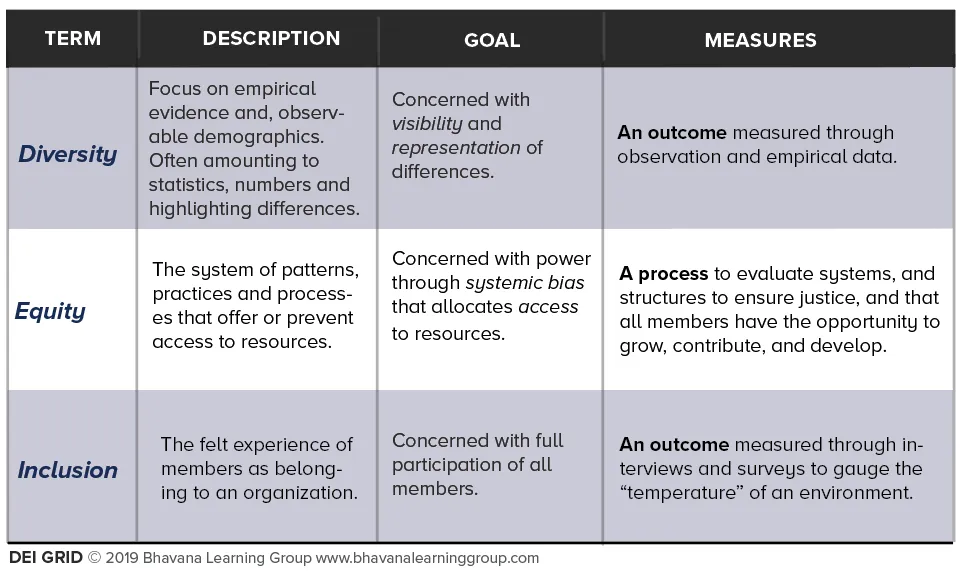
The term diversity includes empirical, observable demographics, often amounting to statistics that highlight differences.
Diversity includes all the ways in which people differ. This includes not only race, gender, ethnicity, and multiculturalism but also age, national origin, religion, ability, sexual orientation, socioeconomic status, education, marital status, language, and physical appearance.
The goal of diversity addresses visibility and representation: When I look at membership and leadership in an organization, do I see marginal groups represented beyond token status? Do I observe their impact and hear their voices?
Equity
The term equity is related to patterns, practices, and processes that deliver routine outcomes.
Equity focuses on just treatment, access, opportunity, and advancement for all people while identifying and eliminating barriers that prevent the full participation of some groups. It involves questioning advantages and barriers within institutions’ procedures and processes and in their distribution of resources.
The goal of equity addresses systemic bias to confront root causes of outcome disparities within an organization (and larger society) and to reduce barriers to access for everyone.
Inclusion
The term inclusion involves the felt experience of members belonging to an organization.
It involves cultivating environments where any individual or group can feel welcomed, respected, supported, and valued to participate fully. An inclusive climate cultivates a shared understanding or commitment for appreciating differences in words and actions.
Note that while an inclusive group is by definition diverse, a diverse group isn’t always inclusive. A shared commitment will also recognize unconscious or implicit bias to encourage inclusivity.
The goal of inclusion addresses full participation to actualize diversity through equitable structures that foster full participation for all members.
Process and Outcomes:
— Diversity is an outcome. A company’s website reveals its multicultural or gender palette, while reports reveal the diverse population via demographic categories.
— Inclusion is also an outcome. Surveys and interviews can reveal the internal “temperature” of a welcoming culture based on marginalized identities.
— Equity is more a context or process rather than an outcome. Equity refers to a process of examining the structures and systems a company consistently engages to ensure that marginalized people have access to opportunities to grow, contribute, and develop — regardless of their identity.
Here’s the larger point: the purpose of the entire DEI enterprise is to produce justice. Only equity addresses the “systems or barriers” that prevent access as a precondition of justice. Therefore, equity requires critical examination to monitor every aspect of the business process.
Equity: a Process of Accountability
Equity has changed the diversity game, making it much more complex and honest in ways that lead to accountability and systemic change. In my research, equity acts as a context for processing justice to address power: 1) the power of individualism, 2) the power of systemic barriers to prevent access, and 3) the power of privilege that exploits unearned advantages.
Equality vs. Equity
To support this inquiry, it is essential first to distinguish between equality and equity, which can cause confusion.
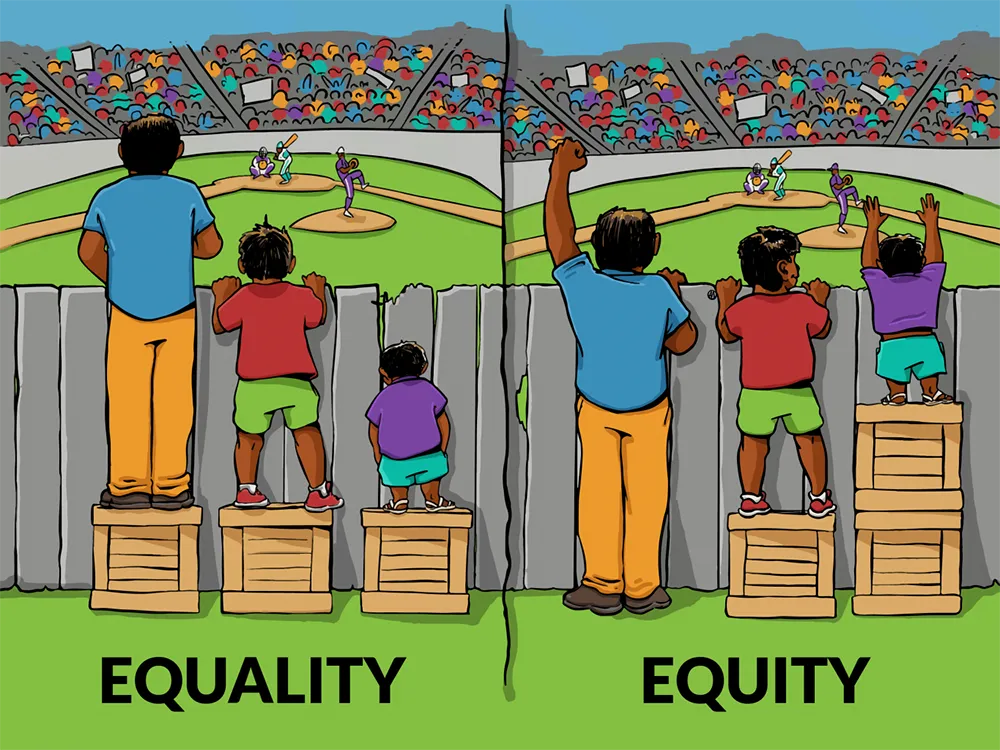
- Equality strives for equal opportunity but can be reduced to “sameness.” In fairness to its noble purpose, equality presumes that treating people the same offers everyone the “same” opportunity or starting point.
- Equity is about justness. It provides access to the same opportunity and measures it in terms of outcomes achieved. Equity can also go astray when it claims to guarantee equal outcomes. This is beyond its mandate.
Some oppose equity as not meritorious. They state that we can only offer everyone the same opportunity. One such belief is meritocracy, which assumes everyone has the same access and opportunities.
Never mind the research showing that members of marginalized groups must work twice as hard to be heard or to achieve average performance. Further, when marginalized colleagues complain about “biased” work conditions, they are labeled as difficult.
When poorly executed, the ideal of meritocracy assumes equal opportunity or conflates equal opportunity with equitable outcomes. Often, this involves favoritism and hiring practices where executives automatically hire people “just like me” rather than focusing on competency.
Education measures stats (diversity) showing parity between women and men and improving racial gaps. But, when examining outcomes, “such data suggests that higher education is not doing much to close the income gap and that it may be helping to reproduce a class system that has grown dangerously fractured.”
Equity is concerned with outcomes insofar as it measures barriers to access and opportunity. These barriers are defined by and serve the existing power structure.
1- Power of Individualism
Equity addresses systemic changes, and root causes operating at the level of ideologies and systems, not individual acts.
The very nature of belonging to a dominant group makes it difficult to see anything beyond ourselves as individuals, never having to carry, navigate, or account for the psychic concerns of our “group” (noted by psychologist Monnica T. Williams).
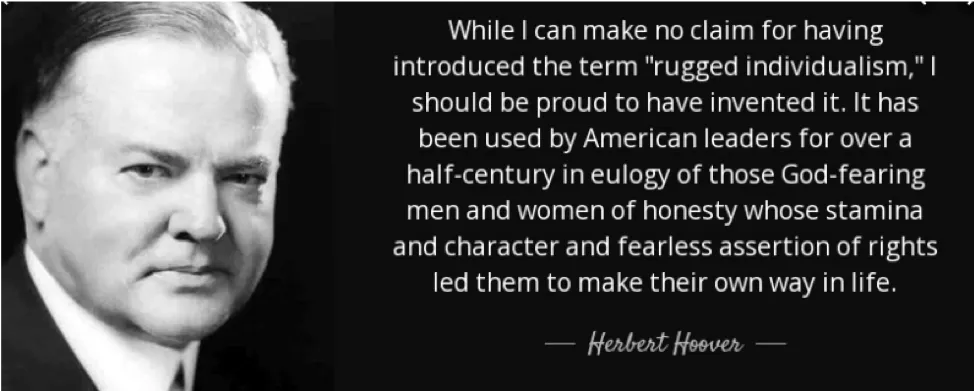
Only the blindness of rugged individualism allows some to believe they are either above or somehow disconnected from everyone else. Ideologies such as individualism tend to rub up against coaching philosophies, espousing that one can write one’s own destiny and, through objectivity alone, can free oneself entirely from bias without inviting ongoing examination of our conditioning.
Consider that being perceived as an individual not associated with anything negative because of skin color is a privilege largely afforded to white people. Now consider that most school shooters, domestic terrorists, and rapists in the United States are white. Yet, do we reduce a white man on the street to a stereotype?
People of color often endure having their views attributed to their racial or cultural identities and are denied the luxury of impartiality.
Advantages and Barriers
As a white man, I have the luxury to focus on my achievements and question any barriers. I take up the space I need, escape any collective psychic baggage (other than personal issues), and consume resources without a second thought.
As soon as I reveal I am also gay, I must now navigate norms I took for granted as a white man. Simply holding my partner’s hand at work can be monumental (imagine a kiss). I must also manage how my gay identity intersects with another’s religion, politics, generation, or worse yet, ignorance about AIDS. I must consider deeply how people will view me as an “other” representing a group and manage the psychic baggage of my group, which can impact my goals.
Still, I have the choice to say something and navigate as a gay white man. Racial and ethnic identities do not have that choice. Until intentionally examined, they are first addressed as part of a group and are usually only seen as individuals if they disavow their group.
Often, members of marginal groups must buy into the dominant system to be granted access as individuals apart from their group.
2- Power of Systems and Systemic Bias
Unlike incremental change, which improves current systems, systemic change questions assumptions, ideologies, and worldviews that preserve the existing power structures and barriers to access.
We begin by understanding that whiteness is not individual to us; it represents a dominant ideology that’s invisible to us. That is how ideologies work. Any dominant group’s ideology is invisible to them as a group. We become oblivious to the systems that inform us or that we perpetuate. Appreciating group identities forces us to see systems and ideologies and to dismantle our “colorblindness” of other groups.
Once we can view these systems, we can effect systematic changes (of methods and practices) and systemic changes (of assumptions and views) that inform those systems.
Consider how power is central to systems of race and racism.
Borne of an impulsive need and self-interest for power and control, we create the structures and policies to satisfy that need, and then we construct the ideas to justify it. Ibram X. Kendi in his book Stamped from the Beginning (and in this piece) unpacks this cyclical power dynamic.
Tackling this power dynamic demands a systemic examination of our impulses via implicit bias, our institutions via structural bias, and our thinking and impact via rational bias.
And unlike diversity or inclusion, equity focuses on dismantling this power dynamic and cultivating justice.
Access Equals Power
In time, we realize how an ideology of whiteness has shaped our norms for meritocracy, success, progress, and growth.
For example, consider a company where promotions can be considered after two consecutive years. What if a woman, because of childbirth, actually accumulated two years, not consecutively, but within a four-year period? Would she not be considered for a promotion?
In this case, both genders may be treated equally—after all, the woman chose to have a child. But the current structures—worse yet, the views held by those promoting those structures—force an inequity. Women have to make a choice a man will never have to make.
In this case, opportunity seems equal based on merits, but the outcomes will not be equitable. Further examination would suggest a structural change. Shift the policy from two consecutive to accumulated years or grant a parental leave policy without penalizing childbirth.
Equity recognizes that advantages and barriers exist and that, as a result, we don’t all start from the same place. Ideally, equity is a dynamic process that acknowledges unequal starting places and continues to correct and address any imbalances.
Either way, equity demands more than just hiring more women for diversity; it demands systemic change.

3- Power of Privilege
Thirty years ago, when academic Peggy McIntosh published White Privilege: Unpacking the Invisible Knapsack. She invited readers to reflect on everyone’s “combination of unearned advantage and unearned disadvantage in life” by the circumstances of our birth.
It is difficult for dominant groups to see that which is invisible. Not having to navigate or account for the psychic concerns of a group identity, it’s difficult to consider that people start at different places.
As Kendi put it, “When you are accustomed to privilege, equality feels like oppression. You already believe equality of opportunity exists, so instead, you’re going to reframe equal opportunity as an assault against you and your livelihood.”
The idea of “advantages and barriers” can often feel intangible, so here are some real examples. A study of a hiring process found that candidates with “white-sounding names” (Greg and Emily) were 50% more likely to receive a callback than candidates with “African-American-sounding names” (Lakisha and Jamal).
Another study asked faculty scientists to evaluate candidates’ competencies for career mentoring and to suggest starting salaries. Female candidates with resumes/criteria identical to male candidates were deemed less competent and less worthy of being hired and were offered less career mentoring and a lower starting salary.
Many members of dominant groups see equity as all about power and see power as a zero-sum game. More women in the C-suite means fewer men; more black and brown people means fewer white people, and so on.
D+E+I = Possibility of Justice
Today, diversity competes at a new level of awareness and understanding involving systemic change. This includes questioning outdated thinking and assumptions that inform our systems that manifest in unfair barriers.
Consider that, as human development professionals, much of what we deal with is the human side of systemic change. We support others in unlearning assumptions and biases about power, which opens new possibilities for justice.
To advance inclusion beyond platitudes, equity—creating justice through fair structures—must be central to diversity and reimagining power:
— Reframe power: Shift from viewing power as a limited, zero-sum game with little value in sharing it.
— Embrace discomfort: Recognize that growth requires the discomfort of learning and unlearning, without fearing a loss of control.
— Depersonalize change: Understand that change is universal and inevitable. View challenges to leadership not as personal threats but as opportunities for healthy, productive dialogue.
— Rethink paternalism: Move away from the assumption that those in power always have the organization’s best interests at heart, and that those advocating for change are ill-informed or emotional.
— Redefine power: View power not as an external force for control, but as the ability to fully engage human faculties—to appreciate, respond, listen, create, and express compassion. That is true power.
Appreciating equity invites power-sharing.
- It invites multiple perspectives that naturally strengthen us to navigate varied experiences.
- We become accustomed to multiple perspectives, which strengthens our “resistance” training that leads to innovation.
- We become agile and able to withstand market forces.
With equity, we can identify and eliminate barriers to cultivating a foundation for diversity, developing an open mindset, and inviting genuine participation. Together, this fosters an inclusive and just environment.
Reading Time: 9.5 min. Digest Time: 13 min
VIEW OUR RELATED BLOGS:
0 Comments