


What if our interactions, experiences, and situations in life are all a conversation? Consider leadership, identity, love, trust, science, learning, and suffering as a conversation.
What if we view life as a network of conversations?
Everything says something. Our very existence evokes conversation. We derive meaning from our engagement with the world. Each interaction reveals significance, backgrounds, histories, and discourses, forming our relationship with reality.
The significance of our life lies not in the rock we stumble over but in how we make sense of that experience and how it shapes our view of reality. We are incessantly in conversations with nature, systems, cultures, technologies, events, experiences, individuals, and with ourselves.
What’s a Conversation?
Fundamentally, a conversation is a churning or turning together. In this dance, human “conversation” evokes deeper connection and understanding.
Beyond mere content, the art of conversation involves forms, such as structures, contexts, and modes, and conversational fields, such as debate, discussion, and dialogue.
How we interpret and interact with conversations constitutes our being, enabling discovery, mutual satisfaction, and shared understanding.
Fields of Conversation: Defending or Suspending
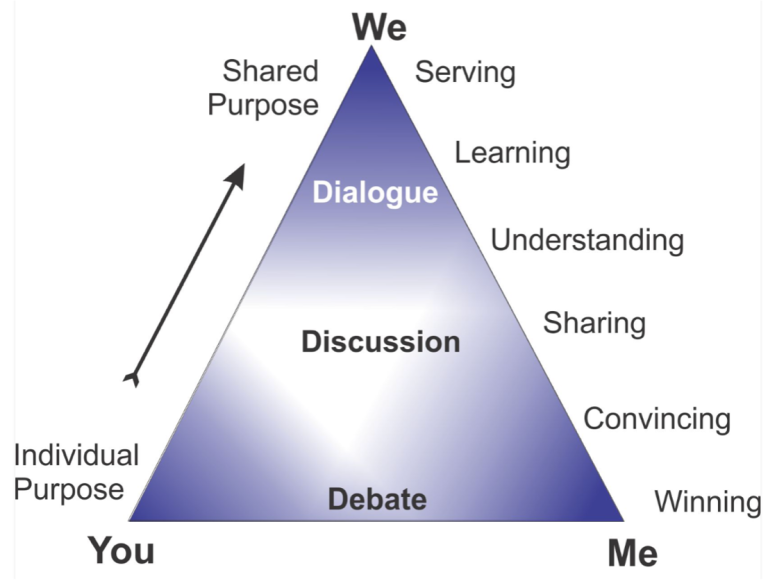
Conversations resolve uncertainty. Our human capacity and needs determine whether we enter the fields of debate, discussion, or dialogue. The field we enter can resolve uncertainty by transferring information, persuading others, or cultivating mutual understanding.
In communication, uncertainty involves disagreements, differences, and confusion that can lead to disputes, which can:
- lead to increased tension if not approached constructively.
- involve arguments, which can be emotionally charged.
- include a confrontational tone or focus on opposing viewpoints.
- often involve winning or losing.
However, when handled with dignity and openness, disputes can lead to deeper understanding by highlighting differences and encouraging clarification.
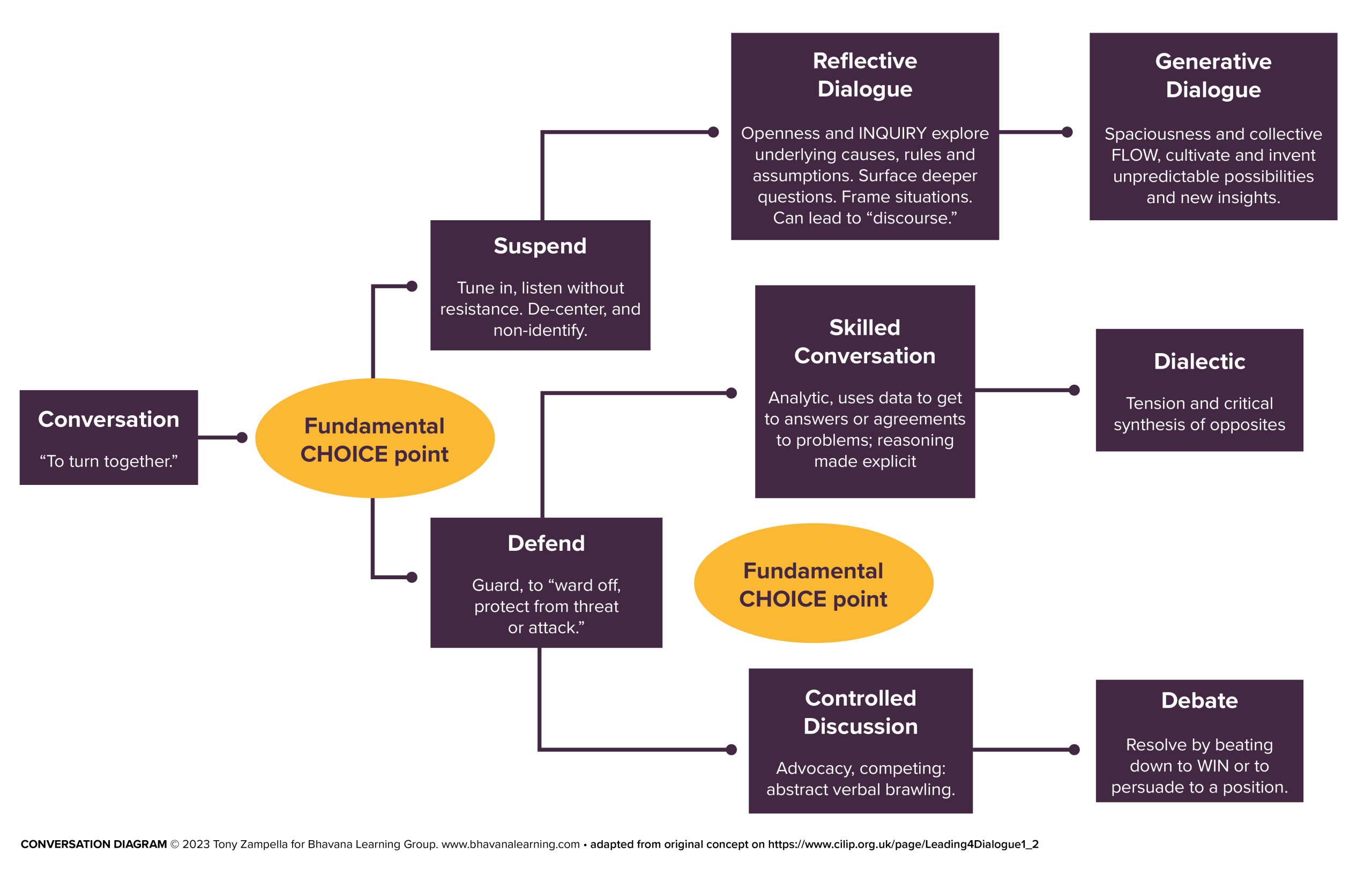
The key is to observe how we enter any “field of conversations” — practice the art of conversation. Are we prone to defend or suspend certainty?
- Defend: We resolve our dispute via debate or discussions—controlled or skilled—which can include dialectics to achieve a victory or deeper understanding.
- Suspend: We suspend positions or beliefs entering into dialogue. Reflective dialogue offers inquiry and can surface discourses, while generative dialogue offers the space for flow and possibilities.
Conversations That Defend: We Expand Expression
Defending is a natural and habitual way of entering a conversation. Bringing awareness to our approach will support recognizing and reflecting on this “defending dynamic” in a conversation.
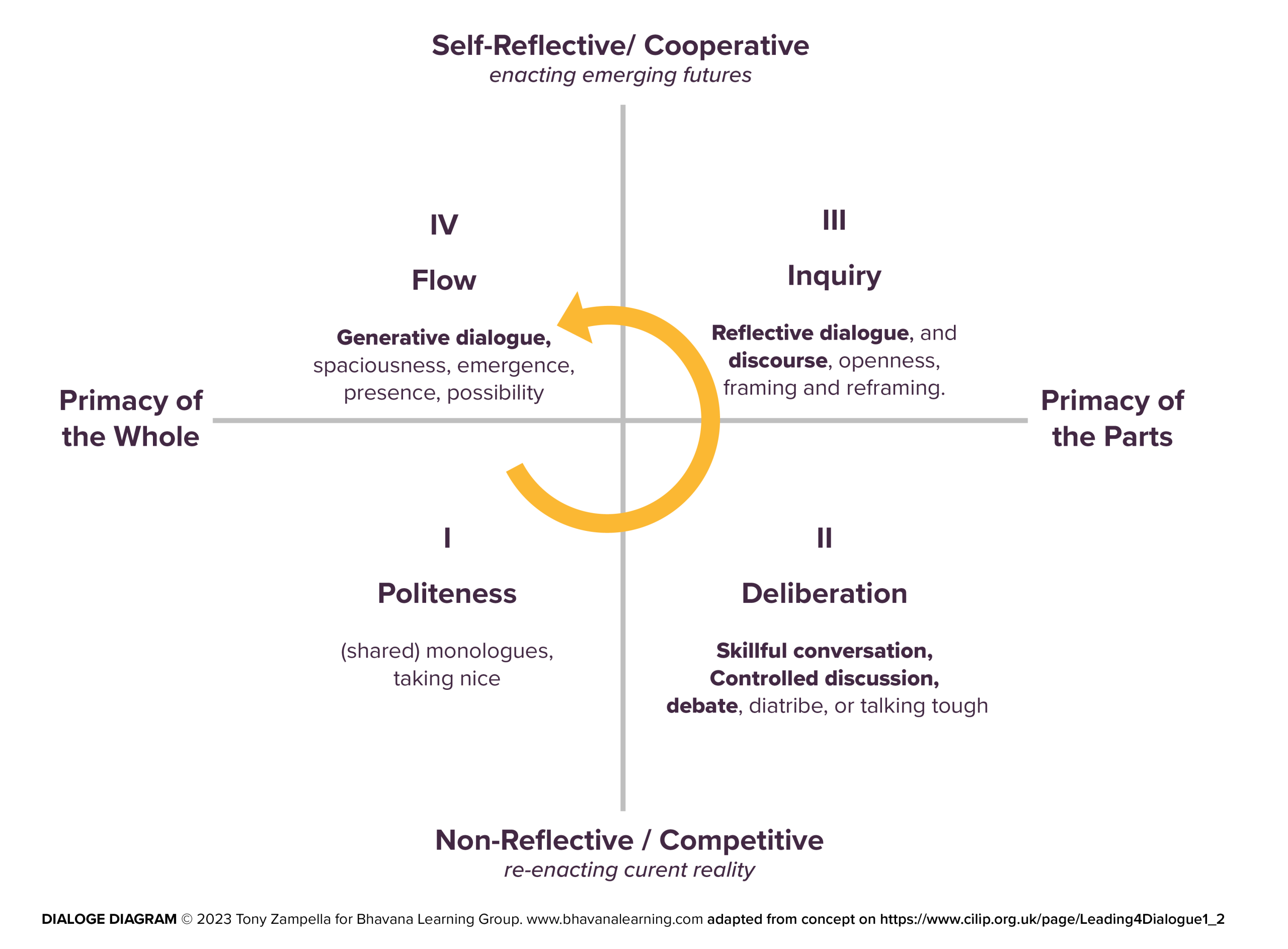
The field of conversation that defends protects us and keeps us on guard. This field includes several forms, such as politeness and debate, and involves discussion, which is controlled or skillful and can lead to dietetics.
POLITENESS
The primacy here is politeness: to appear nice or avoid conflict. Information remains shallow and reveals little. People do not say what they think and often speak to what needs to be said or wants to be heard.
Politeness can include shared monologues involving talking about something but not with someone. For instance, we’ve all been in a situation where someone just doesn’t stop talking. This might include their interests, perspectives, or tendency to dominate a conversation.
Politeness often leads to some type of Breakdown. According to Otto Scharmer of Theory U:
In Breakdown, one or more people break social conventions to say what they really think or feel. This rocks the “politeness” boat, sometimes triggering others to speak about—or at least be in touch with—their authentic thoughts and feelings.
This opening allows for more deliberate communication in the form of Debate or Discussion.
DEBATE
With debate, we enter a more “deliberative” conversation. This formal discussion focuses on a particular topic where opposing arguments are put forward. It may become confrontational and prioritize winning over understanding.
Although it can sharpen one’s ability to articulate and defend ideas, the competitive nature of debate may hinder new understanding or genuine connection.
Characteristics include formal or informal structure with defined or rational rules. Debate involves presenting and countering arguments. Typically, “debate” has a competitive aspect with an emphasis on persuading.
DISCUSSION
Physicist and thinker David Bohm, in his seminal book, On Dialogue, defined discussion as “making something common” as in the root of “Communication.” Based on the Latin commun and the suffix “ie,” which is similar to “fie,” it means “to make or to do.” So “discussion” is “to make something common,” that is, from one person to another in as accurate a way as possible.
Discussions can be controlled or skilled.
- Controlled discussions focus on advocacy and competing ideas and can include abstract brawling. These may lack structure and can sometimes devolve into a less focused conversation.
- Skilled discussions involve an exchange of ideas and opinions, often using analytical data and reasoning to support solutions. When facilitated well, skilled discussion allows for the sharing of perspectives, fostering connections that can lead to a shared understanding.
Generally, discussion is the preferred mode for developing or negotiating agreements. It is also useful for clarifying goals, expectations, and coordinating action.
Characteristics: Although more informal, discussions still have an aim—“to make something common”—this mode can involve exchanging ideas and opinions. When skillful, the emphasis is on sharing perspectives and can be participatory and collaborative.
DIALECTIC
Skilled discussions can become dialectic as a method of reasoning to discover the truth by exchanging logical arguments. Engaging in this level of discussion requires a commitment to intellectual rigor and discipline.
Focusing on logical arguments and rational ideas, including analytical data for discerning truthfulness, can seem cerebral and may not always address emotional or personal aspects. When approached with openness, dialectic can explore tensions, synthesize ideas and lead to a deepening of mutual understanding.
Characteristics: Dialectic includes reasoning to discover the truth through logical argumentation that involves a process of questioning. Unlike debate, the emphasis on dialectic involves exploring ideas and seeking synthesis to find common ground.
Conversations That Suspend: We Deepen Listening
Unlike discussion, which has us “make something common,” Bohm defines dialogue as being interested in something new together “in common.”
The focus here is to create something in common that might not otherwise arise. To identify and then let go of fundamental assumptions and agendas allows for one to be surprised at the new, to behold a discovery, to welcome an insight, that is, to dialogue.
Moving to dialogue is an evolution from communication to communion—from defending and protecting to discovery and inquiry. Here, we enter the conversational field by suspending our position, agenda, or need to achieve some predetermined end.
Genuine dialogue requires a suspension of certainty that cultivates openness and spaciousness, with room for the unknown and unpredictable to arise.
DIALOGUE
The concept of dialogue is more connected with the communication between consciousnesses rather than with knowledge production.
To be clear, there is no gap between consciousness and knowledge, but true knowledge comes from the spaciousness from awareness that defines consciousnesses. The word “consciousness” originates from the Latin “conscius” (con– “together” + scientia– “to know”). “Conscious” means sharing knowledge.
Colloquially, “dialogue” is often conflated with discussion. Genuine dialogue can emerge from the discussion once we shift our focus from speaking to listening. In dialogue, we are “thinking together.”
This field of conversation involves two areas: reflective dialogue, which can include discourses, and generative dialogue.
Reflective Dialogue
Reflective dialogue is a cooperative and open conversation where participants seek mutual understanding. It involves greater vulnerability, requires a commitment to active listening, and may be challenging in situations with a significant power imbalance.
“Inquiry” defines reflective dialogue because at least one person is beginning to reflect on their thoughts and positions. People “suspend” their judgments and assumptions and loosen their grip on previously unquestioned beliefs (e.g., maybe profit is not the primary goal). This opens space for new ways of seeing and being.
Pausing to reflect, listen, and see marks a shift in the field of conversation. Here, it is critical to underscore the importance of listening. Scholar and author Gemma Corradi Fiumara probes listening in The Other Side of Language: A Philosophy of Listening.
One can “study” philosophy with relative ease but it is more difficult to experiment in listening. It is almost as though listen one had to ‘become’ different … Unless we are ready, receptive – and also, possibly, vulnerable – the experience of listening appears to be impossible.
Reflective dialogue is particularly effective in fostering connection. With openness to exploring underlying causes, rules, and assumptions, it deepens questions and understanding to support framing and reframing situations.
Characteristics: Reflective dialogue involves an openness emphasizing inquiry and shared exploration and understanding that encourages deepening relationships. The focus on active listening involves exploring shared meaning.
Discourse
Reflective dialogue expands openness that surfaces and creates discourses. Discourse surfaces mental models, assumptions, patterns, backgrounds, and grand narratives.
Discourse is a way of perceiving, framing, and viewing the world. For example, a dominant discourse often prefers hard skills—technical or practical abilities—over soft skills—interpersonal and emotional intelligence—in business.
Extended and systemic written or spoken communication on a specific subject discourses can lack immediacy. When inclusive and well-reasoned, discourses invite and surface multiple views and truths that can contribute to shared understanding and connection over time.
Generative Dialogue
Generative dialogue allows for uncertainty.
In our emerging systems worldview, we are evolving from the primacy of pieces to the primacy of the whole, from absolute truths to coherent interpretations, from self to community, from problem-solving to creating, and from discrete events to interdependent conditions.
David Bohm believed that an alternative way toward understanding any whole arises through participation rather than abstraction. He speaks to a “different kind of consciousness that is possible among us, a ‘participatory consciousness.’”
In genuine dialogue, “each person is participating, is partaking of the whole meaning of the group and taking part in it.”[1]
“Flow” defines generative dialogue as the rarest field of conversation. Bohm speaks of a special listening:
“If we are to live in harmony with ourselves and with nature, we need to be able to communicate freely in a creative movement in which no one permanently holds onto or otherwise defends his own ideas.”
The deep listening that cultivates flow taps into a non-dual consciousness, creating space for emergence as boundaries dissolve and blur and people “think together.”
For most, seeing anything “false” is immediately denied or justified rather than embraced as leading to a new, unknown whole. When we deny or justify, we embrace resistance over acceptance.
With acceptance, the conversation slows down. People listen deeply, and silence becomes pregnant with shared meaning. It is common for people to complete each other’s sentences. There is a palpable sense of oneness, as though whoever speaks voices the collective intelligence of the group.
In this space, we cultivate a natural flow or presencing (per Otto Scharmer).[2] We are aware of and receptive to the emergence of the unpredictable that can reveal future possibilities.
Staying Open
How do we enter the conversational field? Are we conditioned toward conversations that defend? Can we shift to a conversation that suspend?
Each field of conversation serves different functions and has its limits. The art of conversation encourages us to “turn together” to foster human connection and understanding.
In our divided world, we tend to want to jump in and defend, call out, pick a side, or justify our convictions. This can be useful in some situations and limiting in others.
The most difficult and courageous act can be to remain open. Zen master and peace activist Thích Nhất Hạnh struggled to remain open during the Vietnam War when the warring armies begged him to take sides:
Speaking out for peace, we did not take sides. It was very difficult, very dangerous to take such a stand. When you take a side, at least you’re protected by one side. But if you don’t take sides, you’re exposed to destruction by both … We struggled for peace and engaged in social work in the spirit of nonviolence, and non-discrimination. It was very hard. … our school for youth and services was misunderstood by both sides[3].
Our polarized world encourages taking sides.
The art of conversation involves learning and practicing to remain open — to experience our full human capacity. With awareness, reflection, and practice, we can cultivate the openness to enter dialogue for deeper understanding and connection.
Reading Time: 9 min. Digest Time: 12 min.
1- View our related blogs:
- What’s Growing in Your Conversational Garden?
- Upgrading Conversations Beyond Idle Talk
- Generative Communication: The Power to Connect and Create, part 1
2- References:
[1] On Dialogue, by David Bohm (Author), Lee Nichol (Editor), Peter Senge (Preface)
[2] Otto Scharmer, Theory U: Leading from the Future as It Emerges
[3] Zen and the Art of Saving the Planet, pgs. 109-111
0 Comments