



In the Star Trek: Voyager episode “Sacred Ground,” Captain Kathryn Janeway—a trained scientist with a background in quantum cosmology and a former chief science officer—faces a crisis she cannot solve through conventional means.
When crewmember Kes is rendered unconscious by a planet’s mysterious energy field, Janeway petitions the planet’s monks to allow her to undertake a sacred ritual connected to the field.
The monks assign her a guide.
Before the ritual begins, Janeway encounters three elder monks who engage her in Zen-like Taoist wordplay. Their exchanges subtly expose something unsettling: Janeway is already preparing for the experience. She perceives it as a trial with tests to pass. She is constructing the ordeal according to her expectations of other such rituals rather than letting herself simply be.

The Journey …
Janeway approaches the ritual as a scientist. She anticipates structured challenges: physical endurance, mental discipline, and perhaps psychoactive substances that alter her body’s chemistry and allow her to pass safely through the energy field.
GUIDE*: Do you want me to give you orders, Captain?
JANEWAY: I’ll do whatever you ask of me.
GUIDE: I see. So you think this is just a matter of doing what you’re told.
JANEWAY: No. I’m sure there’s spiritual significance behind the challenges involved.
GUIDE: Challenges. That’s what you expect?
JANEWAY: I don’t know what to expect. I’ve studied ritualistic societies. Many rites share common elements. This one may be different. I’m willing to do whatever is necessary.
When concealed, expectations constrict us. They form a belief structure that generates a sense of certainty and predictability that feels reassuring.
The Guide proceeds, and Janeway endures a series of demanding experiences, including being bitten by a creature whose venom induces a psychoactive state. Yet afterward, the Guide tells her the trials were meaningless.
Meanwhile, Voyager’s Doctor* hypothesizes that the venom may contain the biochemical key to curing Kes. It does not.
Disappointed, Janeway returns to confront the Guide.*
JANEWAY: You meant what you said, didn’t you? Everything I went through was meaningless.
GUIDE: Yes.
JANEWAY: I did everything you asked. You led me to believe it would help Kes.
GUIDE: I haven’t led you anywhere, Kathryn. You’ve taken me along wherever you wanted to go. This was your ritual. You set these challenges for yourself.
JANEWAY: It’s true that I came here with certain expectations. Are you saying that you simply fulfilled my expectations?
GUIDE: You would have settled for nothing less.

The Realization …
Janeway realizes that the ritual was never about endurance, altered chemistry, or passing a test. It was about cultivating her faith—her relationship with “sacred ground.”
Settling into this insight, Janeway recommits to the journey.
JANEWAY: I’m not ready to give up. If there’s still a way to save Kes, I want to try.
GUIDE: You’ve come back to seek the spirits.
JANEWAY: I don’t know what I’m seeking.
Grounded in her realization, Janeway approaches her inquiry differently—without a framework, without any tests or trials to master, and without a mechanism or theory to confirm. The Guide tells her that her willingness is enough.
Rather than collecting data and scans for the Doctor* to analyze in search of a cure, Janeway trusts her own insight. She asks the Doctor to beam Kes down to the original site. Without evidence and without an analytical framework, she walks Kes back into the energy field.
Kes is healed.
Later, the Doctor offers a rational, scientific explanation. It is coherent. It makes sense.
Yet, for Janeway, it is no longer complete.

The Power of Expectations
“Sacred Ground” is not a fan favorite. It is often criticized—especially on Star Trek fan sites—as an episode that pits faith against science. But after watching it more than a dozen times, I’ve come to see it differently. It does not reject science. It explores its limits. It invites us to examine the relationship between what can be measured and observed and what cannot be reduced to explanation.
More subtly, the episode illuminates something even more intimate: the power of expectations.
Janeway’s struggle is not simply about science versus spirituality. It is about how her already formed assumptions shape the reality she encounters. She does not walk into the ritual empty. She brings a framework—a method and a definition of what a “trial” must look like. Within that framework, the experience unfolds accordingly.
Her Guide’s insight is piercing: “This was your ritual. You set these challenges for yourself.”
In my work with clients, this subtle power is everywhere—and is usually concealed.
Like Janeway, we construct our own trials. We define what success must look like. We establish invisible standards. Then, we measure ourselves—and others—against them. When reality fails to comply, we experience frustration, disappointment, and even shame.
Yet, we rarely question the expectations, themselves.
Instead, we treat them as objective benchmarks—fixed and universally valid. When we fail to meet them, the gap feels like evidence of deficiency. The distress seems justified.
However, what if the distress does not concern failure?
What if it is about attachment to a projection?
Expectations are powerful. They set standards that drive us. They motivate action. They help us coordinate commitments.
The question is not whether we have expectations. We always do. The question is whether they have us.

Expectations as Ontological Structures
Expectations are anticipations, or projections. They arise from our experiences and our ideals about how things, people, or situations should be. Some are conscious; many are not. They shape what we believe is appropriate, necessary, or desirable.
They appear in everyday life: expectations of professionalism (being punctual or respectful), social courtesies (saying “please” or “thank you”), relationship dynamics (a friend will listen), or future outcomes (a project will succeed).
When concealed, expectations constrict us. They form a belief structure that generates a sense of certainty and predictability that feels reassuring. It tells us what should happen and how things ought to unfold—what we expect to see, feel, and think.
Yet, this same certainty narrows the field of possibility. Expectations kill possibility not by force but by limiting what we allow to count as real, successful, or meaningful.
From an ontological perspective, expectations are structures of being. They form part of the interpretive lens through which we disclose the world. We do not encounter reality neutrally. We encounter it already shaped by meaning—by what we assume should happen or what we hope will happen.
Janeway did not simply have expectations about the ritual. She was being in a particular way: as a scientist facing a problem to solve. In her world, the ritual became a technical challenge. Her expectations structured what could show up. The “tests” were not imposed on her; they emerged within the ontology she carried into the encounter.
This is how expectations kill possibility.
They narrow the field of what can be seen and reduce the horizon of interpretation. They silently define success in advance.
Possibility often exists outside that predefined frame. However, when we fixate our attention on meeting expectations, anything that does not fit the frame may be dismissed, resisted, or simply unseen.
A Buddhist View: Attachment and Identification
In Buddhist psychology, expectations can arise from attachments (upādāna) and identification. We cling not only to outcomes but also to identities, roles, and worldviews. We cling to being competent, being right, being effective, and being in control.
Expectations are often fueled by tanhā—craving. Not merely desire in a neutral sense, but desire infused with grasping: “This must happen.” “This is how it should be.” “This is what success looks like.”
When the world does not comply, friction appears: disappointment, frustration, resentment, regret. These emotional reactions are diagnostic, revealing where the attachment operates.
Because expectations are often unconscious, friction becomes revealing. Upsets and disappointments invite inquiry:
- What expectations might be concealed?
- Do these expectations reveal any attachments?
- What am I protecting?
- What identity feels threatened?
- What desires or outcomes have I identified with?
- How do these expectations reinforce a sense of certainty or security?
As awareness expands, attachment softens. Identification loosens. The grip of expectation relaxes.
Janeway’s shift did not occur because she had acquired new data. It occurred because her orientation changed. On her second return to the ritual, she says, “I don’t know what I’m seeking.” That is not confusion; it is a surrender of certainty. It is a relinquishing of the need to define the mechanism in advance.
In Buddhist terms, this resembles the beginner’s mind—a posture of openness free from any frame of reference or the compulsive need to control the outcome.
Possibility enters when grasping relaxes.
Click to enlarge
Expectations and Intentions
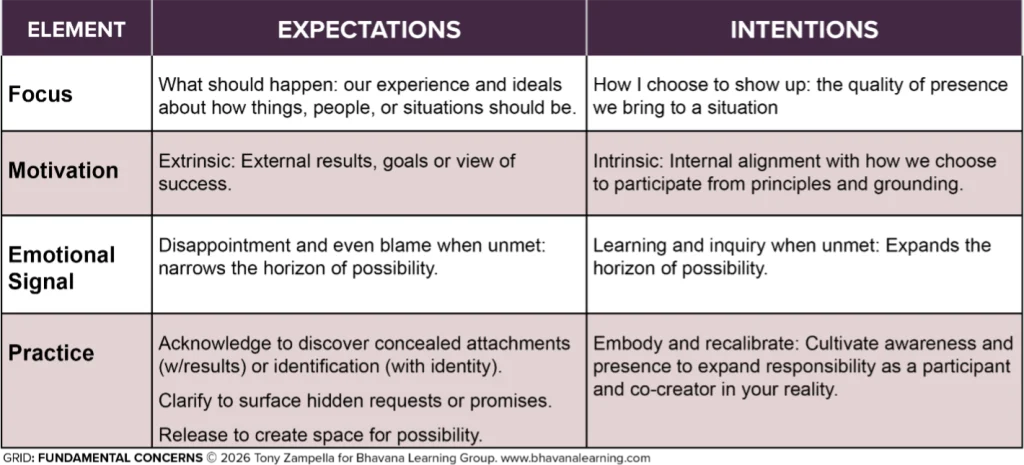
Expectations typically revolve around external, observable desires, goals, or outcomes. They define what success should look like. They are extrinsically motivated, measurable, and results-oriented.
Intentions operate differently.
An intention is an interior orientation rooted in intrinsic motivation and guiding principles. It reflects the quality of awareness and presence we bring to a situation. With intention, we assume responsibility as participants and co-creators in our reality. While expectations fixate on results, intentions shape how we show up.
To balance expectations, cultivate intentions.
When assessing a situation, reflect not only on what you expect to happen, but also on how you intend to be. What qualities are you committed to embodying: Curiosity? Clarity? Compassion? Courage? Patience?
This dual awareness—expectation and intention—grounds us. It allows us to act with purpose without collapsing possibility into a single predictable outcome.
Janeway’s first approach was expectation-driven: pass the test, alter the chemistry, and solve the problem. Her second approach was intention-driven: I am not ready to give up. I will show up fully. I will seek—even without knowing what I seek.
That shift expanded possibility.
1. Becoming Intentional
Using intention provides a fuller evaluation of any situation.
Imagine attending a meeting expecting to receive all the information necessary to progress. Instead, participants arrive unprepared, confused, and needing direction.
Through the lens of expectation, alone, the meeting is disappointing—perhaps even a failure.
But what if you entered the meeting guided by intention? An intention toward full participation, patience, curiosity, or clarity?
Now, the evaluation changes.
You can assess the meeting not only by whether your expectations were met but also by whether you embodied your intention. Did you show up with steadiness? Did you contribute clarity? Did you listen with curiosity?
The friction of unmet expectations still matters and can cause routine upsets. However, this friction may also reveal unclear agreements or unspoken requests. Instead of collapsing into frustration, it becomes information—something to articulate, refine, or renegotiate.
Intention keeps the possibility alive, even when expectations are not fulfilled.
2.Expectations Can Serve Us
Expectations are not inherently wrong. When conscious, they can serve us.
First, expectations often conceal requests. If I am disappointed, it may be because I never articulated what I truly needed. Acknowledge hidden needs masked as expectations. Then, clarify them via requests, offers, or questions, transforming silent assumptions into explicit agreements.
Second, expectations are frequently mistaken for promises. We assume that others “should have known.” Naming and qualifying expectations prevents unnecessary misunderstanding.
Much of professional life revolves around managing expectations—shaping what others believe will happen and establishing standards that define success. In doing so, we generate implicit promises, often without realizing them.
Expectations voiced casually—or embedded in brands, mission statements, taglines, or imagery—can be interpreted as commitments. When they are unfulfilled, disappointment can escalate into a perceived breach of trust. What began as an assumption may ultimately be experienced as betrayal.
The problem is not expectation itself. The problem arises when expectations are concealed, casually spoken, or tightly held as attachments.
When we are unaware of expectations, when they become fixed, or when we become attached to them, they kill possibilities.
When expectations are held lightly—examined, clarified, balanced with intention, or even released—they become information rather than constraints.
When we fixate our attention on meeting expectations, anything that does not fit the frame may be dismissed, resisted, or simply unseen.
Finally…
Janeway listened to the Doctor’s explanation. It was rational. This was plausible.
But something in her had shifted. Science was still valid. Yet, it was no longer the only lens through which reality could be interpreted.
Possibility expanded.
The questions for us are simple, though not easy:
Where are our expectations quietly defining what is allowed to occur or what should happen?
What might become possible if, even briefly, we let ourselves not know what we seek?
And what might become possible if we surface, acknowledge, and release our expectations?
Reading Time: 9 min. Digest Time: 12 min.
*Guide and Doctor are capitalized because they function as proper nouns in this episode. The Doctor has no given name and is addressed solely as “Doctor.”
0 Comments