



The holidays can be confusing. They swing between obligations, unrealistic expectations, and the aspiration to “finally relax.” A great deal of this confusion stems from how we view rest.
We use words such as “relaxation” and “rest” casually, as if they simply mean the absence of busyness. Psychologically, “relaxation” is defined as a state free from tension—a release, an easing, a subtraction. In both cases, “relaxation” is framed negatively: as the removal of something.
An Inquiry into Relaxation
On the first evening of a weeklong retreat, David arrived well after the opening session had begun. He burst through the door with a half-zipped duffel bag, two water bottles, a ringing phone, and the unmistakable energy of someone who had negotiated with the world all day.
As he sought an empty chair, the teacher gently noted that the retreat had begun at 4 p.m. and asked if everything was all right.
Exasperated, David sighed. “Look,” he said. “I’m here to relax. I’m not going to stress about showing up on time.”
A few people smiled politely, but many recognized something familiar in his response—the belief that relaxation comes from removing obligations, loosening structures, or opting out of responsibilities.
But David wasn’t relaxing; he was unraveling.
He was trying to relax without himself: trying to arrive without presence, trying to release without grounding, trying to soften without integrity.
True relaxation is not the absence of tension; it is the presence of being.
To relax in a deep, ontological sense requires a homecoming—a return to awareness, groundedness, and coherence. Relaxation is defined not by what falls away, but by what becomes present.
This essay explores this presence through two primary lenses:
- Ontology: Philosopher Martin Heidegger’s insights into concern, authenticity, and the clearing of possibility.
- Buddhism: The classical teachings of sukha (ease) and dukkha (constriction) regarding spaciousness.[1]
Together, they reveal a compelling truth: Relaxation arises from integrity. Integrity creates coherence. Coherence cultivates spaciousness.
Relaxation is not the absence of tension.
It is the presence of a spacious, coherent being.
The Roots of Relaxation
The word “relax” comes from the Latin relaxare: “to loosen,” “to widen,” and “to open.” Its root, laxare, carries the sense of creating more space—of allowing life to move more freely through us.
1. Buddhism: Sukha, Dukkha, and the Spacious Heart
Buddhism speaks directly to this tightening and loosening dynamic.
Dukkha: The crowdedness of avoided life
Dukkha, often mistranslated as “suffering,” literally means “a wheel axle that does not fit”—a sense of friction, tightness, or constriction. In the Pali Canon, dukkha arises whenever we grasp, avoid, or distort experience. It is the tightening around life that makes relaxation impossible.
In his book The Myth of Freedom and the Way of Meditation, author and meditation master Chögyam Trungpa described dukkha as “the tension of holding onto the reference point of self,” a kind of “existential contraction.”
Meditation teacher Jack Kornfield described it as “the narrow room of the reactive mind,” where thoughts crowd out presence.
Sukha: The ease that arises from alignment
In contrast, the Buddhist term sukha refers to spaciousness, sweetness, and ease. In the Satipaṭṭhāna Sutta, sukha is the natural outcome of moment-to-moment awareness—mindfulness—as an unforced clarity in which the heart settles into openness.
Sukha emerges when the mind ceases to tighten around itself.
True relaxation resonates intimately with sukha, often translated as “ease,” “bliss,” or even “sweetness.” At its core, sukha means spaciousness—the experience of inner space—unconfined, unobstructed, open.
This is neither escapism nor the absence of discomfort; it is the presence of a spacious being. Both linguistically and existentially, relaxation points toward a spacious presence, not withdrawal.
And here, Martin Heidegger enters the inquiry.
2. Ontology: Concern, Care, and Clearing for Possibilities
Ontologically, relaxation is the expansion of being—a clearing of inner space. This “laxing” points to a deeper truth: Real relaxation is the spaciousness made possible through authenticity and presence.
Heidegger begins his analysis of human existence—Dasein—with the insight that humans are always concerned with their world. We find ourselves thrown into a web of meanings, roles, expectations, and relationships. Our concerns (Besorgen and Sorge [2]) are not obstacles to being; they are the ways that being reveals us.
Fallenness as Crowded Space
Heidegger described “fallenness” as the tendency to “fall” into the concerns, expectations, and interpretations of others—the anonymous influence of the “they-self.” In fallenness, we do not simply notice the world; it absorbs us. We scatter ourselves trying to match what “they” expect—fleeing or distracting ourselves, deferring what matters, or losing coherence in inauthentic busyness.
Recognizing fallenness doesn’t shame us; it opens space. The moment we see our absorption for what it is, a clearing appears. Insight becomes possible. Our true nature has room to breathe.
Authenticity as Spaciousness
Authenticity, in contrast to Fallenness, holds our commitments consciously and coherently, with integrity as follows:
- Inauthentic concern (fallenness) tightens us.
- Authentic concern opens us.
Why? Authenticity aligns us with our actual existence rather than against it.
When we hide from what matters or defer our deeper commitments, we generate constriction—the ontological equivalent of dukkha, a kind of inner tightening.
This fallenness mirrors what Buddhism calls “conditioning”—the habitual unconscious patterns that shape our behavior and narrow our awareness. We clutter our inner space with unresolved experiences.
Relaxation, in this sense, is not the negation of concern, but its transformation—the shift from scattered absorption to coherent presence. It is the opening of inner space within which life can unfold freely.
Where Buddhism speaks of tightening and loosening, Heidegger speaks of fallenness and authenticity. Both describe the same movement of contraction and expansion in being.
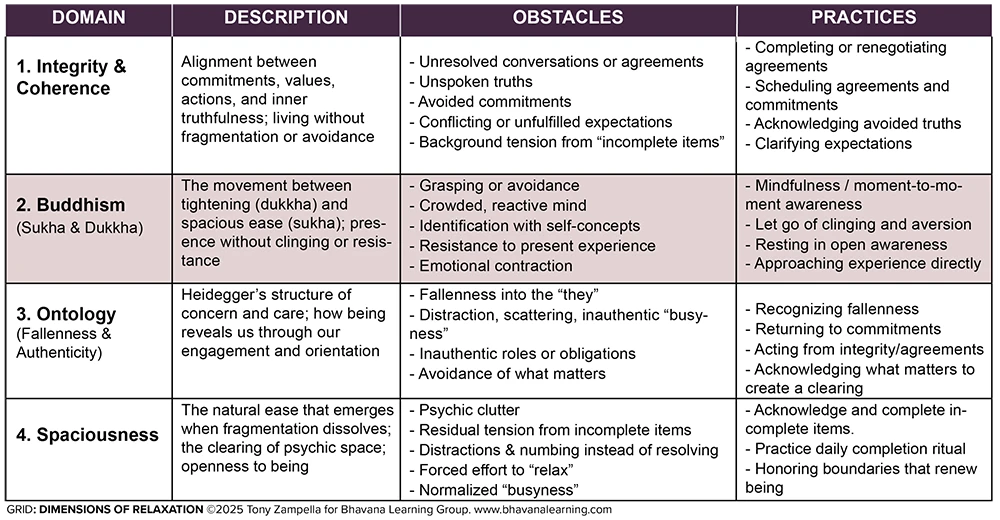
Click to enlarge
The Ease That Follows Integrity
When we meet our concerns with integrity—when we engage the world truthfully and with care—we generate breathing room.
Spaciousness without integrity dissolves into avoidance. Loosening without wholeness becomes escape.
For example, a leader might cancel meetings to “create space,” but sidesteps addressing a team conflict. The open calendar doesn’t bring clarity; it simply delays what must be faced.
Or, someone may take a “self-care day” to relax, but if they’re avoiding a necessary conversation or deadline, the time quickly fills with anxiety rather than ease.
Integrity—cohesion, coherence, alignment, and a unified sense of being—is the necessary ground for genuine relaxation. Without integrity, we do not relax; we merely abandon ourselves.
Why is integrity so essential?
When our lives are unaligned with unacknowledged commitments, unfinished conversations, or unspoken truths, they occupy psychic space. They generate subtle constriction, heaviness, or tightness. They accumulate as background tension.
What we often call “relaxing” is merely the numbing of dukkha, the tightness, friction, and crowded mind that arise when life is resisted or left unresolved. Even taking a break to “rest” while avoiding a difficult task turns the “time off” into tension, not ease.
What real relaxation requires is resolving the inner fragmentation that produces it.
The ease that arises from integrity naturally unfolds into two dimensions of spaciousness: relaxation as presence, and recreation as the re-creation of our being.
1. Relaxation as Presence
To relax is to be here. Fully. Unconditionally.
Mahamudra Buddhism speaks of resting into awareness or “coming home.” This refers to relaxing the mind into its natural, open, and spacious state of being, which is always present. It involves letting go of force, judgment, and conceptual thinking to experience the clarity that is always accessible.
This sense of presence arises only when we are no longer managing ourselves, guarding against something, or negotiating with our own minds. It is the ease that appears when unresolved concerns do not occupy our inner space.
One of the greatest obstacles to relaxation involves incomplete items—the lingering decisions, unfulfilled expectations, and avoided commitments that hover at the edges of awareness. These are not dramatic crises; they are the small but persistent tensions that keep us leaning forward, bracing internally for what has not yet been handled.
Many such concerns can be addressed simply by locating them and giving them a form:
- capturing (writing) them in a notebook for reflection or action,
- scheduling them in your calendar to complete, fully or provisionally,
- delegating or automating them,
- clarifying or communicating unfulfilled expectations, or
- communicating with the relevant parties to complete or modify agreements.
- reflecting on a daily completion practice (see practice completing your day)
Once a concern is held with integrity, it stops gripping us.
Consider a simple monthly mortgage or rent payment. We know the amount and the due date; the only concern is paying it on time. By scheduling or automating it, the concern is resolved. It no longer occupies psychic space. The background hum of “don’t forget” dissolves into clarity.
Relaxation becomes possible when concerns are handled with integrity—when nothing inside us is avoided, bypassed, or incomplete. In that clearing, awareness inhabits the body without obstruction. Relaxation is the natural result of a mind no longer burdened by incompletion.
This sense of presence arises only when we are no longer managing ourselves, guarding against something, or negotiating with our own minds.
2. Recreation as Re-Creation
The word “recreation” literally means “re-creation,” a renewal of being. True recreation is not about diversion, but about returning to ourselves—restoring the spaciousness crowded out by avoidance or fragmentation.
When we address the things that crowd our inner space—completing needed conversations, acknowledging unspoken or inconvenient truths, releasing attachments, taking action, fulfilling or modifying agreements—the grip of our concerns naturally dissolves.
We are not escaping them; we are dissolving them through integrity. In that disappearance, spaciousness returns.
We recreate the openness that was always ours: the natural ease of being human.
Relaxation, then, is not a passive state but an active practice—one that requires:
- Attention to what is present
- Intention to live in alignment
- Boundaries to create space
- Care in tending to what matters
Relaxation is not the absence of tension. It is the presence of a spacious, coherent being.
This is the clearing that Heidegger described: the spaciousness that Buddhism cultivates.
The Paradox of Understanding
Much of what we call being relaxed—or at rest—comes from our habitual, dualistic way of interpreting experiences. In a dualistic frame:
- Happiness eliminates suffering.
- Rest removes stress.
- Relaxation avoids tension.
- Freedom rejects structure.
This worldview treats opposites as mutually exclusive, as if isolating each quality as defined by the absence of its counterpart. Dualism creates separation and then treats that separation as real, permanent, and solid.
Eastern wisdom traditions offer an expanded view.
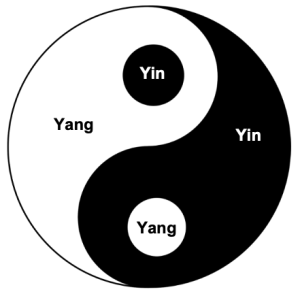
From an interdependent perspective, opposites are not enemies but partners. Reality is not divided into clean binaries; it is a living field of dynamic tension between essential poles. What appear to be contradictions are often mutually dependent (interdependent) forces. Each containing the seed of the other, each necessary for balance.
In this view:
- Ease is possible because we understand tension.
- Spaciousness emerges because we recognize constriction.
- Freedom becomes meaningful because we engage in form, structure, and commitment.
Opposites reveal one another. They co-arise, shape, and inform each other.
This is why genuine understanding is never one-sided. It arises from inhabiting the interplay of these forces, allowing their relationship—not the dominance of one—to create coherence.
Thus, true happiness arises not from the disappearance of suffering, but from insight into its nature. Real freedom honors principles and structures as the grounding that enables the responsibility for true spaciousness to arise.
Here, the teachings of Buddhism and Heidegger converge: Spaciousness is not found in rejecting one pole of experience but in inhabiting the whole with integrity.
The Spaciousness Already There
When we imagine relaxation as escape, we chase activities that numb us. But when we understand relaxation as a spacious presence, a different possibility emerges.
- Relaxation is not passive or a collapse.
- Relaxation is not avoidance.
- Relaxation is not a distraction.
- Relaxation is the return to coherence.
- Relaxation is the freeing of being.
- Relaxation is the natural ease that appears when we are no longer at war with ourselves.
This makes relaxation a fundamentally ontological event:
- When concerns are met with integrity, they dissolve.
- When concerns dissolve, space opens.
- When space opens, sukha emerges—naturally and effortlessly.
Relaxation is not something we manufacture; it is the spaciousness that naturally appears when being is no longer crowded. We do not create ease—we return to it.
FOOTNOTES
[1] Sukkha (ease) and Dukkha (constriction) are translated from the Buddhist Pali Canon.
[2] Besorgen names our everyday, practical concerns with the world. Sorge names the deeper existential care that structures our very being (not an emotion but an ontological condition that makes meaning and involvement possible).
Reading Time: 8.5 min. Digest Time: 12 min.
1- VIEW OUR RELATED RESOURCES & BLOGS:
0 Comments