



Democracy is not an end state. It is not just a value or a process.
Democracy is a commitment to a way of being.
This commitment invites a more human view of politics — not as a struggle for control, but as the courageous work of shaping what’s possible together amid differences. Without the inner disciplines shared by coaching and human development, democracy can easily become reactive, transactional, or hollow.
Since November 2024, I’ve reflected more deeply on what it means to live within a pluralistic democracy — the most defining and fragile feature of the American experiment. To address this inquiry, I will explore how the disciplines that shape democracy, liberalism, and politics intersect within the coaching profession’s focus on human relationships.
Today, politics stands at a crossroads, tested by polarization and the struggle to sustain progress within a pluralistic democracy.
At its best, democracy — like all politics — is a living conversation
that thrives when we reach across differences to create
shared meaning and common purpose
The Politics of Life: A Way of Being with Differences
As the world’s largest pluralistic democracy, the United States invites a vital question: How might we renew our commitment to democracy through the lens of conversation and practice — how we live and learn together amid competing priorities?
Among the voices who have deepened this inquiry, I highlight several guests and essays from The New York Times’ Ezra Klein that have stood out (here, here, here, here, and here).
Beyond politics or position, I’m struck by the impulse for dialogue to explore differences — seeking understanding and meeting disagreement without collapsing into platitudes or surface civilities.
In essence, renewed liberalism is the lifeblood of our politics. As Helena Rosenblatt writes in The Lost History of Liberalism: From Ancient Rome to the Twenty-First Century (2018):
To the ancient Romans, being free required more than a republican constitution; it also required citizens who practiced liberalitas [liberalism], which referred to a noble and generous way of thinking and acting toward fellow citizens.
To practice this spirit of liberalism — as the lifeblood of pluralistic democracy — is to engage consciously in the ongoing work of relationships: remaining thoughtful, listening deeply, and discovering new meaning through the creative tension of disagreement. These are not merely civic skills but ontological practices — ways of being with difference that reveal who we are becoming, individually and collectively.
Intersection of liberalism and human development
The liberalism that animates democratic life — across the left, center, and right — is rooted in the same vital ideals that shape the human development professions. As Cass Sunstein writes in On Liberalism: In Defense of Freedom (2025):
Liberalism is a set of commitments to freedom, pluralism, the rule of law, respect for individual autonomy, and security and self-government.
As this political season stirs the winds of change, we might remember that democracy itself is change — a continual unfolding through relationships and conversation. With the power to create change comes the responsibility to weave diverse perspectives and build coalitions capable of sustaining it.
In a democracy, it is not enough to propose ideas or turn out votes; we must also practice the art of persuasion. Analyses of the 2025 election cycle highlight persuasion as a decisive factor — often more influential than turnout itself. Several “swing” counties saw double-digit shifts toward Democrats in 2025, mirroring the Republican swing of 2024. Increasingly, persuasion is less about changing minds on policy and more about motivating participation — persuading people that democracy itself is worth showing up for.
At its best, democracy — like all politics — is a living conversation that thrives when we reach across differences to create shared meaning and common purpose. Democracy is an evolving inquiry into what it means to live well together.
While democracy is a worthy commitment, politics is inescapably human. It lives wherever relationship and influence exist — in offices, organizations, communities, and even families. Politics is not confined to governments; it is the pattern of negotiation, persuasion, and sense-making that runs through our collective lives.
To practice politics well is to strengthen democracy, itself.
Let discoveries and contradictions unsettle your understanding.
They are invitations to grow, not threats to identity.
Practicing the Disciplines of Pluralistic Democracy
Below are seven disciplines that reflect the spirit of lifelong development that enhances Democracy. Each discipline includes related practices that help us stay in democracy rather than merely believe in it.
1. Good Faith (Being responsible)
The first discipline sets the table for all that can be achieved in democracy, especially a pluralistic one.
Good faith means acting with integrity: honesty, seriousness, and fair play without the intent to deceive or manipulate. It asks us to show up truthfully and honorably in our interactions, negotiations, and agreements.
Acting in good faith forms the foundation of democratic practice. It is the motivation, intention, and responsibility to enter any effort — and any conversation — with a willingness to listen, learn, and educate others with integrity.
Practicing good faith requires relinquishing the need to be right or to reflexively defend one’s preconceived positions. Instead, it cultivates the conditions for trust and credibility — the soil in which dialogue and collaboration can take root. Without good faith, the following six disciplines collapse.
In Healing the Heart of Democracy (2011), scholar and author Parker Palmer reminds us that “we cannot hope to reform politics if we fail to reform the human heart.” Good faith begins there — in the quiet, unseen work of aligning motivation and intention with integrity.
PRACTICE: Discern Your Motivation and Intention
When participating, ask yourself: Why am I involved?
Clarify your intentions beyond any single goal or value. Notice what motivates your participation. If it feels overly personal, it can narrow focus and heighten reactivity. If it feels too abstract or grand, it may disconnect you from the real work at hand.
Bring awareness to your assumptions, blind spots, and personal stakes. The more personal the issue, the greater the energy — and the greater the risk of becoming triggered or defensive.
Good faith begins with awareness. Release any attachment to being right or winning at any cost. Instead, create space for truth to emerge between perspectives, not just from your own.
2. Curiosity and Discernment (Being informed)
The second discipline is essential to a healthy democracy. Staying informed and knowledgeable — understanding the implications of history, new evidence, ideas, and policies — allows us to ask more meaningful questions and make wiser judgments.
To practice democracy is to remain open minded and flexible, suspending certainty. We recognize that truth is dynamic — shaped by time, context, and ripeness. A person of good faith stays attuned to evolving dynamics and changing conditions, aware that understanding is always provisional.
Many issues evoke an emotional response. I often find myself tempted to (over)react. Then I pause to seek out reliable information among a sea of misinformation. This can take time, which is worth it to gain clarity and be informed.
Rigorous inquiry either justifies my emotions or counters them with perspectives that expand my understanding. Emotion then challenges deeper inquiry, the spark that invites reflection rather than reaction.
Being informed, then, is about cultivating a grounded perspective — the ability to synthesize emotion and evidence in service of reason. Curiosity opens the mind; discernment steadies it. In this balance, reason emerges not as cold detachment, but as an act of care, discerning the best possible truth without distorting it.
The challenge lies in balancing the need to be informed with the temptation to become obsessive — doomscrolling, chasing outrage, or mistaking groupthink for solidarity. Sometimes, our search for information is really a need for affirmation.
PRACTICE: Hold Views Lightly
Remember this mantra: Refrain from turning something new into something known.
Allow new ideas, perspectives, and evidence to unfold without labeling them or forcing them into the comfort of old categories. Let discoveries and contradictions unsettle your understanding. They are invitations to grow, not threats to identity.
When consuming information, treat it as a diet for perspective: nourish yourself with variety, balance, and discernment. Notice when you are feeding on affirmation rather than insight.
Counter confirmation bias by seeking diverse perspectives, challenging our assumptions, and engaging with well-reasoned opposing views. Remind yourself that every belief is shaped by limited experience — reality is always broader than our current understandings.
Practiced with discernment, curiosity keeps democracy alive as a living inquiry —sustained not by certainty, but by our willingness to keep learning.
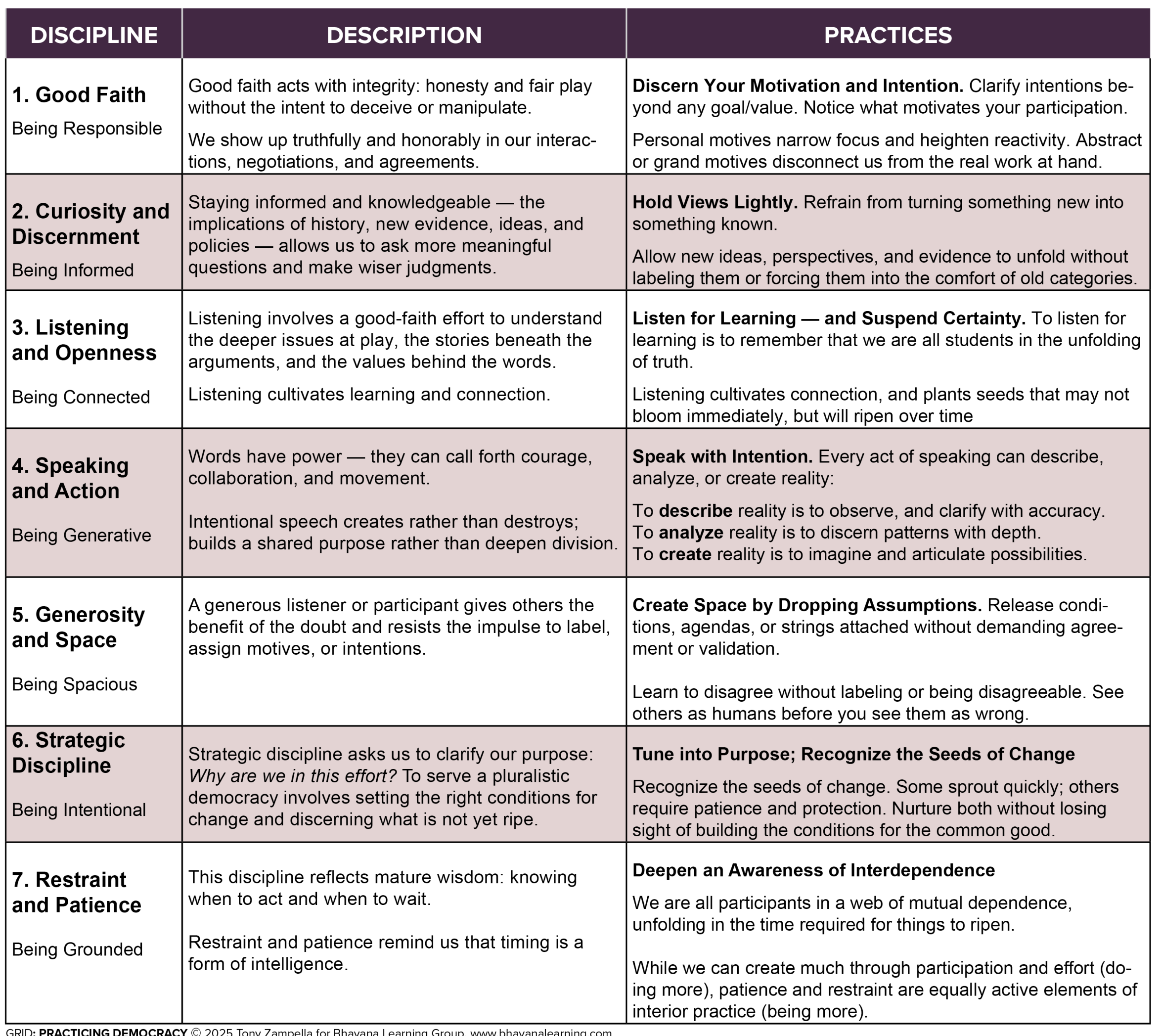
3. Listening and Openness (Being connected)
Listening is an act of respect — and discovery.
In the practice of democracy, listening involves a good-faith effort to understand the deeper issues at play, the stories beneath the arguments, and the values behind the words.
In this way, listening cultivates learning and connection. It keeps us engaged with the democratic process, even when change feels slow or uncertain. As in coaching, true listening transforms the listener as much as the speaker.
Openness complements listening. It is the posture of ontological humility — the recognition that our interpretations are always partial, that our understandings, identities, and convictions are continuously evolving.
Openness keeps dialogue alive and learning possible, even amid disagreement. Without it, we collapse into certainty, suffocating conversations — the very life of democracy.
PRACTICE: Listen for Learning — and Suspend Certainty
In recent years, a popular phrase has emerged: “I am not here to educate you.” I understand the emotional labor that underlies that statement. That is why discipline #1 — good faith — is essential. We can only engage in genuine learning with good-faith partners.
Nonetheless, if you are driving change, you are a teacher in a real sense. Full stop.
Parker Palmer writes, “We must learn to listen to each other, even — or especially —when we disagree. Democracy begins not in the halls of government, but in the habits of the heart.”
To listen for learning is to remember that we are all students in the unfolding of truth. When someone asks me about the LGBTQ community, I always learn as much as I share: how to meet people where they are, how to respond to different questions and perspectives, and how to use my own coming-out story to support another’s journey.
When guided by good faith and curiosity, listening for learning cultivates connection. It plants seeds that may not bloom immediately, but will ripen over time — as all ideas and understandings do.
4. Speaking and Action (Being generative)
Action is essential to democracy. Without it, participation erodes, and disappointment turns into resentment, resignation, or cynicism.
Speaking, in this sense, is action. Words have power — they can call forth courage, collaboration, and movement. Intentional speech aims to create rather than destroy, to build a shared purpose rather than deepen division.
When practiced with awareness, speaking becomes a creative force. Our words shape meaning, invite participation, and turn democratic ideals into living practices. The quality of our language determines the quality of our collective lives.
PRACTICE: Speak with Intention
Use words with care and consciousness. Refrain from labeling; instead, inquire into the story beneath the position — the humanity beneath the policy. Speak with intention, integrity, and imagination to advance the conversation.
Every act of speaking can describe, analyze, or create reality:
- To describe reality is to observe, name, and clarify what is — grounding speech in evidence and accuracy.
- To analyze reality is to discern patterns, connections, and implications — cultivating understanding and depth.
- To create reality is to imagine and articulate what could be — expanding possibilities and shared vision.
Each mode has value, and all are debatable. Invite dialogue, discourse, and even disagreement. Speak to open a conversation, not to close it.
Candidly, I think we lost the art of persuasion. We have lost the art of changemaking over the last couple of years.
—U.S. Congressmember Sarah McBride
5. Generosity and Space (Being spacious)
Generosity deepens all previous disciplines. A generous listener or participant gives others the benefit of the doubt and resists the impulse to label, assign motives, or intentions.
Generosity also involves creating space — for others to sort themselves out, to reflect, and to learn. This spaciousness becomes a form of grace — the willingness to learn with others rather than teach at them.
In a democratic context, generosity centers our common humanity, as expressed by Congressmember Sarah McBride, the only openly trans member of Congress:
I realized … that changing hearts and minds isn’t always just about the intellectual argument. It’s also about allowing all of us to be seen in our full humanity — in our hopes and our dreams and our fears, in our grace and our goodness as people. And it’s through that grace that we give people the space to grow. Once that happens, once someone connects policy with a person’s humanity, it fundamentally changes the way they think.
Generosity, then, is not sentimentality. It is courage and strength to make room for another’s unfolding.
PRACTICE: Create Space by Dropping Assumptions
Generosity arises from spaciousness, releasing conditions, agendas, or strings attached to what we offer. It is both giving and receiving freely, without demanding agreement or validation.
Learn to disagree without labeling or being disagreeable. See others as humans before you see them as wrong. This nurtures the ground for compassion.
No one will ever agree with you completely. Insisting on total agreement may win the argument but lose the relationship or possibility. Instead, treat today’s disagreement as the beginning of a longer conversation.
Ask yourself: How can I leave the relationship intact so we can return to the table another day?
Generosity creates the space for democracy to breathe.
6. Strategic Discipline (Being intentional)
Democratic action requires focus and intentionality. Strategic discipline asks us to clarify our purpose: Why are we in this effort?
A pluralistic democracy, by definition, has many voices and interests. This discipline involves setting the right conditions for change and discerning what is not yet ripe.
Strategic discipline balances vision with reason and persistence with adaptability. In politics, as in leadership, wisdom lies in distinguishing between resistance (which can sharpen our approach) and opposition (which sometimes must be met directly).
Strategic discipline calls for both conviction and calibration — the ability to stay grounded in purpose while remaining flexible in method.
Again, Congressmember Sarah McBride addresses this wisdom in a video podcast with The New York Times’ Ezra Klein (here and here):
Candidly, I think we lost the art of persuasion. We have lost the art of changemaking over the last couple of years. The Civil Rights Movement was disciplined, it was strategic — it picked its battles, it compromised to move the ball forward.
Right now, that kind of compromise would be deemed unprincipled or weak, and throwing everyone under the bus, and that is so counterproductive. … [I]t completely betrays the lessons of every single social movement in our country’s history.
You can’t foster social change if you don’t have a conversation — you can’t change people if you exclude them.
Strategic discipline, then, is not manipulation — it is moral patience in motion. It knows when to press forward and when to let time and conversation do the work of ripening.
PRACTICE: Tune into Purpose; Recognize the Seeds of Change
Begin by tuning into your intention. What is this moment asking of me? What change is truly ready — and what still needs cultivation?
Strategic discipline lives at the intersection of the moral, the virtuous, and the practical, where our ideals meet the realities of governance and human complexity.
At this intersection, leaders must balance intentions with consequences and conviction with humility. The practice is to move toward what is good for the whole, even when progress comes in partial or imperfect steps.
Recognize the seeds of change as they emerge. Some sprout quickly; others require patience and protection. The discipline is to nurture both without losing sight of the larger purpose: building the conditions for progress and the common good.
7. Restraint and Patience (Being grounded)
The final discipline reflects mature wisdom: knowing when to act and when to wait.
Restraint and patience remind us that timing is a form of intelligence.
Recognizing and calibrating timing in a pluralistic democracy is no small task. Democratic change, like all living systems, unfolds in seasons — and forcing ripeness too soon can spoil the harvest. Restraint grounds discernment; patience sustains the long arc of transformation.
Together, they teach us that change does not come from effort alone, but from the right relationship with time.
PRACTICE: Deepen an Awareness of Interdependence
Zen master, poet, and peacebuilder Thich Nhat Hanh taught the principle of interbeing — that “the truth is everything contains everything else. We cannot just be; we can only inter-be.”
Nothing exists in isolation. All things comprise non-thing elements:
- A flower consists of non-flower elements — sunlight, soil, rain, minerals, the gardener’s care.
- Paper has non-paper elements — trees, sunshine, clouds, rain, and human labor.
- Your body is made of non-body elements — air, water, food, ancestors, earth.
- Even peace is woven of non-peace elements — understanding, tension, compassion, justice, restraint, and patience.
- Similarly, any “subject” of change depends on “non-subject” conditions that cannot be known, forced, or controlled. We can never know which conversation, and with whom, will prove essential for transformation. We can only know that we are all participants in a web of mutual dependence, unfolding in the time required for things to ripen.
While we can create much through participation and effort (doing more), patience and restraint are equally active elements of interior practice (being more). Together, they cultivate the conditions for the natural ripening of what we seek to bring forth.
To practice this spirit of liberalism is to remain thoughtful, listen deeply, and discover new meaning through the creative tension of disagreement.
Closing Reflection
Democracy, like coaching, is not about control but cultivation — tending the conditions for growth, learning, and shared purpose. Each of these seven disciplines reflects not only a civic capacity, but also practices that develop modes of being, giving democracy its living character. Engage courageously with difference, stay in dialogue when retreat feels easier, and act with conviction and humility.
Democracy lives through us. It asks us to embody patience, curiosity, and good faith and to listen, speak, and act as participants in a larger unfolding.
As Parker Palmer writes in Healing the Heart of Democracy (2011), “the human heart is the first home of democracy. It is where we embrace our questions, hold the tensions of our differences, and reach beyond ourselves to create the common good.”
At its heart, democracy is a practice of collective awakening — an ever-renewing commitment to becoming together what none of us can become alone.
Reading Time: 13.5 min. Digest Time: 18 min.
1- VIEW OUR RELATED RESOURCES & BLOGS:
Practice #1 Good Faith (Being responsible)
Practice #2 Curiosity and Discernment (Being informed)
Practice #3 Listening and Openness (Being connected)
- Deep Listening as Context and Practice
- Deep Listening Series: Deep Listening Mindsets, Part 1: Commitment to Listening
Practice #4 Speaking and Action (Being generative)
- Generative Communication: The Power to Connect and Create, part
- Intentional Speaking: Five Impediments to Co-creation
Practice #5 Generosity and Space (Being spacious)
Practice #6 Strategic Discipline (Being intentional)
Practice #7 Restraint and Patience (Being grounded)
0 Comments