



In everyday language, care is often treated as an emotion. We speak of caring as a feeling we have toward people, causes, or outcomes. Sometimes it is framed morally—as kindness or concern—and other times therapeutically, as empathy or emotional availability.
In Part 1 of this series, I argued that something essential is lost when care is reduced to sentiment. I also distinguished between two different ways of understanding care: psychology and ontology. Psychology interprets experience—explaining feelings, motivations, and patterns of behavior. Ontology, by contrast, discloses the structures that shape how experience is possible in the first place.
From this ontological view, care is not a trait, preference, or emotional disposition. It is the condition that allows anything to appear meaningful at all.
Drawing from phenomenological inquiry and Martin Heidegger’s understanding of sorge (care), I treated care not as something we possess, but as an ontological structure: the way human beings are already involved in the world, oriented by what matters, prior to reflection, choice, or evaluation.
Once care is recognized as a structural dimension of being, the inquiry necessarily shifts. The question is no longer What do I feel? or What should I value? but rather: How is care already being lived, constrained, or misaligned? And what practices allow care to regain coherence and direction?
This essay takes up that question.
Part 2 begins with awareness—recognizing how care reveals itself through lived patterns of attention and action. It then offers points of reflection and practice for working with being as it is already lived, rather than as we imagine it should be.
What follows introduces two dimensions of awareness.
PART I: Awareness—How Care Reveals Itself
Care does not stay automatically aligned with the possibilities that organize a life. As life conditions change and inherited (habitual) concerns lose their organizing power, care requires ongoing recognition and recalibration.
What follows are two dimensions of awareness that help reveal how care is already operating, where it is blocked or fragmented, and how it might be given a viable future.
DIMENSION 1: Recognizing Being-in-Action
Care is most visible when we stop asking what someone says they want or value and begin noticing the patterns in how they already act—including where they spend time, energy, attention, and resources.
Where is effort spent repeatedly? What receives attention, even when it is exhausting? What commitments are reliably honored, even at a personal cost? Just as importantly, where are there competing commitments or missing commitments, where action contradicts stated intentions, or something vital never makes it into action at all?
Being-in-action discloses care precisely through these tensions. Compulsion, overextension, and contradiction are not noise; they are data. They often reveal loyalties or competing commitments not yet recognized or named.
For example, a client spoke at length about wanting more balance and rest, yet every week, she arrived depleted from overcommitting at work. Rather than correcting the contradiction, the inquiry turned toward what her overextension was protecting. Eventually, it became clear that she was implicitly committed to being indispensable, to being relied upon as a condition of belonging and worth.
Exhaustion, in this light, was not simply misalignment. It was a predictable outcome of a deeper, unnamed commitment: “If I am not needed, I may not belong.” Until that commitment surfaced, no boundary strategy could succeed. What looked like misalignment at the behavioral level was fidelity to a deeper concern.
This same concern becomes central when we later explore reframing and possibility.
Click to enlarge
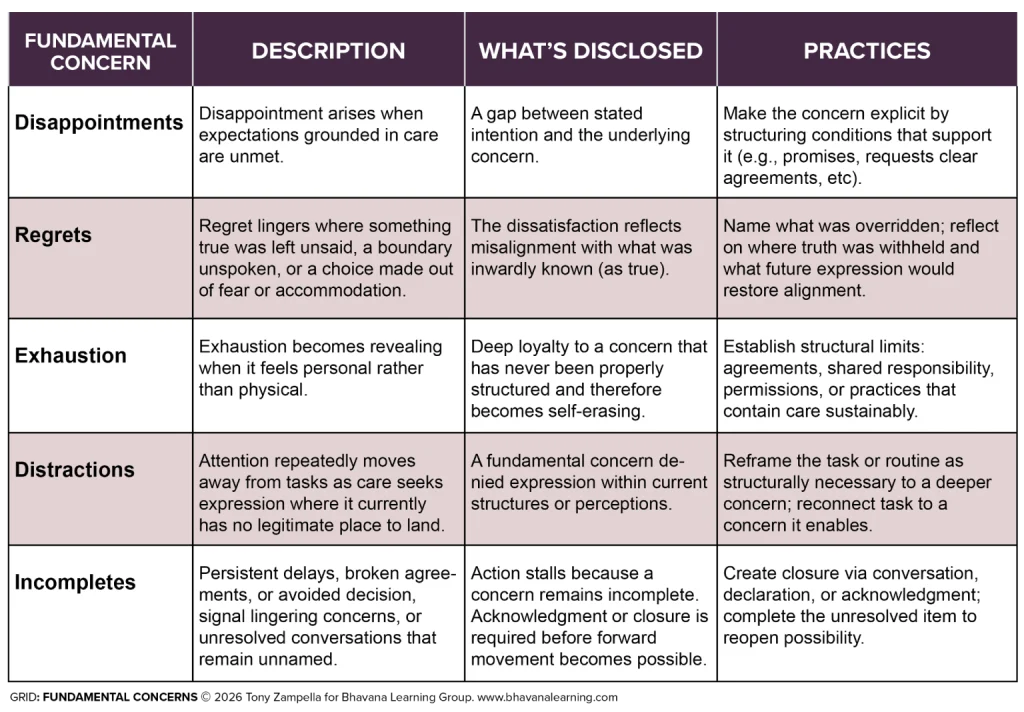
DIMENSION 2: Discerning Fundamental Concerns
Not all concerns are equal. Some are situational, circumstantial, or inherited (habitual) from roles and expectations. Others are fundamental: quietly organizing identity, sacrifice, and meaning over time.
Discerning fundamental concerns is less about asking what matters to me and more about attending to recurring patterns in lived experience. These patterns are often ambiguous. They may reveal where care is expressed, where it remains unexpressed or thwarted, or whether it appears only indirectly.
The task is not to interpret too quickly but to stay with these patterns long enough to see what they protect or seek. Some useful points of reflection might include the following:
Disappointment
Consider a familiar experience: You arrive at a team meeting prepared to work meaningfully on a team project. Instead, much time is spent explaining the context, repeating information, or scheduling the next meeting.
The disappointment here is not simply inefficiency. When explored, it reveals care for excellence through preparation and mutual responsibility. What is thwarted is not convenience but the possibility of meaningful collaboration.
Acting on this care might involve making an explicit request—for colleagues to prepare in advance or surface concerns beforehand—not as a complaint, but as a way of structuring conditions where the concern for quality can actually be expressed.
Regret
Regret often arises when something true is left unsaid, a boundary unspoken, or a self-betraying choice made out of fear, compliance, or impulsive accommodation. What lingers is not only the outcome but also the sense of having lived out of alignment with one’s fundamental concerns.
For example, rushing a project in the name of speed or scaling may override a deeper concern for quality, beauty, or thoughtfulness. The dissatisfaction that follows is not merely about performance; it reflects a betrayal of care.
Hence, regret marks where fear, habit, or accommodation overrode the care for truth and where being-in-action fell short of what was inwardly known.
Compulsion, overextension, and contradiction are not noise; they are data. They often reveal loyalties or competing commitments not yet recognized or named.
Exhaustion
Exhaustion becomes revealing when it feels personal rather than merely physical. It often signals devotion to a concern that lacks structural limits: clear agreements, shared responsibility, explicit permissions, or practices that ground care so it does not become self-erasing.
In this sense, exhaustion may reflect deep loyalty to a concern that has never been properly structured (thus remains ungrounded). Therefore, it consumes the person who carries it.
Distraction
Distraction is often misunderstood as a lack of focus. More precisely, it signals that attention is moving toward what matters, even when indirectly or inappropriately.
Persistent distraction may indicate a fundamental concern that has no legitimate place within the structure of one’s current commitments, attention, and priorities. Care continues to seek expression, but without a viable path through which it can be organized. In some cases, this calls for reframing what appears mundane as structurally necessary to a deeper concern.
For example, reconciling finances may feel tedious, yet the resulting clarity can provide the conditions that enable future experimentation, creativity, or a new direction. The question shifts from Why can’t I focus? to How might this task support a fundamental concern?
In each case, the inquiry is not evaluative but revealing. These patterns often disclose fundamental concerns more reliably than articulated values.
Incompletion
Persistent delays are often interpreted as a lack of discipline, motivation, or follow-through. More precisely, they can signal that something remains structurally unresolved: a broken agreement, an avoided decision, or a conversation connected to a lingering concern.
When concerns remain incomplete, they can narrow the horizon of future action. Progress slows not because care is absent, but because moving forward would require facing or acknowledging something that remains unfinished.
For example, postponing the start or completion of a project may not reflect laziness, but the pull of attention toward an unresolved concern. One may feel stuck because something relevant has not yet been acknowledged or brought to closure.
Completion, in this sense, requires a form of closure—a conversation, a declaration of what remains unresolved, or even a simple acknowledgment of its presence—so action can proceed without resistance.
As with distraction, the inquiry is not corrective but revealing. The question shifts from Why can’t I finish this? to What concern remains unresolved? When left unattended, such incompletions can surface elsewhere—as regret, exhaustion, guilt, or anxiety—carrying forward the weight of what remains unresolved. (See practice Completing your day.)

PART II: Practices—Staying Aligned with What Matters
Coaching can support care not through techniques or prescriptions, but through practices that help care become visible again, especially where it has become obscured, conflicted, or constrained.
What follows are three practices that help surface how care is already operating, where it is blocked or fragmented, and how it might be given a viable future.
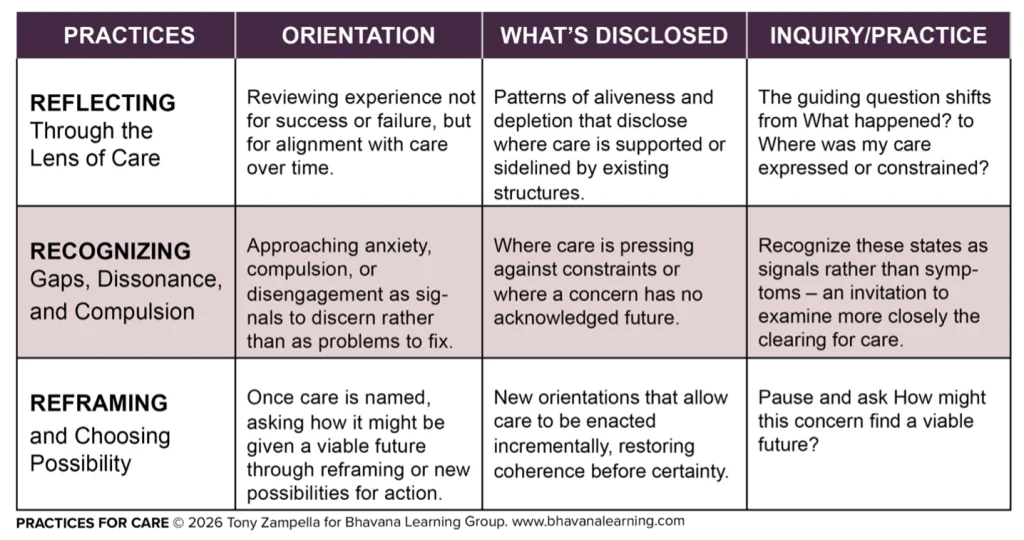
PRACTICE 1: Reflecting Through the Lens of Care
Reflection becomes more revealing when events are reviewed not for success or failure, but for alignment with care.
At the end of a day or week, the question shifts from What happened? to Where was my care expressed—and where was it constrained or sidelined?
For example, a teacher adopted a simple reflective practice, asking where she felt most alive and most depleted each day. Over time, a pattern emerged: Aliveness clustered around mentoring students one-on-one, while depletion consistently accompanied administrative tasks.
The issue wasn’t workload or competence. It was misalignment. Her care for direct human development had little structural support to balance how her time was organized.
Click to enlarge
PRACTICE 2: Recognizing Gaps, Dissonance, and Compulsion
When care cannot find expression, it often appears indirectly as anxiety, compulsive activity, disengagement, or quiet despair.
Rather than resisting these states or treating them as problems to fix, they can be approached descriptively as data. They reveal where care presses against constraints or where a concern has no declared future.
For example, a client described persistent anxiety despite outward professional success. Instead of managing symptoms, the inquiry turned toward what the anxiety was guarding. It became clear that his care for creative expression had been dismissed or ignored within the structure of his life. The anxiety wasn’t irrational. It insisted on acknowledging its existence.
This same concern becomes pivotal in the next practice.
PRACTICE 3: Reframing and Choosing Possibilities
Once care is named, the work becomes practical. How might this concern find a viable future?
Sometimes, this involves reframing current circumstances through the lens of care—seeing existing commitments as provisional supports rather than permanent failures. At other times, it requires choosing new possibilities that enact care, even imperfectly or incrementally.
For example, the client whose anxiety masked a concern for creative expression did not immediately change jobs. Instead, he reframed his current role as economic scaffolding while intentionally creating a protected space for creative work. His anxiety softened as care gained a future. What changed first was not the job, role, or content but the context and orientation.
Similarly, a parent experiencing despair after a career plateau recognized that her unexpressed care was a concern for presence and attunement at work. Reframing her professional role as a provisional state allowed her concern to be honored elsewhere while preserving future professional possibility, without demanding immediate resolution. New professional possibilities emerged later, but coherence returned first.
It is important to acknowledge that humans are not primarily decision-makers or problem-solvers, but concerned beings already involved in becoming.
Care as the Quiet Architecture of Being
Care is neither something we cultivate as a technique nor something we measure as a trait. It is the background structure through which life takes shape.
When care is ignored or treated as secondary, life does not become neutral or efficient; it becomes disoriented. Attention fragments, effort becomes compulsive, and action loses its grounding in meaning. What follows is not freedom, but drift: productivity without fulfillment, choice without coherence, and responsibility experienced as burden rather than expression.
To dismiss care as sentiment or preference is to mistake the surface of life for its source, and to lose contact with what quietly organizes direction, sacrifice, and belonging.
Care stays alive not because we protect it emotionally but because we remain attentive to how it seeks expression in changing conditions. When care is recognized, aligned, and given a future, life regains coherence—not certainty, but direction.
To work with care is to work beneath behavior and belief at the level where meaning already forms. It is important to acknowledge that humans are not primarily decision makers or problem solvers, but concerned beings, already involved in becoming.
Care, in this sense, is not emotional softness. It is existential gravity. Learning to recognize it may be one of the most humane forms of wisdom we can practice.
Reading Time: 9 min. Digest Time: 12 min.
0 Comments