



The early stages of building a company are intense and all-consuming for founders. They make decisions quickly, manage details obsessively, and wear multiple hats to keep the wheels turning. This Founder Mode is a dynamic leadership posture marked by deep personal investment, high control, and relentless alignment between vision and execution.
Founder Mode is not just working hard; it’s a way of leading that feels natural—even necessary—when resources are limited, urgency is high, and there’s an existential risk. It’s being all in.
As companies grow, the question isn’t whether Founder Mode is helpful—it’s whether it can evolve. Is it destined to become autocratic and controlling, or can it transform into something more nuanced, like Radical Accountability?
1. What Is Founder Mode?
Founder Mode is an intense, vision-driven leadership state in which the founder remains, operating with intense personal investment, directly shaping outcomes, culture, and execution. The leader/founder is unwaveringly committed to their vision—often assuming multiple roles to safeguard the venture’s survival, growth, and alignment with its core mission.
Observe its diverse expressions in the leadership styles of current tech figures:
- Elon Musk (X/Twitter and Tesla): Known for his autocratic grip and bold vision, Musk’s leadership has driven innovation and sparked controversy over trust, culture, and long-term cohesion.
- Travis Kalanick (Uber): His hyper-controlling style brought early success and disruption but ultimately fostered a toxic environment that necessitated his removal.
- Reed Hastings (Netflix): Hastings exemplifies a more evolved Founder Mode—balancing deep involvement with radical accountability, fostering a high-performance culture rooted in trust and autonomy.
Founder Mode is not just working hard; it’s a way of leading that feels natural—even necessary—when resources are limited, urgency is high, and there’s an existential risk.
Founder Mode takes many forms, each shaped by the founder’s mindset, the organization’s maturity, and the surrounding culture. Generally, it is defined by the following:
- Vision-Driven Control: The founder protects the original mission’s clarity and consistency.
- Operational Immersion: Hands-on involvement in details, decisions, and team dynamics.
- Urgency and Risk: Leadership is marked by rapid decision making in high-stakes environments.
- Reluctance to Let Go: Delegation feels risky; founders may struggle to trust others with core functions.
While this style may be essential early, it can become a liability if maintained beyond the start-up phase—unless it evolves into a more generative form that may transcend its male-dominated bias (see below).
Timely Reframing of Founder Mode
In a powerful reflection written in September 2024, Paul Graham captured the timely evolution of this concept. Writing in response to a talk by Airbnb co-founder Brian Chesky, Graham recounted how Chesky had followed conventional advice—”hire good people and give them space”—only to watch it nearly ruin the company. Instead, Chesky turned to a more involved, founder-led model inspired by Steve Jobs. Airbnb’s turnaround led to some of Silicon Valley’s best financial results.
This insight reverberated across the startup community. Many founders listening to Chesky admitted to similar experiences: Following professional management advice had backfired. Graham concluded there are two modes of leadership:
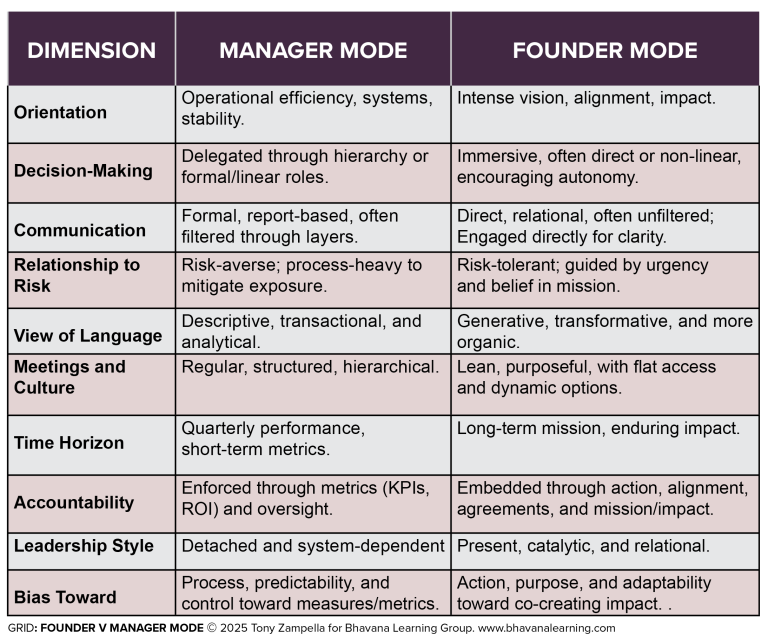
- Manager Mode: Based on detachment, hierarchy, rigorous measurements (KPIs, ROI, etc.), and clear delegation chains.
- Founder Mode: Defined by immersion, non-linear engagement, and leadership through vision, commitment, and cultural coherence.
Graham argued that conventional wisdom is often built for professional managers, not founders. This explains why founders can feel gaslit by advisors and executives, urging them to adopt systems that feel fundamentally misaligned. He predicted that as we understand Founder Mode more clearly, it will be seen not as eccentricity but as a legitimate, often more effective leadership model.
2. Critiques of Founder Mode
Interestingly, Founder Mode has become a Rorschach test: People project their hopes, desires, or fears on it. Here, I discovered ideas to critique and consider for an organization’s evolution.
This model is characterized by an all-in, high-stakes approach that blends vision, operational immersion, and rapid decision making by start-up founders who’ve been mostly male.
While this approach seems suited for male leaders and not welcoming to female leaders, (discussed later), some form of Founder Mode is essential for an organization’s early stages and can become a liability if sustained.
Founder Mode as Autocratic: Control at a Cost
When Founder Mode calcifies, it often drifts into autocracy. Shaped by a broader cultural fascination with strong leadership—especially in politically volatile times—this version of Founder Mode emphasizes control at the expense of collaboration. Decisions are centralized. Dissent is avoided. Trust becomes brittle.
To be fair, this can be useful in an organization’s very early stages. When time, talent, and treasure are scarce, a clear, uncompromising direction may keep the company alive. However, when this approach advances into later stages, it can damage morale, prevent leadership development, and erode team cohesion.
When Founder Mode Becomes a Political Ideology
While Founder Mode can be a generative force, it has also become politicized; its narrative co-opted to support autocratic, exclusionary behaviors. In her New York Times guest essay, Kim Scott, author of “Radical Candor,” warns of a darker turn: Founder Mode, she argues, is increasingly used to justify unilateral decision making and anti-democratic ideals in Silicon Valley.
Scott identifies a “neo-authoritarian” trend in which Founder Mode drifts from creative intensity to unchecked power. Drawing parallels to the early anti-authoritarian spirit of Silicon Valley—where founders rebelled against domineering bosses—she notes a concerning reversal.
Elon Musk and Sam Bankman-Fried are cautionary examples. Musk’s transformation of Twitter (now X) into a personal mouthpiece, complete with massive layoffs and politically charged disinformation, reflects a founder absolutism that devalues dissent and collaboration. Musk’s autocratic version has been so disruptive that his biographer termed it “Demon Mode.” Similarly, Bankman-Fried’s refusal to accept oversight at FTX—praised at one point as charismatic leadership—led to financial collapse and criminal conviction.
Scott’s broader critique is that unchecked Founder Mode undermines corporate governance and democratic norms. It valorizes dominance over dialogue and control over creativity. Her call to action: Resist the seduction of one-man rule disguised as entrepreneurial brilliance. Instead, she argues that great leadership is about self-regulation, trust-building, and cultivating collaboration, not coercion.
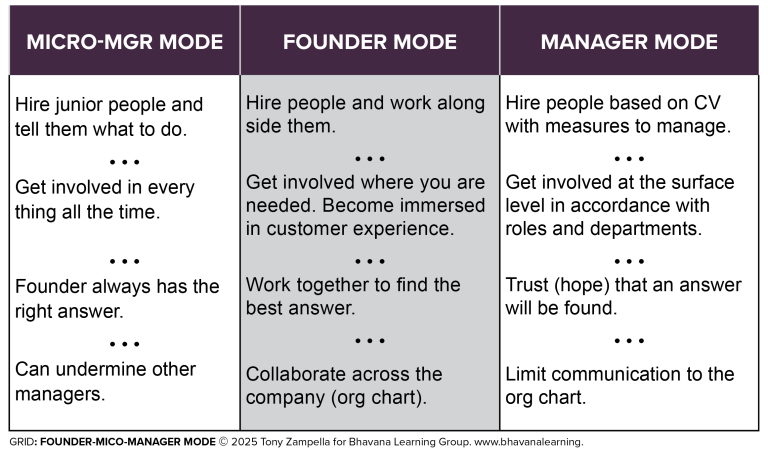
Founder Mode as Controlling: The Micromanager’s Trap
Another common distortion is the controlling founder who can’t—or won’t—let go. This version is less about vision and more about obsessing about the how of everything. Rather than targeting what and why, these founders fixate on method and process. Team creativity withers. Motivation plummets. Complexity increases.
What starts as commitment quickly becomes about compliance or constraints.
While this style may be used early, it can become a liability if maintained beyond the start-up phase, unless it evolves into a more generative form of leadership.
In this version of Founder Mode, leaders draw from their intuitive, entrepreneurial roots to unleash creativity.
3. Creative Evolution
In its most generative form, Founder Mode doesn’t vanish—it evolves. Can it evolve beyond Founder Syndrome or Heroic Leadership—models that enable organizations to depend on one-man rule?
Many Founder Mode elements can evolve as organizations scale to embody a mission and include a new level of co-creation.
Founder Mode as Radical Accountability
If it evolves, Founder Mode does so via radical accountability. Because Founder Mode emanates from Silicon Valley, it’s worth noting how off-brand this can be. So many Founders flout accountability for anything beyond their bottom line.
In this version of Founder Mode, leaders draw from their intuitive, entrepreneurial roots to unleash creativity. Here, Founder Mode evolves from an individual’s “personality” to attributes — even principles — that embody qualities in founders who immerse themselves in the customers’ experiences. This leadership style is closer to art than the analytical rigor that often defines Manager Mode, sometimes stifling it.
The key lies in staying deeply connected to the mission, empowering others to take ownership, and embodying accountability not merely as a tactic for driving results but as a core principle of leadership.
In this Radical Accountability mode:
- Founders remain immersed in the business, obsessed with projects and customer experiences—not to control, but to understand, support, and challenge them.
- Conversations shift from optimizing methods—how things are done—to clarifying conditions of satisfaction—what is required—and impact (why it matters).
- Founders reiterate purpose (why) in everyday conversations and clarify direction (what) in goals and actions. They let go of prescribing how to complete tasks, creating space for creativity.
- Teams are trusted with autonomy and accountable for outcomes reflecting shared meaning, principles, and commitments.
Here, nothing is too small to notice, and no one too junior to engage. Founders operate with creative precision, understanding that small moments can lead to big pivots. They encourage a culture of feedback, clarity, and shared ownership, where alignment comes not from control but shared meaning.
The Power of Action
Growing Founder Mode into a generative mindset requires shifting our relationship to language from transactional to transformative. That means moving beyond just talking about situations to using language to create them.
The bridge here rests on the capacity to coordinate action.
Founder Mode leaders don’t just talk; they generate momentum by moving ideas forward through clear promises, requests, and negotiations, all grounded in shared understanding and conditions of satisfaction. Language becomes their tool for initiating, executing, and following through on meaningful commitments.
Impact over Optics
Founder leaders immerse themselves in the experiences of their customers, products, and services. They embrace details of what must be accomplished (the what) and why it matters or impacts (the why), while releasing how: methods and processes that can bog down momentum and clog creativity.
Rather than managing appearances or minimizing risk, they prioritize real impact. This includes being willing to risk optics in favor of action and clarity.
This version of Founder Mode prioritizes impact and results rather than protecting image or promoting optics. Through radical accountability, they cultivate a culture in which trust is built on follow-through, autonomy, and meaningful outcomes. The result: Teams move from passive compliance to active engagement, and commitments don’t just deliver results—they reshape the future.
Space and Direction
Where professional managers often rely on delegation and distance, Founder Mode leaders coordinate action for impact. Managers may give people space, but they often assume shared meaning, priorities, and understanding. Founders know that clarity must be co-created.
Unlike Manager mode, which gives employees space or direction, Founder Mode leaders close this gap — providing space and direction — by being available as a resource and willing to communicate clearly and directly. They do not micromanage, but check in to offer feedback, insight, support, and even challenges when needed. They ensure that tasks get done and their execution contributes to the broader mission and impact.
Common Founder Mode cultural norms often include the following:
- Avoid unnecessary big meetings
- Limit recurring meetings unless essential
- Leave meetings when no longer contributing
- Ditch jargon and speak clearly
- Communicate directly, regardless of hierarchy
Founder Mode leaders take coordination seriously. They use it to align priorities, catalyze innovation, and build deep trust in collaborating.
Founder Mode evolves from an individual’s “personality” to attributes — even principles — that embody qualities in founders who immerse themselves in the customers’ experiences.
From “Power Over” to “Power To”
Founder Mode’s intensity and care for detail holds the seed of a deeper transformation when it shifts from Power Over—the need to control—to Power To—the capacity to clarify and create.
Power Over
Often associated with repression, coercion, and hierarchy, this is the most familiar form of power. Power Over is a zero-sum, win-lose dynamic: Some have power by taking it from others. This form relies on control, surveillance, or dominance for sustainability.
We see it in politics, management, and systems where a few hoard access to resources or decisions at the expense of many. While it can create immediate results, it demands continuous effort to uphold and can collapse when coercive conditions fade.
Power To
In contrast, Power To opens the field for generative leadership. It is the ability to co-create and to bring something into the world with others. This form of power emerges from purpose, clarity, and trust. As Charles Reich once wrote:
“Power means to me pretty much the same thing as freedom—skiing is power, sex appeal is power, the ability to make yourself heard by your congressman is power. … Anything that comes out of you and goes into the world is power.”
In this view, power is not domination but expression—the energy within individuals that moves others to act. It is inherently relational. The more one shares it, the more it grows.
Author Tracy Goss echoes this in The Last Word on Power, showing how people unknowingly cling to coping strategies that keep them powerless. She redefines power as realizing one’s words in the world—and measures it by two factors:
- The scope and depth of what you speak into being.
- The time and effort it takes to bring your words into reality.
Radical Accountability, then, is the practice of leading with Power To. It transforms Founder Mode from a force of will to a force of meaning—turning vision into shared momentum and authority into alignment via co-created action and impact.
Founder leaders immerse themselves in the experiences
of their customers, products, and services.
The Leadership Mandate Ahead
Paul Graham’s observation is both a warning and an invitation. As the startup ecosystem reconsiders the limits of traditional management theory, Founder Mode is no longer something to outgrow—it’s something to evolve. Done right—with great care, commitment, and creativity—it becomes a path toward radical accountability, not authoritarian control.
The challenge lies in discerning whether Founder Mode becomes a platform for power over or power to—a question that hinges on how leaders relate to language to co-create and connect with others. Will leaders default on coercion, hierarchy, and micromanaging to assert their vision? Or will they cultivate trust, coordinate action, and speak futures into being through integrity-filled commitments?
The answer begins with a shift in mindset from heroic leadership to generative leadership. From managing through fear to coordinating through clarity. From dominating others to co-creating with them to cultivate autonomy.
When Founder Mode integrates the power of language and accountability, it becomes a force for building resilient cultures, not just successful products. This is the new mandate: not simply to build something great but to build in a great way. Not just to lead with vision, but to co-create impact with responsibility, awareness, and autonomy.
This last point is vital. Can Founder Mode leaders move beyond heroic leadership based on personality –– and adopt deeper principles such as awareness, accountability, and autonomy — as part of their mandate to embody their vision and mission?
The future of leadership may not be found in abandoning Founder Mode, but in mastering its evolution.
Reading Time: 10 min. Digest Time: 13.5 min.
1- VIEW OUR RELATED RESOURCES & BLOGS:
0 Comments