



A client once told me they were exhausted because they “cared too much.”
They had tried caring less. They set boundaries, reduced commitments, and even stepped back from a role they loved. Nothing changed. The exhaustion returned, now accompanied by confusion and quiet self-doubt.
What shifted the conversation was not a discussion about balance or priorities but a different kind of listening. I stopped asking what they wanted and began noticing what they were protecting. Again and again, they stepped in when others hesitated. Again and again, they made themselves indispensable at the expense of their own coherence.
It wasn’t a failure of self-care. It was fidelity to something deeper and never named.
Care, in this sense, was not an emotion to acknowledge or dismiss. It was the structure through which their world already mattered (to be explored in part 2 of this blog).
Inquiry into Care as Structure
When care is unrecognized as a fundamental structure of our lives, it lives without clarity. Attention, effort, and sacrifice continue, but without direction. What often follows is confusion: working harder while feeling less oriented, making choices that don’t quite add up, or trying to “fix” oneself when something deeper feels lost.
In these moments, the issue is rarely that someone cares too much, but that care has no visible structure through which it can be recognized or lived.
In everyday language, care is often treated as an emotion. We speak of caring as a feeling we have toward people, causes, or outcomes. Sometimes, it is framed morally as kindness or concern. At other times, it is framed therapeutically, such as empathy or emotional availability.
But something essential is lost when care is reduced to sentiment.
This two-part series explores “care” as an ontological structure unfolding in two movements. In Part 1, care is explored as an ontological structure rather than a psychological trait. Part 2 shifts toward practice, offering points of reflection that help recognize being and work with it as it is lived.

Misunderstanding “Care”
Care is not merely how we feel. It is how we are already oriented. Before emotion arises, before decisions are made, and before values are articulated, humans are already involved in the world in a particular way. Things already matter. Certain possibilities already pull us forward; others barely register.
This mattering is care.
In this deeper sense, care is not something we add to life; it is the quiet architecture that makes life intelligible.
Drawing from Martin Heidegger’s understanding of sorge (care), as articulated in Being and Time (1927), we can understand care not as a psychological state but as a structure of being. It names the fundamental way human existence is already entangled with the world — what Heidegger calls Dasein (being-in-the-world) — a condition that precedes reflection, choice, or experience, and underlies them all (see video).
To be human is to be concerned—not anxiously, not sentimentally, but structurally. We are always already involved with what we are becoming, what we might lose, what we must preserve, and what is at stake.
What makes this inquiry challenging is that the word care already carries a familiar meaning. In everyday language, care is usually understood as a feeling, a moral quality, or a form of kindness. In what follows, care is used in a more fundamental sense: beyond something we have, to something that quietly structures how a life takes shape.
Psychology and Ontology: Two Different Lenses
Much of our common understanding of care comes from psychology. Psychology tends to interpret experience as an expression of personality, history, motivation, or internal states. In doing so, it helps explain who a person is and why they behave as they do.
Ontology, by contrast, asks a different kind of question. Rather than interpreting experience, it examines the structural conditions of being: the patterns of integrity, incoherence, commitment, possibility, or constriction that shape how a human life is already organized in the world.
Psychology interprets experience, while ontology discloses the structures that shape it.
From this perspective, care is not a trait, preference, or emotional disposition. It is the condition that allows anything to appear meaningful in the first place. Phenomenological inquiry (rigorous examination of lived experiences) makes these structures visible directly, without reducing them to personality traits, coping strategies, or explanatory narratives.
This distinction matters. Without it, care is easily mistaken for sentiment or motivation, and the deeper structures organizing attention, effort, sacrifice, and confusion remain unseen.
Care functions like an invisible field that organizes relevance. Certain possibilities (as concerns) stand out as meaningful; others barely register — not as fate, but as the way the world already shows up as meaningful to us.
The distinction that follows is not semantic hair-splitting. It marks the difference between care understood as sentiment or psychological trait, and care as the underlying architecture through which meaning, attention, and possibility arise at all.
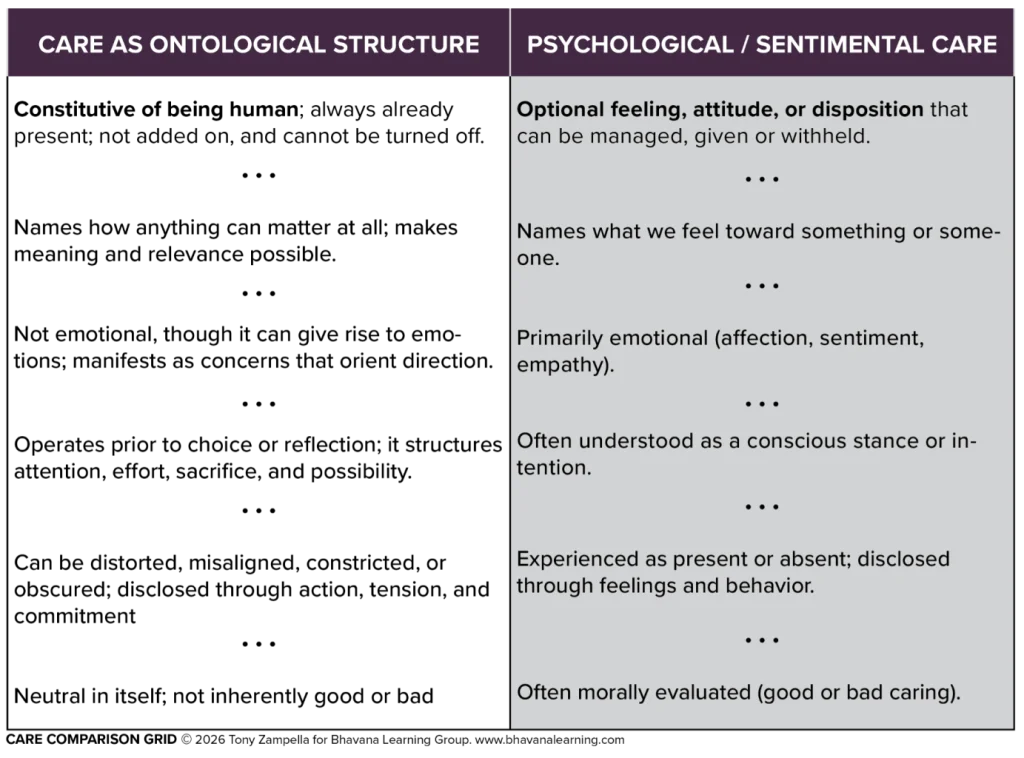
Read this distinction less as a definition to agree with and more as a lens: one that helps explain why effort, sacrifice, and confusion persist even when emotions, values, or intentions seem clear.
Care as an Ontological Structure
As a structure, care is what allows anything to show up as meaningful, as mattering at all. In this sense, care is not psychological or emotional, but ontological.
Ontology is the study of being: how existence is structured and how anything comes to appear as something rather than nothing. To say that care is ontological is to say that it belongs to the basic structure of human being — the way we are already entangled, involved, and invested in the world before reflection, choice, or evaluation.
Seen this way, care does not oppose reason or clarity; it is what makes them possible in the first place. Without care, nothing stands out as relevant. Without relevance, there is no meaningful choice. And without choice, no action feels like mine.
Care does not merely accompany our actions; it organizes the horizon of possibility within which actions appear at all. Care shapes:
- What draws our attention, and what fades into the background.
- What feels urgent versus optional.
- What risks feel worth taking.
- What losses feel unbearable rather than disappointing.
We often imagine that we choose our concerns freely. But, more accurately, our concerns disclose the world to us in particular ways. We do not begin with neutrality. We begin with involvement. This is why two people can face the same situation and see different realities. They orient their care differently. They structure their worlds differently.
Because care is structural, it rarely announces itself directly. Asking someone, “What do you care about?” often produces rehearsed answers, inherited values, or socially acceptable language.
Care shows itself less in declared values and more in lived patterns. It is recognizable as hesitation, intensity, grief, loyalty, and resistance.
Recognizing care requires patience and a willingness to listen to the structures beneath content.
Anxiety need not be framed as a problem to eliminate.
Often, it arises precisely when care is alive but uncertain of its direction.
When Care Becomes Obscured
When care is clear and aligned, life feels oriented, even when it is difficult. There may be effort, risk, or sacrifice, but there is also a sense of direction. Things make sense enough to flow. Mattering moves life.
When care becomes obscured, it does not disappear. It constricts. The range of what feels possible narrows. Action is driven less by choice than by the pressure to preserve what still matters. As a result, a different texture of experience emerges. This can show up as:
- Persistent inner conflict: Wanting to change jobs while feeling unable to leave, caught between necessity and a felt absence of possibility.
- Compulsive activity without fulfillment: Staying constantly busy with emails, tasks, and fixing problems without a corresponding sense of meaning or satisfaction.
- Cynicism or disengagement: Withdrawing effort or care, not because nothing matters, but because what matters no longer seems viable.
- Anxiety or a diffuse sense of meaninglessness: Feeling restless or unsettled without a clear cause, as if standing at the edge of something that has not yet taken shape.
Rather than viewing these states as pathological, they can be understood as signals. They point to a deeper condition: what most fundamentally matters no longer has a viable path of expression or lacks the structures — such as roles, agreements, practices, or permissions — through which care is enacted and sustained.
Seen this way, despair is not the absence of care. It is care without a viable future.
Similarly, anxiety need not be framed as a problem to eliminate. Often, it arises precisely when care is alive but uncertain of its direction; when inherited concerns no longer organize meaning, yet new ones have not fully emerged.
Listening for Care
For coaches, teachers, or service providers, care invites another way of listening. The task is not to upgrade skills, instill values, prescribe purpose, or optimize motivation. It is to recognize and give language to what already organizes a person’s world.
Rather than asking whether an action is reasonable, effective, or appropriate, the inquiry turns toward meaning: What must matter, such that this action appears as possible, or even necessary, to this person?
This question suspends judgment long enough to understand how a person is already entangled in what they are doing.
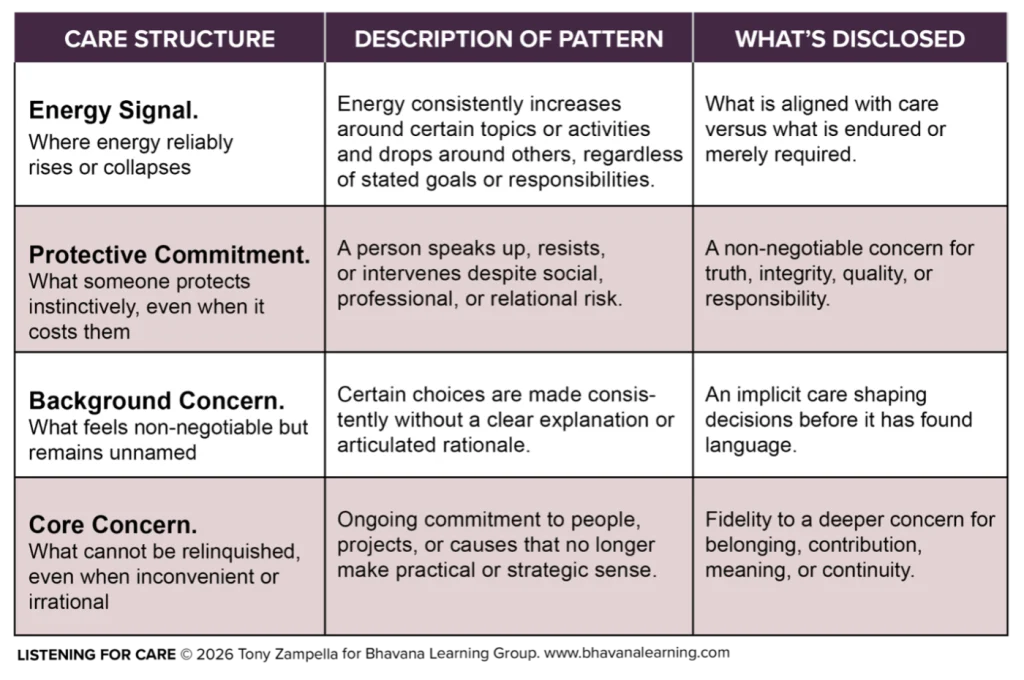
This kind of listening—described in Theory U by Otto Scharmer as “listening for being”—attends less to stated goals or isolated experiences and more to lived patterns. It listens for where care is already disclosing itself:
Energy Signals: Where energy reliably rises or collapses. A team member may appear disengaged in routine meetings yet become fully animated when discussing how a project might genuinely help real users.
Protective Commitments: What someone defends instinctively, even when it costs them. A colleague shares uncomfortable but critical information with their boss, knowing it could risk their reputation or job.
Background Concerns: What feels non-negotiable but remains unnamed. A parent repeatedly declines late meetings without fully explaining why, even when doing so slows career advancement.
Core Concerns: What cannot be relinquished, even when inconvenient or irrational. Someone continues to invest time in a struggling community initiative long after it stops making practical sense.
Before we affirm or question a person’s orientation to care, we must first witness it, surfacing it through inquiry to reveal its structural significance. When care is recognized and named, something often settles.
Experience gathers around a clearer sense of what matters. People feel “gotten,” not because answers are provided, but because orientation becomes palpable again. They feel seen, heard, and recognized as care. A person can once more sense where they are standing.
We are concernful beings, living physical and emotional lives organized by what matters to us.
Finally …
Care does not reveal itself most reliably through feeling, but through lived patterns of attention and action—commitments, resistance, and avoidance. These patterns disclose care long before it becomes a conscious value or decision.
We are concernful beings, living physical and emotional lives organized by what matters to us.
Once care is recognized as a structural dimension of being, the question shifts: How is care currently being lived, constrained, or misaligned? And what practices allow care to regain coherence and direction?
Part 2 of this essay takes up these questions—beginning with the recognition of care as a structure, while offering points of reflection and practice for working with being as it is already lived.
Reading Time: 8 min. Digest Time: 11 min.
0 Comments