



In part 1 of this blog series, I introduced the flood—the overwhelming distractions, disconnection, and dissatisfaction of our time. Shaped by mechanistic and digital worldviews, this “Flood” – creating a crisis of meaning — conditions us to prioritize consumption, transactions, and speed over depth, connection, and purpose.
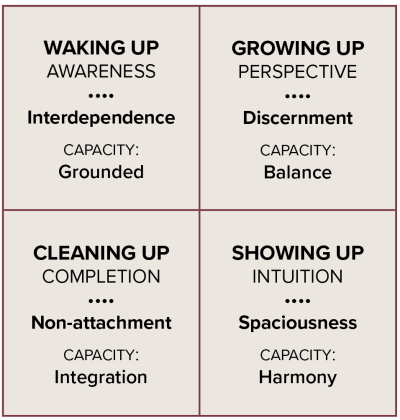
This blog series focuses on cultivating inner wisdom to withstand this Flood as explored through four domains of being human: Waking Up, Growing Up, Cleaning Up, and Showing Up.
So far, I’ve examined Waking Up, or cultivating awareness (Part 2), Growing Up, or gaining perspective (Part 3), and Cleaning Up, integrating the fragmented self (Part 4).
In this blog, Part 5, I describe Showing Up as culminating our embodiment of wholeness to cultivate wisdom.
Inner Wisdom
Throughout this series, I’ve drawn from Eastern and Western perspectives to define inner wisdom:
Inner wisdom is a state of consciousness that reveals deep insights through a discernment process. It involves an intuitive capacity to understand reality’s interconnected dimensions for thoughtful decisions and skillful actions.
Showing Up embodies wisdom—integrating awareness, perspective, and inner clarity into a way of being. It is characterized by spaciousness, allowing fluid responsiveness rooted in presence and integrity. In this final domain, wisdom is no longer just cultivated—it is lived.
1. Three Pillars: Presence, Integrity, and Responsiveness
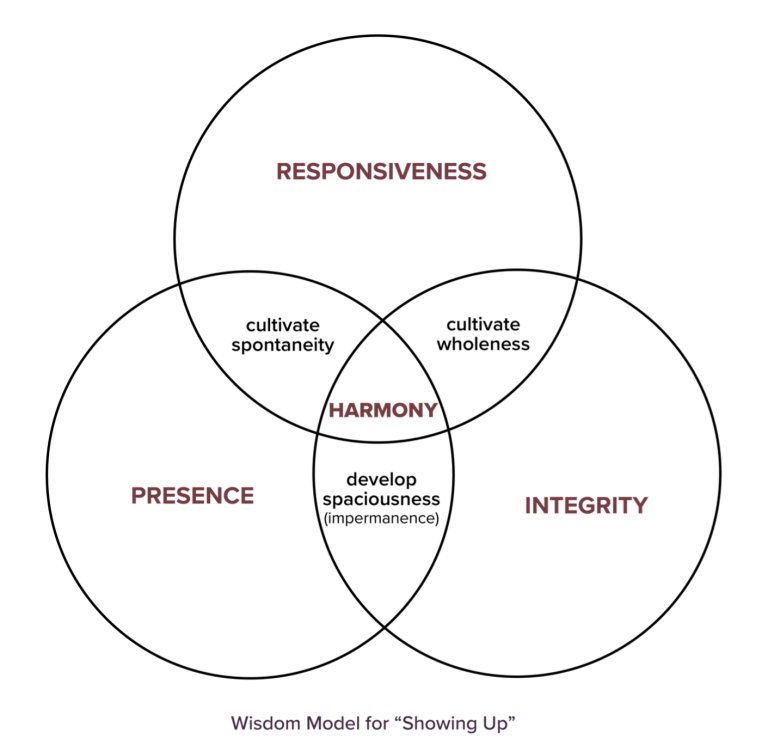
In cultivating inner wisdom, the final domain—Showing Up—embodies interdependent awareness, greater perspective, and deeper integration. Here, we bring insights and intuition into this moment. The following three pillars support this dimension: Presence, Integrity, and Responsiveness.
Presence
Presence is attunement to the here and now—a deep intention to connect with oneself and others without distraction or pretense. It integrates an interdependent awareness cultivated in Waking Up, helping us perceive and engage the truth as it emerges.
Presence is not just about physical availability; it concerns openness, receptivity, and a deep attunement to life as it unfolds. Mindfulness supports awareness and the capacity to cultivate presence.
Two thinkers offered perspectives on presence to expand our understanding:
\Master coach Doug Silsbee, in Coach-Based Presence, describes presence “as a state of awareness in the moment, characterized by the felt experience of timelessness, connectedness, and a larger truth.”
Scholar Peter Senge states in Presence, “I think a Buddhist would say that presence can arise to the extent that we develop the capacity to extend our conscious awareness in both domains: the absolute and the manifest.”
Grounded awareness, the mindfulness of presence, and the wholeness of integrity provide the foundation for our capacity to be responsive.
Integrity
Integrity is being whole and complete, aligning one’s principles, actions, and commitments with one’s agreements.
- As an inquiry, integrity invites us to recognize where we are misaligned—where there are broken, missing, or incomplete agreements—with ourselves or others that create a lack of workability.
- As a practice, integrity is a mountain with no top—an ongoing practice toward greater wholeness. We learn to recognize life’s lack of workability, not as a problem but as an invitation to ask what might be missing, unaligned, or broken to bring about our natural wholeness.
Integrity is the natural consequence of Waking Up to recognize our ego, Growing Up to question our perspective, and Cleaning Up to confront discomfort. It ensures that we show up authentically in the service of something greater than ourselves.
When we fully embody presence and integrity, our responses to life arise naturally and fluidly, leading to the third pillar: Responsiveness.
Responsiveness (a.k.a. Respontaneous)
Responsiveness is often considered a proactive action shaped by habitual anticipation. Yet this view overlooks spaciousness—the openness that allows us to meet each moment afresh, tuning into what arises, not imposing preconditioned responses.
This expanded understanding aligns with respontaneous, a term I created to blend responsiveness and spontaneous. It is not just about reacting skillfully but embodying a fluid, flowing responsiveness that emerges from presence and integrity. When these qualities balance, we move beyond effortful action to intuitive, natural responsiveness, embracing spontaneity not as impulsivity but as an organic flow from spaciousness.
Unlike impulsivity, which is reactionary and ungrounded, respontaneous action arises from intentional openness. It cultivates harmony, movement with the unfolding moment, not against it, acting with clarity and discernment—neither reactive nor passive.
This deeper responsiveness integrates the awareness of Waking Up, the maturity of Growing Up, and the integrity of Cleaning Up, cultivating effortless harmony in action—one that meets life with wisdom and flow.
These three pillars—Presence, Integrity, and Responsiveness—underly Showing Up, as an integrated expression of wisdom.
When we cultivate these qualities, we move beyond control or hesitation. We harmonize with life—ready for what comes yet unattached to any outcome. Showing Up is about doing and being in a way that unfolds with wholeness and flow, allowing wisdom to move through us effortlessly.
2. Power of Space: From Holding to Creating Space
At the heart of Showing Up is our relationship with space. Each domain deepens this relationship:
- Waking Up cultivates concentration to slow us down and recognize the moments of space unfolding in life.
- Growing Up employs reflection to create space between events, such as meetings, calls, or activities in our schedule.
- Cleaning Up deepens awareness to release ego-clinging, discerning between identity and experience in our interior world that cultivates non-attachment.
- Showing Up involves mindfulness to cultivate inner spaciousness—a paradox in which we become the space that transforms life’s heaviness into lightness and fluidity.
Spaciousness invites emergence and connection. Underlying spaciousness is the Eastern principle of impermanence, which recognizes that everything is in a constant state of change, including our bodies, thoughts, and feelings. This insight offers a view of existence as fluid and open, allowing us to meet experience with ease rather than resistance. When positive or negative experiences arise, impermanence reminds us that all states pass, making room for new emergence.
Without spaciousness, presence can become forced, responsiveness can turn into reactivity, and integrity can harden into dogma. To inhabit presence and integrity with a spontaneous flow, we must learn to work with space in two key ways: holding space and creating space as explored below.
Holding Space
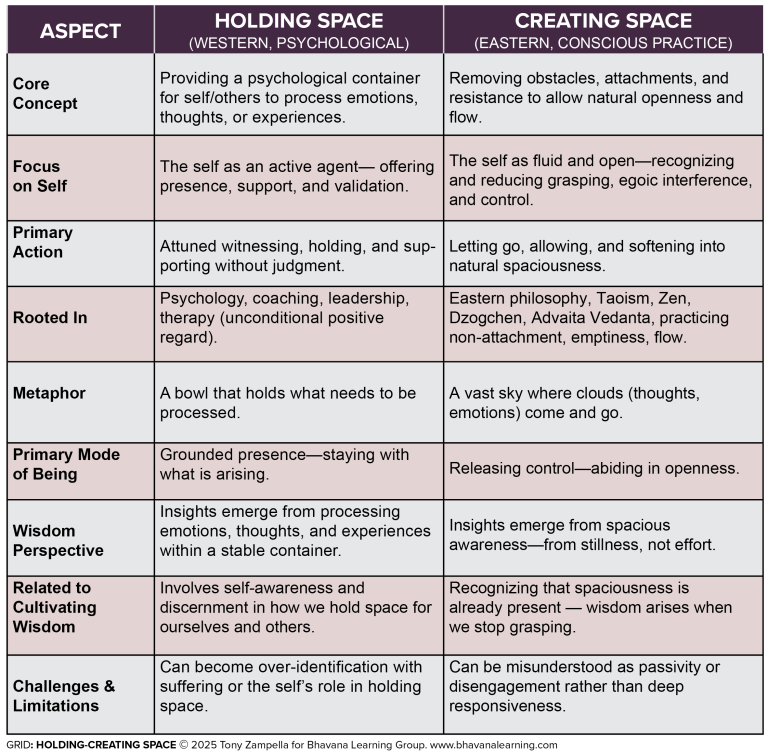
Holding space is the practice of attuned witnessing, providing a psychological container for the self and others to process emotions, thoughts, or experiences without judgment. Widely used in psychology, coaching, leadership, and therapy, it is often linked to Carl Rogers’ concept of “unconditional positive regard“—accepting and valuing someone completely without judgment or conditions, as well as showing genuine care and support regardless of their behavior or choices.
Holding space means allowing what is present to be seen, felt, and acknowledged without interference or premature resolution. It requires remaining open and steady amid uncertainty, emotions, or complexity.
- Metaphor: A bowl that holds what must be witnessed and processed.
- Primary Practice: Grounded presence—staying with what is arising.
- Potential Limitation: Overidentification with safety, suffering, or the self’s role in holding space.
Holding space forms the foundation of compassionate witnessing, where patience and depth are cultivated. Insights emerge from processing emotions, thoughts, and experiences within a stable container.
Creating Space
Creating space involves recognizing impermanence, seeing existence as constantly emerging and dissolving. We cultivate conditions for something new by removing obstacles, attachments, and resistance, allowing natural openness and flow. This practice involves both letting go of what no longer serves and inviting in what wants to arise by softening into natural spaciousness.
Rooted in Eastern philosophy—Taoism, Zen, Dzogchen, and Advaita Vedanta—creating space cultivates non-attachment, emptiness, and flow. This aspect of spaciousness embraces the paradox of control and surrender, enabling a dance between effort and ease.
- Metaphor: A vast sky where clouds (thoughts, emotions) come and go.
- Primary Practice: Releasing control—abiding in openness.
- Potential Limitation: Sometimes misunderstood as passivity or disengagement rather than deep connection and responsiveness.
When we develop an expansive awareness of space—both holding and creating—we unlock the ability to reveal a situation’s true nature. We neither rush to fill the void nor fear the unknown but allow what is essential to unfold.
Navigating space with mastery enables us to move beyond reactivity into a deeper way of being. This is the principle of making room—in our schedules, surroundings, attention, minds, hearts, and relationships.
Consider a leader navigating a difficult conversation. Holding space allows them to remain present, listening deeply without rushing to fix or control the outcome; it offers safety. Creating space enables them to let go of preconceived solutions, allowing new insights or resolutions to surface organically.
Mastering the interplay between holding and creating space transforms how we engage life. It is the evolution of how we meet experience—the essence of Showing Up.
This brings us to the final key aspect of Showing Up: the evolution of how we meet experience.

3. Stages of Being: From Instinct to Intuition
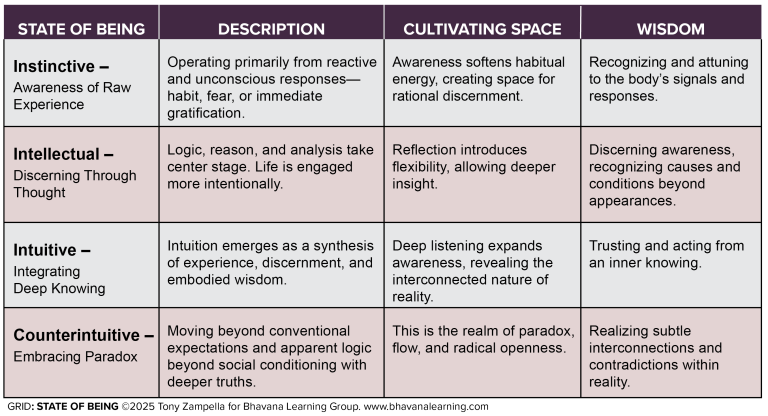
To fully embody Showing Up, we must expand our way of being. This evolution unfolds through stages – instinctive, intellectual, intuitive, and counterintuitive — each building on the last. Practices like mindfulness cultivate an intuitive presence that integrates wisdom into fluid, responsive engagement with life.
Instinctive—Awareness of Raw Experience
Here, we operate primarily from survival responses—habit, fear, or immediate gratification. Actions can be reactive and unconscious. Awareness of this domain softens habitual energy, creating space for rational discernment.
Wisdom involves: Recognizing and working with instinctual patterns by attuning to the body’s signals and responses. Examples include wisdom from martial arts and gut instincts in leadership and life.
Intellectual—Discerning Through Discerning Thought
Here, logic, reason, and analysis take center stage. We engage life more thoughtfully but may still be confined by rigid structures or the over-reliance on cognition. Reflection introduces flexibility, allowing deeper insight to arise.
Wisdom involves: Discerning awareness—recognizing causes and conditions beyond appearances, holding multiple perspectives without attachment. Examples might include strategic insight and philosophical discernment in decision-making.
Intuitive—Integrating Deep Knowing
This stage transcends the rational mind, allowing intuition to synthesize experience, discernment, and embodied wisdom. Deep listening expands awareness, revealing reality’s interconnected nature.
Wisdom involves: Trusting and acting from an inner knowing that aligns with deeper patterns of interconnection. Some examples include creativity, improvisation, and deep listening.
Counterintuitive—Embracing Paradox and Deeper Truths
The highest evolution of being moves beyond conventional expectations and apparent logic. Here, wisdom contradicts social conditioning yet aligns with deeper truths. This is the realm of paradox, flow, and radical openness.
Wisdom involves: Realizing subtle interconnections and contradictions within reality, allowing profound clarity and trust in the unseen. Examples include dialectical thinking, riddles and ironies like Zen koans, or insight from Taoist wisdom.
Through this progression—from instinct to intellect, intuition, and counterintuitive knowing—we refine our ability to Show Up with presence, adaptability, and depth. Mastery concerns integrating earlier stages into a fluid, responsive way of being.
Intuition In Practice
An experienced coach or mediator learns to trust the silences in a conversation, and knowing wisdom often arises in the gaps between words. At the counterintuitive level, we recognize that stepping back—rather than stepping in—can be the most powerful form of guidance. What seems unnatural to the intellect becomes second nature to the deeper wisdom cultivated through practice.
The journey toward intuitive and counterintuitive stages allows Presence, Integrity, and Responsiveness to emerge naturally. At this level, Showing Up is no longer effortful but a way of being—an expression of wisdom that moves through us rather than something we impose upon ourselves.
Living the Practice of Showing Up
Showing Up is not a singular act but an ongoing practice of embodying wisdom in the present moment. It is a commitment to living with presence, here and now, in integrity, toward greater wholeness, and with responsiveness for a flow and fluid dance.
Showing Up recognizes the role spaciousness and openness play in evolving being, integrating instinct, intellect, and intuition. It also recognizes the nature of impermanence — that each moment is an invitation to engage anew without attachment to fixed identities or outcomes.
To cultivate wisdom is to move beyond seeking it. It is to embody it. And in doing so, we become the space through which life flows, effortlessly showing up to meet the world as it is, in all its complexity and elegance.
At Series End: Cultivating Inner Wisdom to Withstand the Flood
This series concludes with a map for cultivating wisdom through four human domains: Waking Up to develop interdependent awareness, Growing Up to gain perspective through discernment, Cleaning Up to integrate the fragmented self with clarity, and finally, Showing Up by opening up to emergence with presence, integrity, and responsiveness.
Through these four domains, a vision emerges—one that expands ethics by integrating wisdom. Applying wisdom to human development, including coaching and leadership, is not just an intellectual pursuit but a necessary evolution.
Cultivating inner wisdom, as outlined in this five-part series, offers the possibility of an expanded view of ethics that includes the following:
- Inner practices for the coach or leader through meditation, contemplative inquiry, and shadow work.
- Commitment to non-attachment, guiding clients beyond conditioned desires rather than reinforcing external success.
- Deep responsibility for energy and presence, ensuring that a coach’s presence is a catalyst for insight rather than mere neutrality.
- Awareness of suffering and its causes, leading clients beyond egoic suffering toward deeper freedom and wisdom.
Wisdom is not a luxury—it is a necessity. Meeting the volatile and disruptive complexities of our time requires more than merely knowledge and strategies. It demands cultivated inner wisdom, a presence capable of navigating the flood—the overwhelming distractions, disconnection, and dissatisfaction that characterize our era.
This is the path of wisdom—a grounded, ethical, and transformative way of being that allows us to meet the world with the embodiment of clarity and insight, cutting through illusion and deepening awareness.
NOTE: To support cultivating wisdom, Bhavana Learning Group will host an online, 2.5-day retreat in Sep 2025 to explore the four domains: Waking Up, Growing Up, Cleaning Up, and Showing Up.
Reading Time: 10 min. Digest Time: 13.5 min.
1- VIEW OUR RELATED RESOURCES & BLOGS:
0 Comments