



My aunt, with whom I lived for five years beginning at age eight, never spoke about values—but you always knew where she stood. Her quiet consistency taught me early on that principles aren’t things we talk about; they’re things we live by.
Recently, in a leadership session, a client asked, “Our values are clear—so why do we keep losing our way?” As we explored further, it became clear: the issue wasn’t the values themselves. It was the absence of the principles that ground them—and the practices that bring them to life.
This blog is an invitation to go beyond the language of values and rediscover the deeper structure that gives them meaning.
Over recent decades, we’ve seen a cultural shift toward a values-based ethos. Whether in organizations, communities, or personal development, values have become the dominant language of meaning and motivation. We speak of them as preferences—what matters to us individually—but also elevate them to the level of “core values,” implying something deeper and more enduring. This dual use can create confusion.
Are values flexible and chosen, or foundational and stable?
To make sense of this tension, we need to recover the full framework—where principles provide grounding, values offer direction, and practices bring those commitments to life.
Exploring Values, Principles, and Practices
In many cases, values have become a catch-all term, representing everything from mission and culture to ethics and strategy. Consequently, we’ve lost the clarity and grounding from distinguishing values from principles, the universal convictions that transcend preference, and practices, the deliberate actions that embody and reinforce both values and principles.
This ambiguity has also shaped our understanding of the self. We’ve increasingly shifted our focus from character to personality to identity.
- Character is rooted in moral convictions and principled actions—what we stand for, often regardless of circumstances.
- Personality expresses our consistent behavioral tendencies and emotional patterns—how we relate.
- Identity is shaped by our values and beliefs—what we choose to align with, often adaptable over time.
However, in a time of disruption and instability, values alone aren’t enough. They can guide choices, but they often lack the grounding of principles or the traction of practice. If we are to navigate uncertainty with integrity and clarity, we need something sturdier than values alone. We need principles to anchor us in enduring truths and practices to bring those principles and values into our lived experience.
When these three—principles, values, and practices—are woven together, they create a resilient framework for human and organizational wisdom: integrating who we are, what we know, what we care about, and how we act.
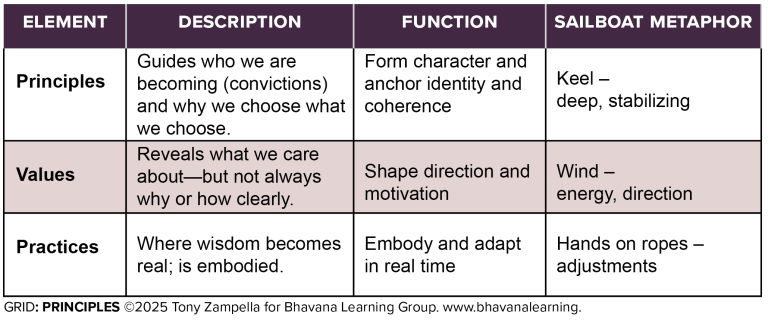
Below, I develop principles, values, and practices to clarify how they support our grounding, direction, and actions.
1- PRINCIPLES: Anchors in a Shifting World
Principles are the steady throughlines in a changing world. While values can shift with context, principles are universal and non-negotiable. They do not ask, “What do I prefer?” but rather “What is right?” or “What endures?”
Principles are grounded in moral insight and often emerge from deep reflection, lived experience, or spiritual traditions. They are not reactive but rooted—revealing a compass rather than a weathervane. For individuals, principles express a coherence of character. For organizations, they clarify the boundaries of trust and accountability.
At a developmental level, principles reflect the maturity of holding perspectives beyond one’s own. They are not rules imposed from without but commitments chosen from within—like justice, compassion, or truthfulness. In times of disruption, principles often prevent values from becoming unmoored.

Principles guide who we are becoming and why we choose what we choose.
Principles = Our Stand. “I stand for truth, for justice, for non-harming. …”
In stormy seas, principles act like the keel of a sailboat: Deep below the surface, they keep us upright and oriented—even when the winds shift and the waves rise.
2- VALUES: Meaning and Motivation
Values are essential, but they are only one part of the equation. They are how we articulate what matters to us—what we believe is important, meaningful, or worth pursuing. Values help shape identity, purpose, and culture. However, they can also be negotiated, adapted, or even contested.
Values live at the intersection of the personal and the collective. They help individuals and organizations define what they stand for—creativity, equity, loyalty, and innovation. However, without a grounding in principles, values can become overly relative or selectively applied.
From a developmental standpoint, our values evolve as our perspective deepens. What once felt paramount may give way to broader or more integrated priorities. When values remain unexamined, however, they can become echo chambers of identity or blind spots of belief.
Values reveal what we care about—but not always why or how clearly.
Values = Our Direction. “I value transparency, kindness, courage. …”
In the sailboat metaphor, values are the wind: They energize us and give direction, but without a keel (principles), they can blow us off course.

3- PRACTICES: Bridging Wisdom and Action
Principles and values are inert without practice. Practices translate intention into behavior and aspiration into embodiment. They make our inner commitments visible and sustainable.
Practices can “wake” us and be formal or informal. They can involve categories such as:
- Reflective, like journaling, meditation, or completing your day,
- Physical, like yoga, running, or fitness/gym work, or
- Relational, like listening, dialogue, or feedback.
Organizationally, practices become culture in motion, with a set of best practices or rituals, decision frameworks, or learning rhythms.
In transformative work—whether individual or systemic—practices cultivate integration. They help us “clean up” unconscious patterns, “grow up” through stages of maturity, and “show up” with presence and discernment. Without practice, even our best principles and values remain conceptual.
Practice is where wisdom becomes real.
Practices = Our Path. “I journal for self-awareness. I pause before responding. I offer feedback with clarity and care.”
On a sailboat, practices are hands on the ropes and rudder. They help us adjust to real-time conditions while staying true to our direction and purpose.
Why Tradition Matters
Much of our cultural and developmental drift today stems from a pattern of adopting new ideas in a pendulum-like fashion, expanding by excluding rather than including. We often embrace innovation without the thoughtful discernment or integration of foundational truths as taught in wisdom traditions—those enduring philosophical and spiritual frameworks that offer guidance for living with clarity, compassion, and purpose.
Essentially, our sequential and linear view of growth easily jettisons traditions that a circular view of development would include. As a result, values become unanchored, and change becomes reactive rather than principled.
For instance, champions of emotional reasoning have increasingly sidelined critical thinking, leaving many anxious, unmoored, and without the tools to examine assumptions or discern bias.
Meanwhile, others elevate rationalism at the expense of traditional wisdom, forgetting that the wisdom of the land, the rhythms of nature, the natural ecosystem, and ancestral knowledge all offer vital insights into interconnection and interdependence.
We know, for example, that the oxygen we exhale nourishes plants, and the oxygen they release sustains us. Such reciprocal relationships reveal deeper principles of interconnectedness. Yet, culturally, we often behave as if we are autonomous and separate.
Returning to tradition doesn’t mean reverting to dogma. Rather, it offers a way to elevate principles that can support and clarify values—grounding our preferences in deeper wisdom. Principles of human dignity are being revived today through the Right to Repair movement, which shifts American values from convenience and consumption toward sustainability and the nobility of work.
By exploring wisdom traditions, we can reclaim the principles that clarify our values and enliven them through sustained practice.
1. Western Thought: Aristotle’s First Principles
In Western philosophy, Aristotle used the word arche (ἀρχή) to describe a principle—a foundational element that underlies a system or reality. These first principles are not derived through logic, but are recognized through intuition and experience as self-evident starting points for understanding.
Aristotle explored principles across disciplines—metaphysics, ethics, and natural science—to identify the first causes and foundational truths that underpin reality. In his ethical philosophy, he viewed eudaimonia (flourishing) as the highest good, attainable through the cultivation of virtue—grounded not in preference but in principled living.
This tradition affirms that knowledge and character both begin with principled foundations that inform and refine values over time.
2. Eastern Traditions: Taoism and the Buddhist Path
In the East, traditions such as Taoism and Buddhism also emphasize the importance of principle-led living, although their articulation is often more relational and process-oriented.
Taoism emphasizes harmony with Tao, the fundamental principle of the universe, through wu wei—non-striving, simplicity, and natural alignment. Core principles include flexibility, humility, and compassion. Taoism teaches us that by observing nature and yielding to its rhythms, we can live in greater integrity and ease.
Buddhism’s Eightfold Path presents a clear integration of principles and practices within an ethical and developmental framework. At its core are timeless principles: non-harming (ahimsa), compassion (karuna), interdependence, and the renunciation of ego. These are not abstract ideals but are revealed through direct insight and serve as orientation points for living with integrity.
We can enact these principles through practices such as the following:
- Right Speech: mindful communication
- Right Action and Livelihood: ethical behavior and consumption
- Right Effort: cultivating discipline and restraint
- Right Concentration and Mindfulness: meditative awareness
Together, the Path’s wisdom (Right View, Right Intention) provides grounding, its ethical commitments serve as a compass, and its practices offer a path of realization and transformation.
3. Modern Views: Principles in Contemporary Leadership
In the modern leadership literature, we see a re-emergence of principles as the basis for sustainable development and meaningful success.
In Principle-Centered Leadership, Stephen Covey identifies security, guidance, wisdom, and power as core internal resources built on universal principles. He distinguishes between principles (unchanging truths) and values (personal or cultural preferences), emphasizing that values must align with principles to lead to effectiveness and character development.
Covey’s Seven Habits of Highly Successful People emphasizes that lasting success comes not from personality techniques but from cultivating inner character. His distinction between the character ethic and personality ethic highlights that genuine transformation is slow, cumulative, and principle-based.
Scott Galloway, a marketing professor and cultural commentator, echoes similar themes by advocating for personal and organizational “codes”—core commitments that provide identity, clarity, and direction in branding.
Recently, Galloway applied this notion to redefine masculinity as grounded in responsibility, vulnerability, and service to the collective good.
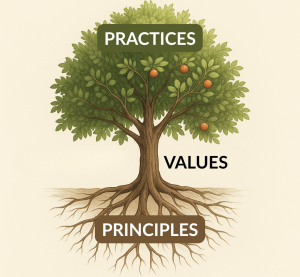
Using a tree metaphor, principles, values, and practices come together to ensure growth and development:
- Roots = Principles (deep, unseen, anchoring)
- Branches = Values (visible shape, responsive to conditions)
- Leaves/Fruit = Practices (what touches the world, regenerative, and renewing)
Why Principles Anchor Us Today
In times of instability and complexity, what’s required isn’t more ideology but deeper integration of wisdom with knowledge. As Ken Wilber (Integral Theory) suggests, notions of “development” honor evolution by expanding and including, not by swinging from one extreme to another.
Humans find direction through aligning meaning and purpose—yet for many, that alignment feels elusive. Principles ground our sense of purpose; values cultivate our sense of meaning. Rediscovering and realigning with principles—whether philosophical, ethical, or spiritual—offers the grounding we need to support our values and bring meaningful practices to life.
The Triad in Summary
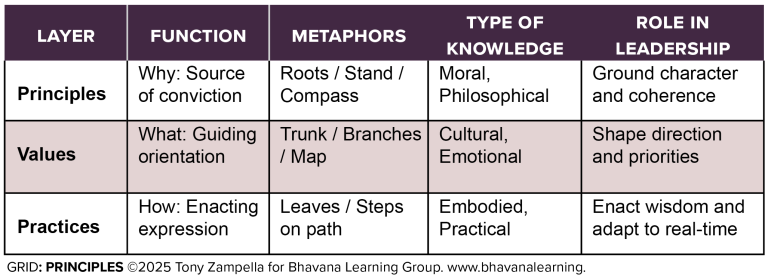
When principles, values, and practices come together, they form a resilient and dynamic foundation — a structure for navigating complexity:
- Principles offer clarity and coherence.
- Values provide energy and direction.
- Practices bring traction and transformation.
Together, they allow individuals to live with integrity across time and organizations to lead with clarity through change. In an age that prizes agility but suffers from drift, this triad offers not just survival—but conscious evolution.
Try it Out: Developing Your Principle-Based Model
Creating your own model begins with inquiry and reflection. The following prompts can support this process:
PRINCIPLES — Your Stand/Compass
Principles are universal truths or guiding commitments you stand by, regardless of your circumstances.
- What truth or reality would you uphold, even if it cost you something?
- What feels right, beyond recognition, reward, or comfort?
List 1–2 principles
- _____________________
- _____________________
(e.g., Integrity, Compassion, Freedom, Non-Harming, Dignity)
VALUES — Your Map/Direction
Values are the qualities or priorities that energize you and help you prioritize your choices.
- What energizes or calls you forward?
- What values support navigating difficult decisions?
List 2–3 values
- _____________________
- _____________________
- _____________________
(e.g., Family, Adventure, Growth, Achievement, Community)
PRACTICES — Your Path
Practices are the embodied behaviors and rituals that habituate your principles and values in daily life.
- What habits or rituals help you embody your deepest commitments?
- How do your daily actions reflect what matters most?
List 2–3 practices
- _____________________
- _____________________
- _____________________
(e.g., Daily Journaling, Deep Listening, Breathing Practice, Pausing, Walking in Nature)
Example: “Principle” Sets
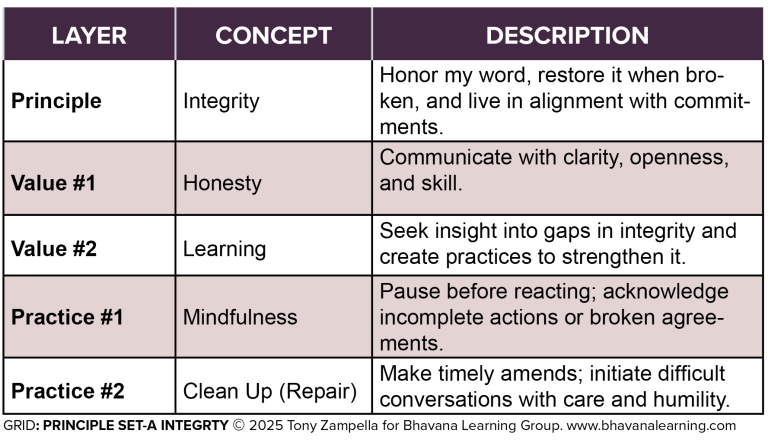
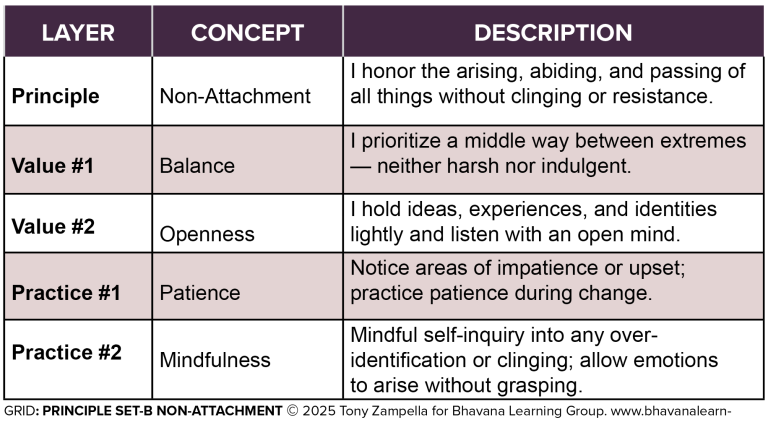
Living by your principles requires intentional design. Below is a sample framework to develop integrity and non-attachment as principles with one possible set of aligned values and practices for each. In this design, principles, values, and practices are expressed as actionable commitments to embody in daily life.
Set A- Integrity in Action
The grid below illustrates how a set of values and practices align to support a principle, in this case, “integrity.”
Set B- Non-Attachment
The grid below illustrates how a set of values and practices align to support a principle, in this case, “non-attachment.”
Bring Rigor to Reflection
Use these prompts to deepen your alignment:
- Are my principles truly universal and non-negotiable?
- Are my values consistent with how I make real-world decisions?
- Are my practices reliable, sustainable expressions of my commitments?
- Where do I feel a strong alignment? Where is there tension or disconnection?
- What one practice could I strengthen or begin to live my principles more fully?
An Important Blind Spot
When choosing a coach or entering leadership development, it’s worth asking: Does this person understand the nature of principles and how they differ from values? Many coach training programs emphasize neutrality—which, while useful, can sometimes discourage the deeper inquiry needed to surface what truly matters. But neutrality is not the same as clarity.
Likewise, consultants often rely on data, analysis, and theory—tools that may highlight values but often overlook principles. Rarely are principles connected to organizational performance or strategic direction, or practices to personal fulfillment. What’s missing is an integrative core, a grounding or coherence that ties values and practices to a deeper ethical or existential stand.
This blind spot matters. Left unaddressed, it risks reinforcing the very suffering we seek to alleviate—especially in a world saturated with distraction, disruption, and disconnection, which incentivizes incoherence.
Elsewhere, I’ve written about the FLOOD dynamic—fragmentation, loss, overload, and disorientation—that defines so much of modern life. Reconnection isn’t merely about what we consume, fix, or organize externally. It begins within—with the inner work of rooting ourselves in what is most true and enduring.
And that work begins—with principles.
Reading Time: 11 min. Digest Time: 14.5 min.
1- VIEW OUR RELATED RESOURCES & BLOGS:
0 Comments