


A colleague sends me an invitation to try a new app. Everyone’s talking about it. The instinct’s quick: sign up, log in, join the stream—don’t fall behind. Before I click accept, I pause.
What part of me is eager here? The part that wants connection? The part that fears being left out? The part that hungers for novelty, distraction, or recognition? Technology, itself, isn’t the issue—it’s how it feeds needs, sometimes at others’ expense.
So, I ask: Does this serve me? If it does, which me does it serve? The one who seeks wisdom or the one who craves noise? The one who longs for belonging or the one who craves escape?
This small pause is a practice of discernment—an act of recognizing truth during the flood of overwhelm and distraction. Sometimes, the answer is yes; sometimes, no. What matters is the awareness that choice exists.
The study of wisdom invites a different mindset: patient attention, honest reflection, compassionate openness, and the courage to sit with questions that unsettle us.
In a blog series on the Flood of overwhelm and distraction, that pause exemplifies what I’ve termed as the work of cultivating inner wisdom—developing discernment across four human domains:
- Waking Up to cultivate awareness.
- Growing Up to gain perspective.
- Cleaning Up to integrate the fragmented self.
- Showing Up to embody wholeness.
But how do we actually cultivate wisdom?
Wisdom is not more information or sharper problem-solving. True wisdom grows from an awareness that meets our ego honestly and discernment that can see clearly and act with balance. At its heart, inner wisdom recognizes truth.
Recognizing Living Truth
We live in an era when truth is under siege—denied outright, reduced to mere opinion, drowned in noise, or replaced by power and imposed narratives.
The truth differs: a living intimacy with reality within an interdependent, non-dual awareness that opens into freedom. As Tolstoy reminds us, “Truth is the only safe ground to stand upon.” When we are still, we each can access this deeper truth. The aim is not to seize an absolute but to cultivate clarity—to move ever closer to what is real.
The focus on interdependent awareness and non-dual existence takes time to train, cultivate, and recognize. This is why “study” requires space and reflection and why confusion is often integral to it. Over a lifetime, this awareness unfolds through another kind of study—not the accumulation of knowledge but a patient inquiry that asks: What is real? Who is the one who knows?
With practice, the intellect softens its grip, and intuition expands into a wiser spaciousness. Amid the flood of our information-driven, knowledge-saturated society—especially in eras of technological volatility—the study of wisdom requires moving beyond knowledge. We must train both heart and mind to recognize wisdom—an inner knowing of how to apply what we know in service to greater freedom and wholeness.
The Study of Insight
Similar to physical training, mind training requires a diet. It begins simply. Over time. A slow diet, not binging on information or hoarding knowledge, but absorbing small morsels of wisdom that train the mind to question assumptions about reality. A ritual develops to build muscles that recognize truth as it unfolds.
Each day’s early moments are especially fertile. A rested mind can take in even a short passage of wisdom—not an idea to grasp, grok, or collect but a seed to carry into lived experience. A single line, such as the Taoist phrase “To be sick of sickness is the only cure,” can lodge within us and deepen our awareness of self and reality.
The following four books offer such daily nourishment—a few minutes of passages to help you expand your awareness and sharpen your discernment.
A Wisdom Diet
Read. Reflect. Reveal. Each of these books offers the beginning of a study diet for wisdom. Begin with one to develop a ritual and cultivate an experience. This is not a race or an assignment. It’s not a challenge or a competition. There’s no grade or test.
Cultivating wisdom is simply this: a daily diet of insight that reminds us of what is real—and the freedom to meet it with clarity and care. This “study” marks a contemplative approach to consuming ideas that cultivates a way of being reflective and discerning.
1. Thich Nhat Hanh
Your True Home: The Everyday Wisdom of Thich Nhat Hanh
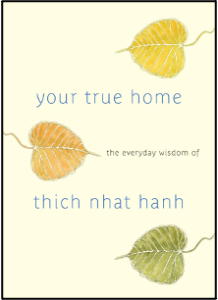
Thich Nhat Hanh brings true presence into our daily lives with 365 entries. This book offers a decent beginning for novices, offering daily inspiration to train the mind to meet every moment of life with 100 percent attention.
Thich Nhat Hanh was a Vietnamese Zen Buddhist monk, peace activist, and global spiritual leader known for popularizing mindfulness and “Engaged Buddhism” in the West. Martin Luther King Jr. nominated him for the Nobel Peace Prize before the monk died in 2022 at age 95.
Thay (as his students call him) offers wisdom from the more than 100 books he’s authored to reflect the great themes of his teachings on how mindfulness practice brings joy and insight into every moment. Here’s an example for Day 10:
Lotus in the mud. The goodness of suffering is real. Without suffering, there cannot be happiness. Without mud, there cannot be any lotus flowers. So, if you know how to suffer, suffering is OK. And the moment you have that attitude, you don’t suffer much anymore. And out of our suffering, a lotus flower of happiness can open.
2. Le’Guin’s Tao Te Ching
Lao Tzu: Tao Te Ching: A Book About the Way and the Power of the Way
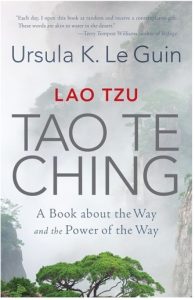
This entry into Taoism by Ursula K. Le Guin is from a renowned science fiction and fantasy author with a literary career spanning 60 years. In this text, Le Guin offers a gentle translation with sparse commentary on this Taoist classic, which has significantly influenced her work.
Jargon-free but faithful to the poetic beauty of the original, Le Guin’s unique translation encourages longtime readers of the Tao Te Ching and invites those discovering the text for the first time.
With its 81 passages, Tao Te Ching is a foundational work of Taoism to support one’s intentions. It can be read linearly, a passage a day, or the reader can simply open the book and review a random passage.
Here’s part of passage 22:
Growing Downward.
Be broken to be whole.
Twist to be straight.
Be empty to be full.
Wear out to be renewed.
Have little, and gain much.
Have much, and get confused.
3. Daily Taoist Passages
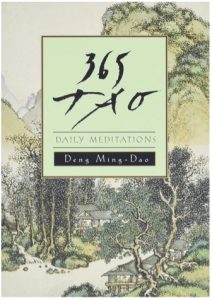
This book offers daily meditations on the meaning of being wholly part of the Taoist way, thereby achieving complete harmony with oneself and the surrounding world.
The author, Deng Ming-Dao, has written several books, including The Living I Ching and Chronicles of Tao.
Each page of this text offers a theme such as Work, Walking, Sound, Disaster, Laughter, Communication, Compassion, Creativity, Beauty, Nonconformity, Independence, Fear, Interpretation, Time, Encourage, Awareness, Readiness, Immigrant, etc.
Each theme begins with a passage and proceeds with a page-long commentary for reflection.
Following is the passage for theme 213: “immigrant.”
Magic doesn’t work in this new place.
Native poetry has lost rhyme and rhythm,
Familiar food is labeled a curiosity,
And hostile stares replaced familiar love.
To be an immigrant
Is to be solitary amid millions.
4. Leo Tolstoy’s Daily Wisdom
Calendar of Wisdom: Tolstoy on Knowledge and the Meaning of Life
The Marginalian (formerly Brain Pickings) offers an excellent summary of Leo Tolstoy’s Daily Wisdom: a book of reflections on life, knowledge, and virtue, originally published in three editions between 1903 and 1911.
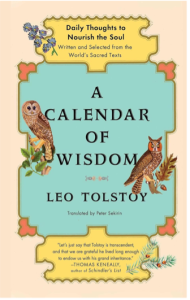
What makes this book unique is its diverse gathering of daily readings from a wide range of traditions, including Western philosophy and religion, Eastern philosophy, and other spiritual traditions. Tolstoy curated these voices into a single collection, inviting readers to nourish themselves daily with a brief reflection, focusing with directness and clarity on truth and wisdom.
Leo Tolstoy is best known for his epic novels War and Peace and Anna Karenina, but he was also a philosopher and social thinker. Tolstoy’s writings and moral vision influenced later leaders, such as Gandhi and Martin Luther King Jr.
Though born into privilege, Tolstoy wrestled all his life with questions of truth, meaning, morality, and freedom. His openness to wisdom beyond his cultural sphere was unusual for a 19th-century Western writer, freely weaving insights from Eastern and Indian philosophy into his work.
These examples of partial entries offer diverse reflections:
“Be attentive to what you do; never consider anything unworthy of your attention.” — April 2, Confucius.
“When you feel the desire for power, you should stay in solitude for some time.” — August 27, Henry David Thoreau.
“There is only one real knowledge: that which helps us to be free. Every other type of knowledge is mere amusement.” — June 23, Vishnu Purana (Indian wisdom tradition)
Set a Ritual
How best to begin?
The study of wisdom invites a different mindset: patient attention, honest reflection, compassionate openness, and the courage to sit with questions that unsettle us.
Read. Begin each morning with quiet time—perhaps 10 minutes with a cup of water, tea, or coffee. Read a page or passage, and reflect on what it reveals.
Reflect. Write any discovery in a journal or on the book’s page. Return to the same reading, and carry part of it into your day.
Revisit. Continue this practice daily with a new passage. Even after finishing any of the books, revisit the passages. The mind that returns will not be the same as that which began.
Reveal. Allow yourself to be confused. Practice staying with the confusion and the questions it raises. Zen teachers remind us that confusion is the second-highest mind state because it precedes clarity.
Morning Moments of Wisdom
In the flood of distraction and overwhelm, taking a few moments each morning to seed your consciousness, deepen your awareness, and expand your perspective becomes an act of protection and freedom.
These pauses remind us of deeper truths: We are more interconnected than we realize, we are capable of depth, and even amid noise, we can choose to remain light, open, and subtle.
Morning light slips across the kitchen table. The phone is already pulsing—news, meetings, messages—today’s installment of the Flood. I set it face down and open a thin book instead. A few lines, then a breath. The kettle clicks off.
In that pause, I notice the rush in my chest (Waking Up), the story about how much the day demands (Growing Up), the small knot of worry I’d rather not name (Cleaning Up), and the one simple act I can do with care before anything else (Showing Up).
Nothing dramatic. Just a passage received, a breath of stillness, and a steadier step into the day. This is the work of cultivating wisdom: a quiet recognition of what is and what matters next. These small daily practices give us the strength to stand in the current without being carried away.
During the flood, this daily study-reflection practice is not an escape but an anchor, a small reminder that wisdom can be cultivated, one passage at a time.
Reading Time: 8 min. Digest Time: 11 min.
1- VIEW OUR RELATED RESOURCES & BLOGS:
0 Comments