



Embrace uncertainty!
How many times have you heard this declaration? A Google search on the term yielded 73.3 million hits. Woah!
Embracing uncertainty seems prudent during times of volatility. But doing so requires embracing confusion, the first experience we confront when becoming open to the unknown.
In my years as a coach, teacher, guide, and consultant, I’ve found “confusion” to be the important threshold in determining how people learn and grow.
Thus, the experience of confusion deserves attention. How we relate to confusion determines how we learn, grow, and evolve—and our ability to embrace uncertainty.
The Roots of Confusion
The word “confusion” comes from the Latin word “confusio,” which means “mingling, mixing, blending together.” By the fourteenth century, “confusion” was adopted into English, meaning disorder or chaos—the state of being mixed up or unclear.
“Confusion” comprises two syllables.
- Con (with): This prefix means “with” or “together” in Latin, indicating the bringing together of elements.
- Fusion (mixing, blending): The root “fusion” relates to the process of mixing or blending, a state where individual components are no longer distinct—in other words, “undifferentiated phenomena.”
The joining of “together with” plus “undifferentiated phenomena” captures the essence of confusion as a state where different elements are mixed together, resulting in a lack of clear differentiation or clarity.
Managing confusion clarifies whether we view the unknown
as a threat, opportunity, or discovery.
In cognitive terms, confusion emerges when various thoughts, ideas, or stimuli are presented as an “undifferentiated” state. The mind seeks to resolve this through reasoning, learning, or problem-solving.
In educational contexts, confusion reflects the learner’s experience of encountering new information that initially lacks any frame of reference, clear structure, or meaning. The learning process involves differentiating and making sense of this information.
Causes of “Confusion” or “Being Confused”
The vast amount of information— misinformation and disinformation— available through the internet and digital media can overwhelm us. It becomes difficult to process and distinguish between what is useful, irrelevant, or false information.
The confusion about what is true and reliable leads to increased anxiety and a sense of overwhelm and exhaustion.
A- Information Overload
The vast amount of information— misinformation and disinformation— available through the internet and digital media can overwhelm us. It becomes difficult to process and distinguish between what is useful, irrelevant, or false information.
The confusion about what is true and reliable leads to increased anxiety and a sense of overwhelm and exhaustion.
B- Rapid Change
The pace of technological advancement often outstrips our ability to adapt and keep up with new tools, platforms, and systems. These shifts create a sense of being left behind and create challenges in professional settings where new technologies are quickly adopted.
Rapid cultural changes and evolving social norms, values, and behaviors can create confusion, leading to generational divides, identity crises, and conflicts over values and behaviors.
C- Internal Disorientation
The fluid nature of identity and the diverse range of communities and subcultures can create confusion about where individuals fit in and how they identify themselves.
The increasingly complex and polarized socio-political landscape can confuse our understanding of different viewpoints and policies, leading to disenfranchisement and difficulty engaging in civic participation.
Together, these changes, heightened by the abundance of individual choices resulting from new levels of complexity, create an internal state of confusion, leading to decision fatigue, identity crises, disorientation, and social isolation.
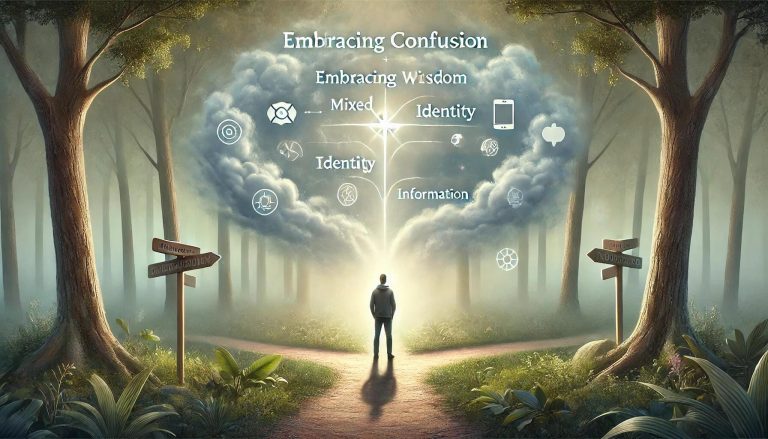
5 Reasons People Avoid “Confusion”
Over time, “confusion”—like uncertainty or the unknown—has become something to avoid, particularly in educational, business, and psychological contexts. Here are five common reasons we avoid confusion:
Discomfort: Confusion often leads to feelings of discomfort and frustration. People generally prefer seeking certainty, a sense of control, and even clarity; confusion can be unsettling. Rejecting confusion supports our comfort zone, which can lead to delusion.
Choosing confusion over delusion requires letting go of comfort.
Perceived Incompetence: Being confused can make individuals feel incompetent or foolish. “I don’t know” may be the three hardest words to utter today. Social pressure to appear knowledgeable and competent leads individuals to avoid situations where they might appear confused by faking it.
Yet, the beginning of wisdom involves recognizing our ignorance.
Fear of Failure: Confusion is sometimes associated with the fear of making mistakes or failing, which can impact self-confidence.
Often, such confusion results when our experiences do not meet our expectations. Yet such gaps can reveal and release attachments and free us from fear.
Time Constraints: Confusion can be seen as a waste of time, especially in fast-paced environments where efficiency and a quick understanding are valued.
Consider that any learning process evokes confusion as we enter the unknown. Moreover, learning is inefficient and inevitably leads to experiments that result in mistakes. Yet, we cannot improve or grow if we do not learn; hence, we must make time to be confused.
Cognitive Load: The mental effort required to work through confusion can be exhausting, leading people to avoid it to conserve their cognitive resources.
Habits such as multitasking or continuous partial attention (CPA) continue to fragment our attention, supporting a high cognitive load.
In sum, avoiding confusion may lead to comfort yet becoming closed-off, resulting in confirmation bias, magical thinking, arrogance, unwillingness to receive critical feedback, or the inability to discover new insights, to name a few.
Whenever we want to learn or venture into the unknown,
we are first confronted with our ego, offering a deep look in the mirror.
Evolution of Confusion
Recently, we’ve realized the importance of “confusion” as a necessary part of our learning and discovery process. Dzogchen Master Tulku Urgyen Rinpoche put it succinctly: The path means the state of confusion.
In several learning domains, we’ve reconsidered confusion as a first step to embracing uncertainty.
- Pedagogical Shift: In modern educational theory, confusion is increasingly seen as a natural and valuable part of the learning process. It is recognized as a signal that a learner is encountering new, complex information and is in the process of constructing a new understanding.
- Psychological Perspective: In cognitive psychology, confusion is seen as a state that can stimulate curiosity, exploration, and problem-solving. It prompts us to seek resolution, leading to greater cognitive engagement and eventual clarity.
- Mindset and Resilience: Modern thinking also links confusion to developing a growth mindset and resilience. Embracing confusion and working through it can build persistence, adaptability, and confidence in one’s ability to overcome challenges.
- Eastern Thought: Eastern education, such as those influenced by Confucianism and Buddhism, often emphasizes the learning process and personal growth. Confusion is a natural and valuable part of the journey toward understanding. Tibetan Buddhism uses confusion to purify the self. Per Tulku Urgyen Rinpoche: “Teachings are given to let the path clarify this confusion, thus purifying [our] obscurations … .
- Zen Buddhism: “Confusion” is the second highest mind state because it precedes clarity. This common Zen thought reveals the confusion-to-clarity dynamic.
Zen Koans and cloudy riddles interrupt the mind’s rational machinery. The resulting confusion provokes questions and deep contemplation, revealing insight into the nature of reality and the self.
Confusion Reveals Being
Confusion fills the space between the “beginner’s mind” and the ego. Whenever we want to learn or venture into the unknown, we are first confronted with our ego. This experience offers a deep look in the mirror.
Managing confusion clarifies whether we view the unknown as a threat, opportunity, or discovery.

A- Learning From Confusion
With confusion, our fears, anxiety, and deep needs emerge.
- We become aware of our conditioning, habits, assumptions, and needs.
- We become vulnerable yet full of wonder.
When I teach, I include the following statement to prepare learners:
Please create space for new experiences, allow yourself to be confused, and become aware of yourself in confusion.
This statement is both a warning and invitation.
- It alerts us to the nature of learning that involves confusion.
- It invites us to normalize confusion and create expectations of learning from it rather than avoiding it or judging ourselves.
The statement also begs the question: What is leaning for?
Is learning designed to confirm your knowledge or for problem-solving to create fixes? Or does learning place you in a dilemma where questions emerge to unearth new consciousness or awareness?
B- Practicing With Confusion
In Tibetan Buddhist studies, which are more circular than linear, the first sign of wisdom is confusion. To be confused indicates the moment the mind encounters something new, different, or undifferentiated. We arrive at a gap in our awareness.
Rather than rejecting that moment, we can embrace it. To recognize this new state of consciousness, we can stay with the confusion and differentiate the many parts to better understand what we are experiencing.
Staying with confusion involves awareness and introspection through reflection. We experience and examine our emotions, thoughts, views, and emerging questions with grounding and breathing to discover new insights and understanding.
Confusion unsettles us and breaks open our being. Embracing learning in this way invites us to experience ourselves as unrecognizable—a step to embracing uncertainty!
These experiences mark a departure from our conditioning and the expectations in Western learning, where we work to acquire knowledge rather than discover the unknown. With discovery, we learn to let go of expectations, certainty, and the predictable.
We create space for the unknown and become open to surprises.
Finally…
Confusion means to be with (con) undifferentiated phenomena (fusion), resulting in a lack of clear differentiation or clarity. It often stimulates our senses and perceptions.
When encountering a new experience, we first encounter confusion—undifferentiated phenomena—until we discover a way to make sense of it. Staying with rather than avoiding this confusion reveals much about our willingness to be in discovery.
Accomplishing this level of discovery can eventually lead to some clarity. This process requires letting go of expectations, creating space for confusion, and opening our minds to what emerges, be it emotions, thoughts, views, or emerging questions.
Appreciating and embracing confusion reconditions our mind and senses to expand awareness. We become open, willing, and available to the unknown.
Reading Time: 7.5 min. Digest Time: 10 min.
1- VIEW OUR RELATED BLOGS:
0 Comments