



About a decade ago, I noticed a troubling pattern in my coaching practice. Clients began arriving at sessions drained, fragmented, and deeply distracted. The rapid ascent of technology appeared to play a significant role, fostering issues such as cognitive load, sensory overload, decision fatigue, hyper-consumption, and the challenges of navigating misinformation.
These clients weren’t just stressed—they were completely spent. We devoted much of our time to “becoming present” before addressing their goals. Beyond goal setting or problem-solving, the coaching session became a space where clients could reconnect with themselves, hear their inner voice, and regain a sense of humanity. I described this “crisis of meaning” in a previous blog.
The Flood: A Crises of Meaning
Over years of reflection and research, I’ve come to see this as part of a broader societal crisis—a flood that leaves many feeling distracted, disconnected, and even disoriented. This crisis of meaning is marked by a relentless wave of uncertainty, fragmentation, and anxiety.
While countless solutions are offered to address these challenges, I’ve come to realize that much of the discourse misses a key point: the role of consciousness. To truly navigate this flood, we need a deeper understanding of the intersection of information, truth, power, and awareness.
In my own journey, I turned to wisdom traditions beyond the Western worldview. Ironically, many of our Western assumptions have contributed to the conditions of disconnection we now face.
Enabling Worldviews
To find my bearings, I first had to appreciate two models of reality that make up our Western worldview: the mechanical and digital models of reality. Together, they have conditioned our habitual reality today.
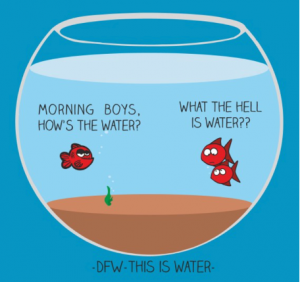
As you explore these worldviews, consider how ingrained they are in our lives, much like the air and water we breathe. We are the fish in the water, asking, “What water?”
I’ll devote several blog posts to cultivating inner wisdom. In this blog, I’ll provide a more complete description of this flood and the worldviews that enable it.
Mechanistic Worldview (1880s to 2000s)
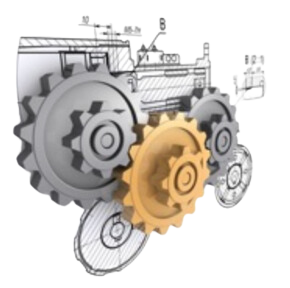
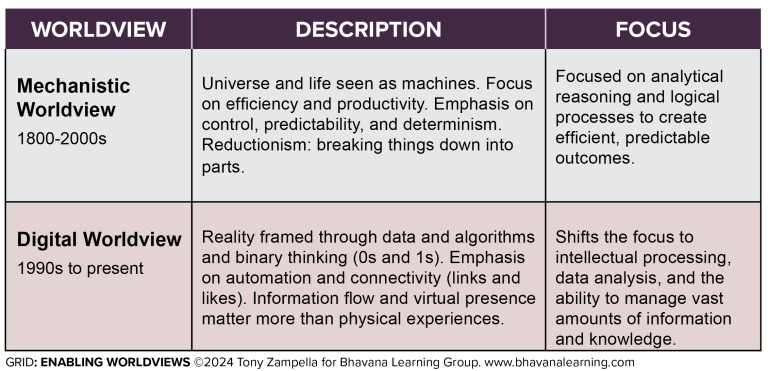
Description: Driven by mechanistic thinking and the invention of machines like the steam engine, the mechanistic worldview dominated the nineteenth and twentieth centuries. It culminated in factory systems and mass production techniques that persisted until the advent of the information age in the 1990s.
The mechanistic worldview is rooted in reductionism, predictability, and control. The Industrial Age focused on mechanization and efficiency and required humans to think in terms of sequential logic, processes, and systems that could be controlled and optimized.
The critical capacity here is the ability to apply logical thinking to achieve predictable results, mirroring the machine-like approach to problem-solving.
Impact: People are viewed as cogs in the system, focusing on roles and functions rather than individual needs, minimizing emotional and subjective experiences.
Digital Worldview (1990s to Present)
Description: The 1990s saw the start of the Information Age with the widespread adoption of computer chips and the rise of the Internet. This shift to digital connectivity and data-driven approaches has shaped society to this day.
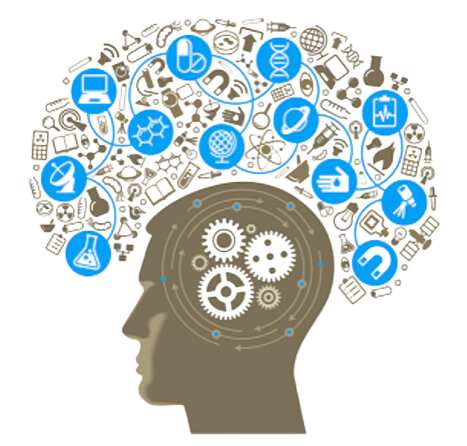
Information management and knowledge sharing are at the core of the digital worldview. Intellectual capacity is directed toward data collection, organization, and the ability to process vast amounts of information.
The critical faculty is the intellect, particularly in the form of information literacy and the ability to make sense of complex digital environments.
Impact: Humans are seen as “data points,” with their experiences mediated by digital tools. With the rise of virtual identities, people feel increasingly detached from the physical world.
These worldviews focus on external stimuli, ranging from the material to the informational realm. Together, they reduce humanity to mere stimulus–response.
The digital worldview, initially heralded as a way out of mechanistic thinking to connect us, has been optimized, creating a set of conditions that characterize this FLOOD.
Humanity is drowning in information and starving for meaning.
Flood Symptoms
I’ve selected the following symptoms that characterize current reality. Each deserves more space, and I could include others. However, as you review the list, how many do you recognize for yourself? As a coach, how many do you recognize in your clients?
- Instant gratification and shortened attention span breed impatience. People expect quick responses and quick solutions. The result is difficulty focusing on complexity or deep content (i.e., in education: There’s a Very Good Reason College Students Don’t Read Anymore).
- Echo chambers and polarization. Algorithms reinforce existing beliefs. People become entrenched, and polarization reduces constructive dialogue.
- Social comparison and anxiety. Curated online identities fuel unhealthy social comparisons. This results in increased anxiety and dissatisfaction with one’s life.
- Fear of missing out (FOMO). The pressure to stay up-to-date and connected triggers anxiety about missing out on experiences or information. This leads to compulsive online behavior.
- Surveillance and erosion of privacy. Surveillance has normalized widespread data collection, eroding privacy and making users feel powerless.
- On-demand expectations. Remote work and digital communication blur the boundaries between personal and professional life. People experience burnout and struggle to disconnect.
- Curation and validation. Sharing every experience fuels constant distraction. With constant consumption, we prioritize online validation over authentic experiences.
- Decision paralysis from information overload. The sheer volume of information makes decision-making fragmented, overwhelming, and difficult. Too many choices can lead to decision paralysis, decision fatigue, and increased stress.
- Tech dependency and anxiety. Overreliance on digital devices fosters anxiety when disconnected, reinforcing an unhealthy attachment to technology.
- Misinformation, disinformation, and erosion of trust. Widespread misinformation and disinformation make it difficult to find reliable information. This leads to an erosion of trust in the media, institutions, relationships, and even democracy, fueling social disconnection, isolation, and confusion in navigating life.
- Curation and Validation. The line between living an experience and posting about it is increasingly blurred in a world where everything is shared. We curate moments for approval, often sacrificing authenticity for validation.
- Altered Sense of Reality. Augmented and virtual realities offer immersive escapes, but they also risk blurring the line between real and digital. As screens become our primary lens, real life can feel… less vivid, offering a disconnected and distorted view of reality.
Humanity is drowning in information and starving for meaning.
The Digital Toll on Being Human
The 12 symptoms above reveal several qualities and symptoms that come up in coaching sessions.
I recently spoke about this flood to a gathering of about three dozen coaches and heard, “We see this all the time and don’t know what to do about it.” Even more dismaying, many coaches admitted they were also vulnerable to these symptoms.
This flood—a relentless torrent of demands, distractions, and dissatisfaction—shows up in coaching sessions through familiar refrains:
- “I get anxious when I look at my to-do list.”
- “It’s easier if I just do it myself.”
- “I’m so busy.”
- “I feel disconnected and powerless.”
- “I feel uncomfortable being so reactive.”
- “I’m always anticipating the next experience while in my current experience.”
These experiences reflect deeper qualities: impatience, anxiety, burnout, decision paralysis, disconnection, and a fragmented sense of self.
The Digital World Amplifies Our Crisis of Meaning
Research by the International Coaching Federation (ICF) shows that mental health concerns, including burnout, are on the rise worldwide. Coaches increasingly hear calls for support, with 85 percent of professionals reporting a demand for strategies to improve mental well-being.
The survey emphasized the need for reflective practices in addition to more common techniques, such as mindfulness, visualization, and meditation. While this is a start, treating the symptoms alone is insufficient. To navigate the flood, we must examine its roots.
Mental and Cognitive Overload
Just as junk food harms the body, consuming “junk information” depletes the mind.
When a client shows up at a coaching session feeling drained, fatigued, or burned out, we may inquire about their sleep, exercise, hydration, or consumption of nutrients, such as salt, sugar, or caffeine.
Eating junk food destroys our bodies and affects our nervous system. But do we ever question our habits of the mind?
- What about consuming junk information, ideas, lies, and misinformation that increases fear, anxiety about the future, and distrust?
- What about related habits, such as excessive or doom scrolling, perfectionism, and context switching, that hack attention, distract focus, or distort perceptions?
- What about the unprecedented assault on our senses that drains our energy, impairs cognitive functions, and creates anxiety?
- What about the distractions that limit our recovery, disrupt our sleep, and increase stress to affect our overall well-being?
A recent article in The Guardian highlights how our negativity bias draws us into cycles of drama, danger, and fatigue, fostering habits like doomscrolling that sap vitality. This unrelenting assault on our senses disrupts recovery and deepens the crisis of meaning that many face today.
Breaking free from an app-driven, screen-consuming, transactional world requires more than superficial fixes.
Beyond the Surface: A Crisis Rooted in Worldview
While disconnecting from technology may seem like a solution, it’s merely a Band-Aid for a deeper issue. The worldview driving the digital age—transactional and consumption-driven—amplifies dissatisfaction and detachment. The very tools intended to connect us often leave us feeling more fragmented and isolated.
The Assault on Consciousness
At a time when humanity is expanding its emotional intelligence and awareness, the digital worldview overwhelms this growth with disinformation and distractions.
In his book, In Over Our Heads (1994), Harvard professor and adult development scholar Robert Kegan foresaw this challenge, warning that many are unprepared for the complexities of a knowledge-driven world. Today, this crisis is evident, as our consciousness is flooded with toxic information that distorts the truth and destabilizes our grounding.
Instead of addressing the cravings that drive app and screen addiction, we medicate behaviors to cope. This only perpetuates dissatisfaction and reinforces a worldview that prioritizes transactions over relationships and consumption over connections.
Dissatisfaction in a Transactional World
The flood has reduced much of life to transactions. Consider the CEO of Starbucks, who lamented in a letter how the company’s shift to an app-driven assembly line can “feel transactional, [where] menus can feel overwhelming, the wait too long, or the handoff too hectic,” with inconsistency that erodes connection.
Similarly, our obsession with screens—constantly showing us better or worse lives—amplifies anger, anxiety, and dissatisfaction, creating a loop of consumption and coping.
Heightened dissatisfaction and instant transactions encourage escape through the consumption of entertainment, possessions, or information to cope, find comfort, or validate our views yet remain trapped in a cycle of craving.
This flood keeps us trapped on the surface of life, living a transactional existence: scaling up, moving fast, avoiding boredom, and constantly striving for more and better. The absence of depth means the loss of quality, purpose, meaningful connections, and the grounding needed to navigate times of volatile change.
Breaking free from an app-driven, screen-consuming, transactional world requires more than superficial fixes.
Navigating this flood requires a shift in perspective. Instead of treating symptoms, we need to explore the ingrained assumptions and expectations that shape our lives—our “water.” By asking different questions, we can unlock the dimension of being to cultivate inner wisdom.
A Path Forward: Cultivating Inner Wisdom
Coaching is a place and a space to better understand these human concerns.
Coaching can help us reflect on these challenges and deepen consciousness by reconnecting with what truly matters. It helps individuals move beyond a transactional existence by fostering a deeper understanding of themselves and their values. In this space, we can begin to reframe our expectations of success, happiness, progress, stress, and wellness.
Cultivating inner wisdom requires us to clarify what wisdom means beyond the world of information and data, inviting greater introspection to expand our interior landscape.
In future blogs, I’ll offer the following four domains of being human to support coaching in cultivating wisdom.
- WAKING UP = Expanding awareness to become grounded.
- GROWING UP = Providing space and reflection to expand perspectives.
- CLEANING UP = Recognizing and integrating our shadow tendencies.
- SHOWING UP = Practicing mindful presence to recognize emergence.
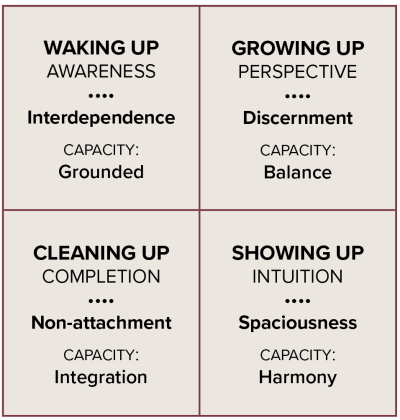
Coaching involves cultivating insight by creating a space for keen observation, deep listening, and intentional inquiry and dialogue.
— Accessing wisdom does not require doing or knowing more; rather, it involves a willingness to suspend what we know in favor of embracing uncertainty.
— Suspending certainty creates space for intuition to surface questions, inviting a deeper connection to truth and immediate inner knowing.
— Cultivating wisdom begins with “I don’t know” and a willingness to acknowledge obstacles.
Future blogs will support concepts and practices that support increasing awareness (waking up), expanding perspectives to deepen meaning-making (growing up), integrating our shadow (cleaning up), and recognizing emergence (showing up).
While knowledge, competence, and skills are essential to increasing performance, coaching is positioned to support the grounding and capacity to cultivate wisdom.
Exploring this inner wisdom can lead to resilience and meaning, transcending the limitations of a purely transactional, technology-driven world.
Reading Time: 9 min. Digest Time: 12.5 min.
1- VIEW OUR RELATED RESOURCES & BLOGS:
- Part 2: Waking Up: To Withstand the Flood
- Part 3: Growing Up: To Withstand the Flood
- Part 4: “Cleaning Up” to Cultivate Inner Wisdom
- Part 5: Showing Up: The Embodiment of Inner Wisdom
- A Wisdom Diet: Daily Reading for Clarity and Care
- Annual Wisdom Retreat – This online retreat develops this framework for cultivating inner wisdom.
2- SOURCES:
The four-quadrant framework developed by philosopher Ken Wilber for individual development will be applied in future blogs to cultivate inner wisdom.
0 Comments