

Life unfolds through creative tension.
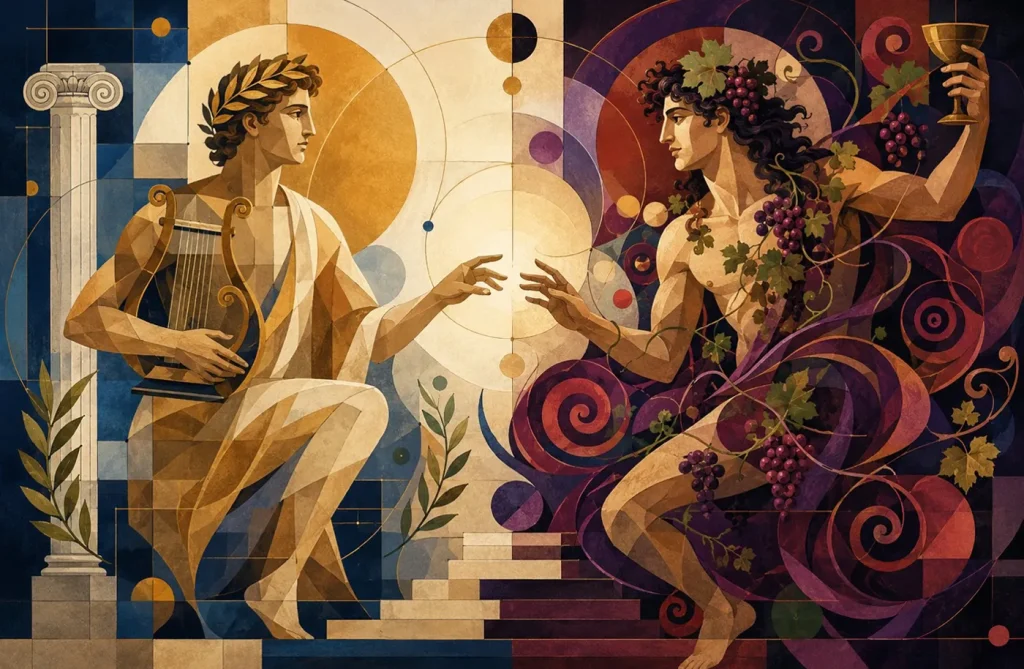
The ancient Greeks captured this tension through two mythic figures: Apollo and Dionysus, both sons of Zeus (though born of different mothers: Leto and Semele, respectively).
Popularized by Nietzsche in The Birth of Tragedy, the Apollonian–Dionysian duality captures the enduring tension between order and emergence, reason and instinct, structure and vitality.
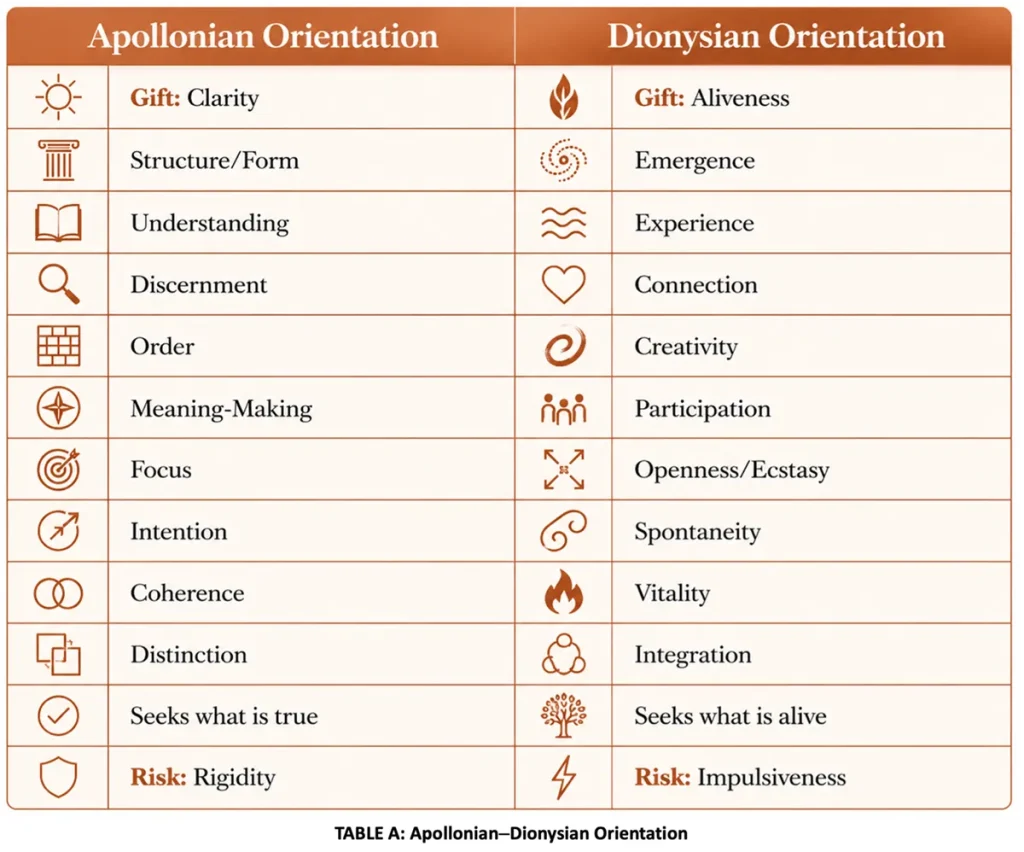
Through Apollo, we seek harmony, clarity, understanding, and distinct form. He helps us distinguish, discern, organize, and make sense of experiences.
Through Dionysus, we encounter the spontaneity, immediacy, and emergence of life. He invites participation, not control, and experience, not explanation.
Both are essential.
- Without Apollo, life can become chaotic and ungrounded.
- Without Dionysus, life can become rigid and lifeless.
Human flourishing depends not on choosing one over the other, but on cultivating the capacity to move fluidly between them.
Our current culture continually pulls us away from this balance. We live within systems designed to amplify reactions. Algorithms reward certainty, visibility, and immediacy. Social media encourages reaction without reflection.
Professional identities become attached to hyper-credentialing, methods, frameworks, and ideological camps. We flood our attention with more content than we can absorb and more opinions than we can thoughtfully consider.
The result is not greater understanding or wisdom. Often, it is simply increased attachment …
- To certainty
- To identity
- To being right
- To our norms or preferred way of serving
That’s why restraint matters.
Restraint, Enough-ness, and Freedom
Traditionally, restraint is often associated with Apollo’s order and discipline. Yet, the form of restraint I am describing is different. It is neither the suppression of Dionysian vitality nor the triumph of order over spontaneity. It is the capacity to remain free from attachment to either impulse.
Restraint creates space. Space creates freedom.
At a deeper level, restraint is rooted in an inner knowing of enough. Enough certainty. Enough expression. Enough action. Enough explanation. It is the capacity to sense when more is no longer serving and to trust that enoughness is not a limitation but a source of freedom.
From that freedom emerges the possibility of responding to reality rather than merely reacting from habit.
In Buddhist traditions, the practice of non-attachment reflects this capacity. Not detachment from life, but freedom from clinging to outcomes, identities, or beliefs.
In Taoist traditions, “enoughness” appears in the principle of wu wei, acting in harmony with circumstances, not forcing them.
Both indicate the same insight: Wisdom emerges when we stop trying to impose ourselves upon reality and learn to participate more skillfully in it.
AI can generate questions, summarize patterns, and offer increasingly sophisticated insights. It can analyze experience, but it cannot participate in experience
Serving and Being
To cultivate this capacity, I have explored three interrelated dimensions of serving and being of service:
- Presence — cultivated awareness for being with reality.
- Discernment — cultivated awareness for understanding reality.
- Responsiveness — cultivated awareness for acting within reality.
Before exploring their intersections, it is worth noting the pattern they share: cultivated awareness. It is from awareness that presence, discernment, and responsiveness arise.
Awareness is the ground from which we recognize, interpret, and respond to reality. Attuning to awareness becomes less a procedure to master and more a commitment to embody—a way of being that supports our capacity to serve.
At the intersection of presence and discernment, we cultivate a first form of restraint: humility. Humility restrains certainty. It reminds us that reality is always richer than our interpretations of it. It allows us to remain curious before rushing to conclusions.
At the intersection of discernment and responsiveness, we cultivate a second form of restraint: space. Spaciousness dissolves reactivity. It creates a pause between perception and action, allowing us to choose our response, not simply act on impulse.
At the intersection of presence and responsiveness, we cultivate spontaneity, often misunderstood as impulsiveness or improvisation without structure. In practice, spontaneity is the opposite. It is disciplined attunement to the moment. Similar to a jazz musician improvising within a shared structure, spontaneity emerges from practice, awareness, and responsiveness rather than from abandoning them.
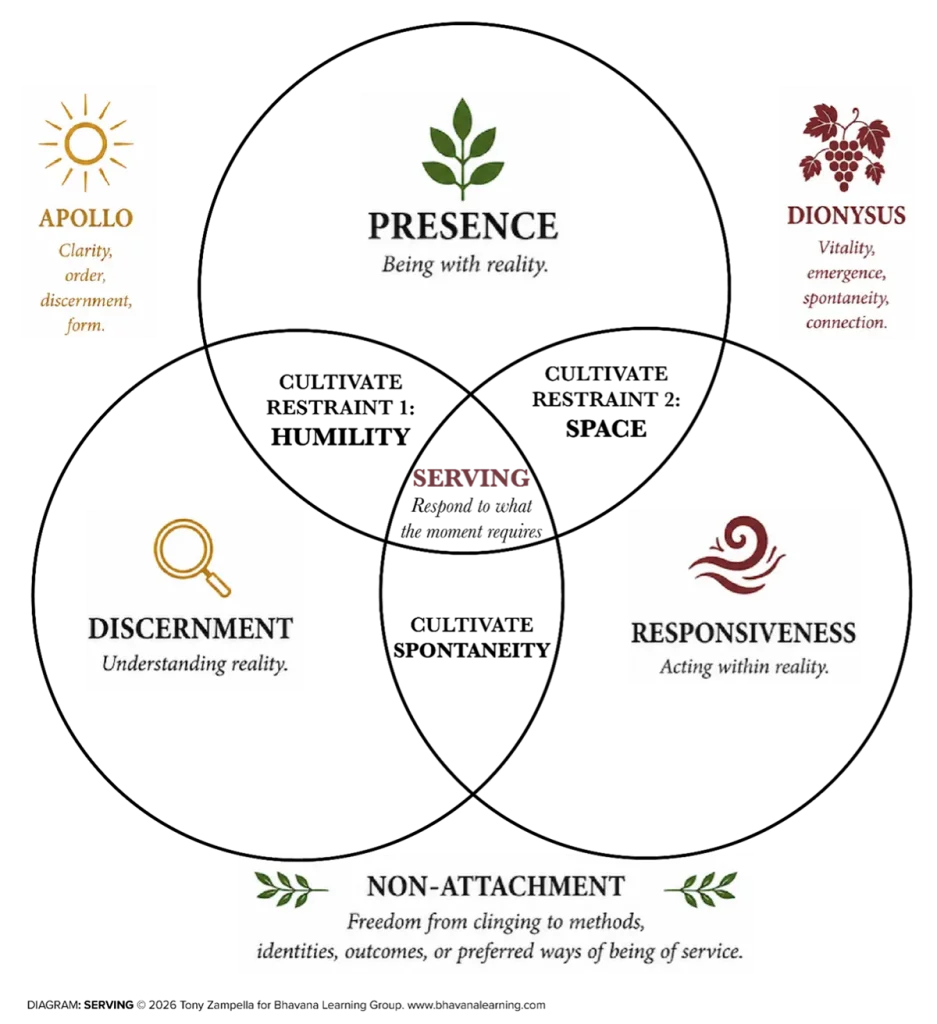
Together, humility, spaciousness, and spontaneity emerge from a deeper awareness of attachment. By recognizing our attachments, we cultivate nonattachment.
Nonattachment does not mean detachment or indifference. It means freedom from clinging to any particular interpretation, identity, method, intervention, or outcome.
Nonattachment allows us to move between Apollo and Dionysus without either imprisoning us.
What happens when we bring this understanding of nonattachment into coaching and leadership?
Serving the Moment Beyond the Method
When I began coaching more than two decades ago, there was less emphasis on prescribed methods and more attention to the coach’s being. I recall being reminded of the Apollonian–Dionysian duality, not as a method but as a metaphor for developing the full range of humanity.
The work involved cultivating oneself as a vessel, a process of learning to stay with what arises, understand what matters, and respond to serve the person in front of you.
Effectiveness was measured less by how one adhered to methods and more by one’s capacity to serve the moment. In that sense, the coach was constituted as co-creator of the experience, process, and outcomes — partnering to support what arose.
1. The Purity Trap
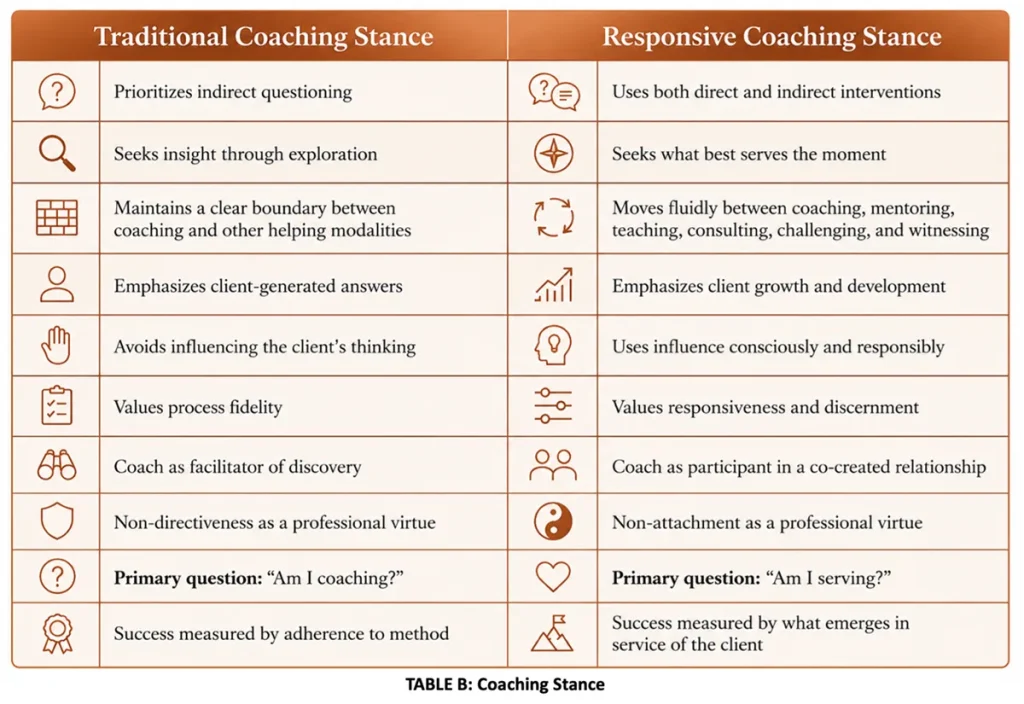
About a decade ago, a shift began. In many coaching traditions, the pursuit of professional legitimacy elevated frameworks, competencies, markers, testing, credentialing, and increasingly refined definitions of coaching. Alongside this came the elevation of a nondirective stance as the defining virtue of professional coaching.
Rooted in a desire to honor client agency and avoid imposing solutions, the nondirective stance positioned questioning as the primary vehicle for insight and transformation. While this principle emerged for good reasons, it can become another form of attachment.
I experienced this attachment often when presenting to coaches the simple practice of spending a few minutes breathing before a session began. Over the years, I noticed a qualitative shift in how clients arrived: distracted, overwhelmed, fragmented, and often struggling to settle into conversations. Many found tremendous value in taking a moment to pause and arrive.
Yet the discussion quickly shifted from the client’s experience to concerns about whether breathing might be prescribing, advising, teaching, or somehow no longer coaching.
We were breathing.
The unspoken hierarchy often sounds similar to this:
- Good coaches ask non-directive questions.
- Poor coaches ask direct questions.
- Non-coaches offer answers.
The result is that the coach can become more attached to the method than responsive to the human.
2. The Power of Participation
Rebecca Rutschmann, publisher of The Future of Coaching & AI, points directly to this tension:
For years, parts of our profession have spent enormous energy defending the purity of coaching. The clean lines. The nondirective stance. The discipline of holding questions rather than giving answers. Those principles matter. They are not wrong. But they were also, if I am honest, sometimes a way of protecting the profession’s identity at the expense of the person in the room.
The deeper question is not whether an intervention is direct or indirect. The deeper question is whether it serves (see Table B above). When attachment to methodology becomes more important than responsiveness to reality, the method has become the master rather than the servant.
Serving requires presence, which means honoring what arises.
Sometimes, serving requires questions. Sometimes, it requires challenge. Sometimes, it requires silence or witnessing. Sometimes, it requires teaching. Sometimes, it requires answers.
The determining factor is not the intervention itself, but the quality of presence, discernment, and responsiveness behind it.
This understanding points to a deeper way of knowing. Theoretical physicist and author of On Dialogue, David Bohm challenged the assumption that understanding arises primarily through observation. He suggested that a genuine understanding of a whole emerges through participation, describing this as a form of “participatory consciousness.”
For Bohm, we do not stand outside reality and observe it. We participate in it. This insight is central to serving. Presence, discernment, and responsiveness do not arise from separating ourselves from experience but from entering more fully into a relationship with it.
In that sense, the coach was constituted as co-creator of the experience, process, and outcomes — partnering to support what arose.
3. Co-Creating in the Age of AI
The most masterful coaches, leaders, and facilitators are not attached to any particular method. Instead, they are committed to serving the person and the moment before them. This often demands moving beyond the confines of what coaching has become. Rutschmann continues:
One of the most striking things I observed [at a recent professional conference] was how naturally the best coaches moved between coaching, mentoring, and consulting — not as a compromise, but as a genuine response to what the person in front of them needed.
In her essay, “Coaching Is at a Major Inflection Point. That Might Be the Best Thing Possible,” Rutschmann points toward something deeper than debating coaching methodologies. The most effective practitioners are not merely applying a process; they are participating in the living relationship they co-create.
Practitioners move fluidly between coaching, mentoring, consulting, teaching, challenging, and witnessing because their primary commitment is not to protect a method but to serve what is needed. This requires a quality of awareness and discernment that cannot be reduced to markers, frameworks, or a set of competencies.
In many ways, this is the contemporary expression of the Apollonian-Dionysian dance. Apollo brings clarity, structure, and understanding. Dionysus brings connection, emergence, and aliveness. Neither is sufficient on its own. Together, they cultivate presence—the capacity to remain fully engaged with reality while responding to what is emerging. This is not a technique but a way of being.
The Apollonian–Dionysian dance highlights what remains uniquely human in the age of artificial intelligence. AI can generate questions, summarize patterns, and offer increasingly sophisticated insights. It can analyze experience, but it cannot participate in experience.
The art of serving emerges within the intersubjective space where trust, intuition, and meaning are co-created between humans. It lies not simply in what is said but in the quality of awareness from which it arises. That remains beyond the reach of any algorithm.
Co-creation and Commitment Beyond Process
At the center of this practice lies a simple principle: Serving is recognizing and responding to what the moment genuinely requires. The serving practitioner cultivates the capacity to become a clear vessel through which experience and truth can emerge and be recognized, understood, and co-created into the next wise step.
Rather than imposing a method on the moment, they participate in a process of discovery through which appropriate action reveals itself. This is supported by the deeper harmony between Apollo and Dionysus. Together, discernment and connection, held by restraint, create space. Spaciousness is the unconditional ground enabled by nonattachment—a freedom from clinging to certainty, identity, methods, or outcomes.
From spaciousness, presence emerges — and from presence arises the natural response to serve what the moment is asking for now.
Reading Time: 8 min. Digest Time: 10.5 min.
VIEW OUR RELATED RESOURCES & BLOGS:
0 Comments