



The headline — “Gen Z workers think showing up 10 minutes late to work is as good as being on time” — first caught my attention two years ago.
Since then, many articles have explored and even normalized this sentiment. Predictably, these conversations often spiral into debates about work culture, generational values, capitalism, power, and respect.
Exploring commentary and Reddit threads, I found evidence of these discussions dating to 2019, well before the pandemic reshaped our relationship to work and time.
What I found were several surface interpretations of timeliness and lateness:
— Some argue that strict adherence to time is merely a corporate control mechanism.
— Some insist that lateness is fundamentally disrespectful because it wastes one thing people cannot recover: time itself.
— Others experience time as one of the few things they can withhold in a world that increasingly leaves many feeling powerless.
— Others perceive the normalization of lateness as a sign of growing intolerance toward responsibility, reliability, and accountability.
Why does timeliness still matter so much in a world increasingly organized around immediacy, speed, and asynchronous interactions?
What Does It Mean to Be Late?
Generally, issues of lateness — often labeled tardiness or a lack of punctuality — are not new. Nor are they confined to one generation.
In more than two decades of working with leaders, teams, and organizations, one persistent theme I have encountered is reliability: showing up and delivering on time, responding in a timely manner, and fulfilling commitments when promised.
What makes the current conversation about lateness particularly interesting is its emergence within a generation shaped more by digital time than analog time. In a world of instant access, fleeting connections, and disconnected interactions, our relationship to time, itself, may be changing.
This raises a deeper question: Why does timeliness still matter so much in a world increasingly organized around immediacy, speed, and asynchronous interactions?
Ironically, the essence of digital time has disconnected us from our temporality. The shift from organic, rhythmic experiences to an “always-on” culture defined by fragmentation, speed, and efficiency prioritizes the immediate present over a sense of the past or the future.
This acceleration distorts expectations, erodes perspectives and deeper meaning, and has led to cognitive decline, requiring intentional efforts to find balance.
Perhaps we’ve forgotten that timeliness represents more than efficient scheduling. Beneath the mechanics of clocks and calendars, timeliness shapes our relational and ontological existence.
Beyond Time Management: A Question of Being
Modern culture tends to treat time as a measurable commodity—something to spend, save, maximize, optimize, or control. However, humans do not merely exist as isolated individuals moving between appointments. We exist within webs of coordination, connection, expectation, and shared participation.
As the digital world accelerates, many people experience increasing fragmentation disconnected from the relational realities that sustain trust and coordinated action. The deeper question is not simply how to manage time more efficiently but how to reclaim ourselves as reliable participants in shared life.
Time is social before it is mechanical or digital.
Every meeting, commitment, delivery, promise, and agreement exists within a relational field where humans coordinate action.
When someone says:
“I’ll be there.”
“I’ll send it tomorrow.”
“I’ll complete this by Friday.”
They are not merely exchanging information. They help create a shared future.
That is why timeliness matters more than efficiency. Beyond mere productivity, timeliness is about trust. It is about whether others can reliably organize their actions around our words.
This issue becomes even more significant inside organizations. Organizations are not merely systems of processes, hierarchies, or job functions. At their core, organizations are networks of commitments. People coordinate actions through requests, promises, agreements, expectations, declarations, and responsibilities.
The functioning of organizational life depends on the integrity of those commitments. Without trust in those commitments, collaboration breaks down, accountability erodes, resentment accumulates, coordination weakens, and cultures slowly deteriorate.
This is why the issue of “being late” cannot be reduced to rigid rule following or managerial control. Something deeper is at stake.
The deeper questions are: How — and who — are we choosing to be in time? What kind of relationship do we have with our agreements and our participation with others?
Beyond mere productivity, timeliness is about trust. It is about whether others can reliably organize their actions around our words.
Different Forms of Lateness
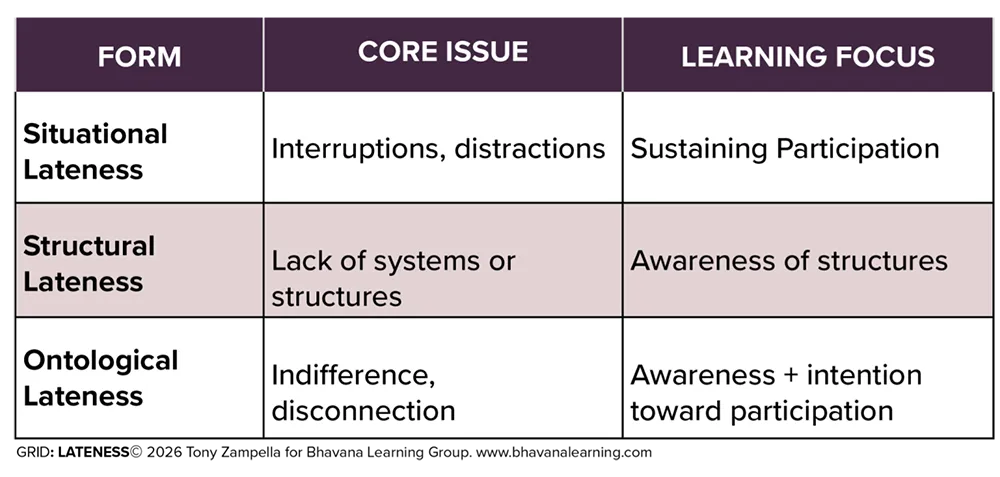
At its deepest level, timeliness reflects our capacity for reliable participation in a shared reality. To explore this more clearly, it is important to distinguish different kinds of lateness. Not all lateness carries the same meaning.
1. Situational Lateness
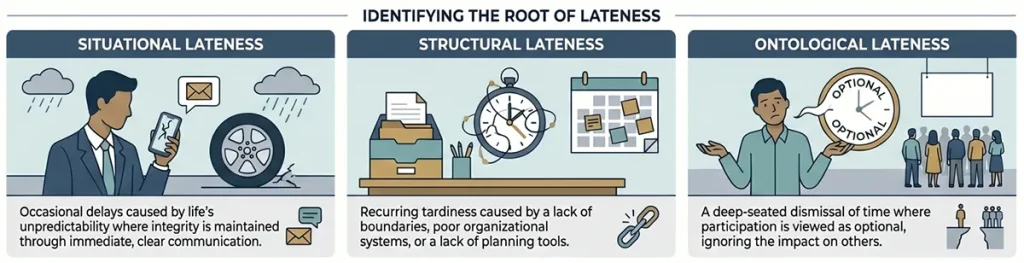
Sometimes, life happens.
Traffic, emergencies, caregiving responsibilities, health issues, weather, and unpredictability are all parts of human life. A person can absolutely be late with integrity.
In fact, integrity often reveals itself in how one responds when circumstances interfere.
People with a strong relationship to their impact — that is, a lived sense of responsibility — typically communicate quickly when delays arise. They understand that reliable participation involves continuously coordinating actions, plans, and expectations around interrelated promises, commitments, and agreements. The issue is not perfection. The issue is sustaining participation within one’s relational field.
2. Structural Lateness
There are also recurring patterns of lateness associated with disorganization, distraction, overwhelm, a lack of boundaries, or insufficient structures.
In these situations, the issue may not be indifference, but awareness. A person may genuinely underestimate the impact of their lateness or lack the structures necessary to support reliable participation.
Practically, this can involve setting alerts for calendared events, recording promises with buffers, tracking agreements, and creating routines that support reliable planning. It may also require practices to better scope commitments that realistically account for one’s capacity, needs, and competing responsibilities.
The issue is not task management. It is increasing awareness and discovering the structures to develop discipline, better prioritize, and align with what matters most.
3. Ontological Lateness
But another form of lateness runs even deeper.
This occurs when time is dismissed as insignificant, because one’s participation is unconsciously experienced as optional or inconsequential. At this level, the issue is no longer scheduling or structure. It becomes a failure to recognize how deeply interconnected our participation actually is:
- Others rely on us,
- Our absence alters coordination,
- Our participation matters,
- and our word carries consequences beyond ourselves.
Awareness alone is insufficient here. Ontological lateness also reflects a weakening of intention — a diminishing commitment to reliable participation.
Here, lateness deeply connects to how we relate to being. Arriving late is not inherently immoral, but repeated indifference toward commitments can reveal a diminished relationship to reliable participation and a shared reality.
To exist socially is to participate in mutual reliance networks. Our actions ripple outward. Whether we acknowledge it or not, people organize their lives around the reliability of our agreements, that is, our word.
Being, Time, and Coordinating Reality
To fully understand the importance of time beyond clocks, timers, and schedules, we must examine humans as temporal beings.
Summarizing philosopher Martin Heidegger, humans do not merely move passively “in time.” We exist through time as we navigate the tension between discerning the past and generating futures through commitments, all while tuning into and interpreting the present.
This ongoing movement across memory, meaning, and mission is one of the defining features of organizational and social life.
- A meeting exists because people agree to participate in a future moment together.
- A project exists because promises have been made regarding future actions.
- A business exists because networks of people coordinate around shared commitments over time.
Civilization, itself, depends on the human ability to trust promises. This is why accountability matters so deeply, because coordinated action collapses when promises lose reliability.
At its best, accountability is the relational structure that protects trust. Without accountability, agreements weaken, expectations become unstable, commitments lose credibility, and organizational trust erodes.
Competence alone cannot sustain healthy cultures. A person may be intelligent, highly skilled, creative, and productive. However, if others cannot rely on their word, coordination eventually fractures.
Trust depends less on talent than reliability. Reliability depends on the integrity of our relationship to time, agreements, and commitments.
Punctuality is part of the invisible social glue that holds together agreements, promises, and coordinated action over time.
Punctuality, Promises, and Agreements
To deepen this inquiry, it is helpful to examine the philosophical assumptions of the words we use that modern culture often forgets. Discussions about lateness often focus narrowly on punctuality, overlooking the deeper relational function it serves.
Punctuality is part of the invisible social glue that holds together agreements, promises, and coordinated action over time.
1. Punctuality: Fidelity to the Point
The word punctual comes from the Latin punctualis, meaning “of a point,” derived from punctum: a point, mark, and precise location.
Originally, punctuality was not primarily about clocks. It referred to exactness, precision, and attentiveness to important details. To be punctual was to “meet the point” precisely. This reveals something profound. Punctuality is not simply obedience to schedules. It is fidelity to a shared point in relational space and time.
A meeting time is not merely a number on a clock. It is a point of coordination where humans agree to converge their attention, energy, and participation.
To arrive punctually is to honor that point.
2. Agreement: Harmony of Will
The word agreement comes through Old French from roots associated with favor, pleasure, harmony, and shared will.
Originally, agreement implied a kind of attunement — a coming into alignment together.
This is very different from the modern reduction of agreements into merely contractual obligations or transactional compliance. At a deeper level, agreements represent a shared orientation. They are acts of coordinated meaning.
Every healthy organization depends on this invisible coherence. Teams function effectively not merely because rules exist, but because people are sufficiently aligned in their purposes, expectations, and responsibilities to coordinate action.
In this sense, organizations are fundamentally networks of agreements through which humans generate relational harmony, while promises carry those agreements forward through time.
3. Promise: Extending Ourselves into the Future
The word promise comes from the Latin promittere: “to send forth.”
Beyond a prediction of the future, a promise extends oneself into that future. When we promise something, we project our intention, responsibility, and possibility forward over time.
Promises are one of the primary ways that humans bring coherence to uncertainty, establish reliability, and coordinate action.
- Projects move forward because promises are made.
- Trust develops because promises are honored.
- Leadership functions because people believe words and actions will remain connected over time.
A promise binds the present being to future action. When promises repeatedly dissolve, trust dissolves with them.

When Words Lose Weight
One of the great challenges facing modern organizations is not merely inefficiency, but the gradual erosion of the weight of language.
When commitments are casually made and casually broken, meetings lose meaning, deadlines lose credibility, accountability becomes performative, and trust begins to decay beneath the surface. Organizations often attempt to solve this through more systems: more tracking, better metrics, faster processes, and additional oversight.
However, systems alone cannot compensate for weakened integrity. At the core of every functioning culture is a shared belief that words matter.
That agreements matter.
That promises matter.
That participation matters.
Without this, organizations slowly become fragmented collections of individuals rather than coherent networks of coordinated action. Worse still, organizations can begin drifting toward a subtle, soft nihilism — a quiet detachment from meaning, responsibility, and shared participation.
This is why being on time is ultimately about much more than punctuality. It reflects how we perceive promises, how we honor agreements, how we participate with others, and how seriously we hold our word.
To show up on time is not merely to satisfy organizational expectations. It is important to recognize that humans are always participating in shared realities built through trust, coordination, and commitment.
Our word matters because it builds futures. The integrity with which we hold it shapes the quality of our organizations, our relationships, and ultimately, our shared reality.
Reading Time: 8.5 min. Digest Time: 11.5 min.
1- VIEW OUR RELATED RESOURCES & BLOGS:
0 Comments