



In a previous essay on coaching, politics, and democracy, I explored what it means to treat democracy as a living conversation—and offered practices to sustain it. The foundational practice included a simple, but essential commitment: good faith.
Since then, sociopolitical tensions—both globally and at home—have only intensified. What once felt foundational now feels indispensable. In every effort, conversation, and even disagreement, good faith establishes the conditions under which we remain whole and understanding remains possible—even in the presence of opposition.
Ezra Klein captures this principle in a recent New York Times column:
Conversation is not a reward to be bestowed on those with whom we agree; it’s a necessary habit in a democracy. The point is not to find agreement so much as to deepen understanding. To talk with others is to believe in the possibility of change — theirs and your own. Whether you like everything that someone has said should be severed from the question of whether that person is worth talking to.
The Oxygen of Civic – and Civil – Life
At its simplest, good faith is understood as sincerity of intention, an orientation toward honesty and helpfulness. However, this modest definition conceals something deeper. The word intention does enormous work. It points not just to what we say but to the posture from which we engage.
In practice, a good faith exchange is not merely polite. It is structured by shared commitments: to engage in mutually agreed-upon terms of inquiry, to remain faithful to what is expressed, and—most importantly—to care enough about truth to remain open and genuinely interested in what is being presented.
Good faith is like oxygen—ever present, unnoticed, sustaining every breath. When it’s there, it disappears into the background; when it’s not, we suffocate.
In law, this idea is more precise. Bona fides refers to acting without deception or unfair advantage—honoring the letter and the spirit of an agreement. It is the invisible infrastructure that enables contracts, cooperation, and trust.
Yet, something has shifted.
Bad Faith
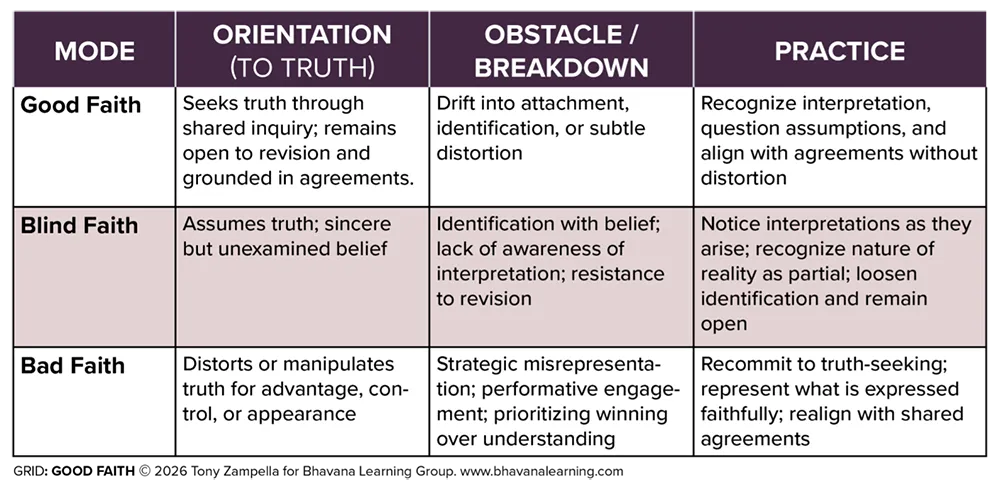
Our environment now rewards the opposite of good faith. Bad faith works, be it deliberate deception or subtle distortion. Attention is captured through distortion, provocation, and strategic misrepresentation. Bad faith is no longer an exception; it’s a tactic. It wins visibility. It accumulates power.
The consequence is not just dishonesty, but disconnection.
Indeed, a recent profile in The New Yorker on OpenAI’s Sam Altman reveals this tension. It shows how easily good faith is displaced when competing incentives—innovation, financial gain, public perception, and first-mover advantage—override truth-seeking. In sum, bad faith seeps in, suffocating the oxygen that good faith provides. It often goes unnoticed, as these competing incentives blur the signals that would otherwise reveal this shift.
Increasingly, we cannot engage across commerce, policy, purpose, or even simple human differences. It’s not that disagreement is new; it’s that the conditions for good faith have eroded. Without it, dialogue collapses into performance, groupthink, vitriol, heroic gesturing, or conflict. Listening waits to counter. Understanding gives way to positioning.
We see this in small, everyday moments. Recently, a client shared a moment from a meeting: a colleague subtly reframed a shared agreement as if it had already been discussed, thereby shifting its meaning. No one challenged it. The room moved on. The point was won, but something else was lost: the shared ground that made the conversation possible and, with it, the trust that held it together.
No ideology, identity, or partisan affiliation is immune. In a gladiatorial culture of short-term wins, bad faith becomes the easiest path to dominance.
When bad faith prevails, something fundamental is lost: Reason weakens, trust dissolves, and the ground of relatedness fractures, sometimes bending toward violence.
Good faith is like oxygen—ever present, unnoticed, sustaining every breath.
When it’s there, it disappears into the background; when it’s not, we suffocate.
Resurrecting Good Faith
To restore good faith, we cannot reduce it to politeness or courtesy. Those belong to a different era and are too easily performed, too easily gamed. What is required instead is a deeper reorientation: an ontological commitment to how we show up in relationships.
What if good faith were reclaimed as a generative stance, one that enables connection and understanding, even amid disagreement?
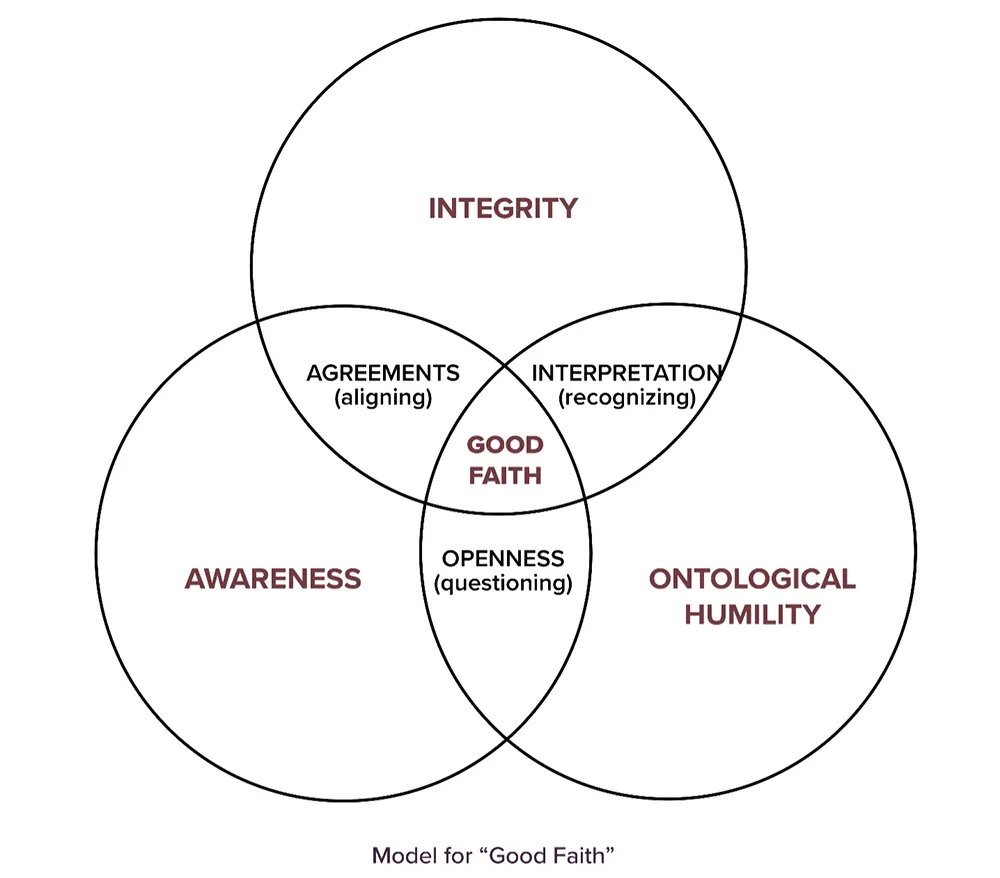
To embody good faith requires (see diagram below):
Awareness: The recognition that understanding is always partial and shaped by interpretation. “I see that I am interpreting reality, not simply perceiving it.”
Ontological humility: The willingness to hold interpretations lightly, remaining open to being changed. “I hold my interpretations lightly, open to revision.”
Integrity: The willingness to honor and act aligned with stated commitments and agreements, guided by principles and evidence, not distortion. “I act aligned with my commitments and agreements, without distortion.”
Destroying is easy; creating understanding is not.
Yet, if we are to move beyond fragmentation—personally, socially, and globally—this is the work before us.
Impediments to Good Faith
The obstacles to good faith arise within us. They reveal our blind spots, shape how we enter conversation, and reveal how quickly we foreclose the possibility of understanding. Below are some impediments to good faith.
1- Blind Faith
The first obstacle is a near enemy of good faith: blind faith.
It often appears as good faith—until examined more closely. Blind faith involves sincere beliefs that dismiss the need for inquiry and resist the possibility of being changed. Without awareness and openness to revision, belief becomes identified with the self and mistaken for integrity as a virtue.
In this state, belief becomes fixed and simplified, lacking the awareness and ontological humility to recognize that all perception is interpretive and, therefore, partial. This narrowing creates blind spots—limits in understanding that remain invisible to us. Only through sustained inquiry and questioning can these blind spots be brought into view.
2- When It Becomes Personal
At the root of these obstacles is what Buddhist psychology describes as ego clinging—the tendency to personalize views and experiences—driven by two fundamental conditions: attachment and identification, detailed below:
- Attachment involves fixating on beliefs, experiences, or material conditions in ways that reinforce comfort or certainty. It can also bind us to particular outcomes—being right, being validated, or remaining in control—narrowing our capacity to remain open to what is unfolding.
- Identification is a deeper form of attachment in which our views, roles, or experiences fuse with our sense of self. In this state, disagreement can feel like a threat, not an invitation. When we encounter failure, loss, or difficult emotions, this fusion leads us to interpret the experience as defining who we are—I am a failure, I am unlovable, and I am this sadness—rather than something we are experiencing.
To practice good faith, we must learn to recognize these experiences in real time.
When we notice attachment, the work is not to suppress it but to loosen its grip and create space—deep breathing, mindfulness, presence—between ourselves and any desired outcome or expectation.
When we notice identification, the invitation is to disentangle (non-identification) who we are from what we believe or experience—allowing our views to be examined without feeling threatened or diminished.
3- When It Gets Even More Personal
As we begin to disentangle from identity, space opens—and something emerges.
I noticed this in myself recently. In a conversation I entered intending to understand, I felt myself tighten around a single point, needing to be right. What I considered integrity was, in fact, a subtle overidentification with my role or position—mistaking conviction itself for virtue. Only upon reflection did I see how quickly the self had collapsed into the belief it was trying to defend.
By bringing awareness to this space, we begin to notice the energy and impulses that arise in response to what is unfolding. Do we seek to control it? Reject it? Avoid it? Or are we willing to remain present and inquire?
Good faith begins here, with the willingness to pause, notice, and choose differently.
It then asks a more difficult question: What is my intention in entering this conversation? What motivates me?
Is it to win? Dominate? Defend? Or discover what I cannot see yet?
To practice good faith is to clarify intentions beyond any single goal or position. It requires an awareness of assumptions, blind spots, and personal stakes. The more personal the issue, the greater the energy—and the greater the risk of becoming reactive or defensive.
Good faith asks something different: to release the need to be right or to win at any cost and instead create space for truth to emerge—not from a single perspective, but in the space between perspectives.
The Pursuit of Truth
To enter into genuine dialogue or to create connection is to become vulnerable to learning. It is the willingness to say, “I don’t know.” It is to risk being changed.
At its core, good faith is not about seeking agreement; rather, it centers on a shared commitment to truth-seeking. This requires more than exchanging positions. It requires cultivating a deeper orientation—an authentic interest in understanding reality more fully, together.
As Zen Master, teacher and poet, Thich Nhat Hanh taught, understanding is the essence of love—“understanding is love’s other name.”
Connection does not arise from winning arguments but from seeing more clearly.
Recall Klein’s pronouncement: “The point is not to find agreement so much as to deepen understanding.”
To pursue truth thus is neither to eliminate conflict nor to weaponize answers in service of control, righteousness, or dominance. It is to uncover the blind spots that limit our understanding—and to allow what is revealed to deepen the connection.
We practice good faith in the service of this pursuit. That is why it matters—and what has been lost.
Good faith is cultivated through three interdependent disciplines:
- Awareness—recognizing our attachments, identifications, and motivations, so we can see how we are interpreting and where we may be mistaken, partial, or incomplete.
- Ontological humility—accepting the limits of our interpretation and understanding and entering into inquiry with an openness to revision, expanding perspective, and surprise.
- Integrity—remaining accountable to our commitments and agreements, expressing truth grounded in principles and evidence, without distortion.
When bad faith prevails, something fundamental is lost: Reason weakens, trust dissolves, and the ground of relatedness fractures, sometimes bending toward violence.
Finally …
Good faith is the oxygen required for truth-seeking.
It requires an awareness of the interpretive nature of experience and the ability to notice our interpretations as they arise, the ontological humility to hold those interpretations lightly, and the integrity to engage in agreements and dialogue truthfully.
Without good faith, distortion and division take hold, cultivating bad faith and suffocating connection and understanding. Reason weakens, trust dissolves, and the ground of relatedness fractures.
With good faith, we create the conditions for understanding, connection, and something larger than ourselves to emerge.
Reading Time: 7.5 min. Digest Time: 10.5 min.
1- VIEW OUR RELATED RESOURCES & BLOGS:
0 Comments